

Our bindle of brilliant reviews this week includes Christian Lorentzen on Thomas Pynchon’s Shadow Ticket, Grace Byron on Eliezer Yudkowsky and Nate Soares’s If Anyone Builds It, Everyone Dies, Jeet Heer on Kamala Harris’s 107 Days, Hermione Hoby on Amie Barrodale’s Trip, and Mary Turfah on Sabri Jiryis’s The Foundations of Zionism.
Brought to you by Book Marks, Lit Hub’s home for book reviews.
*
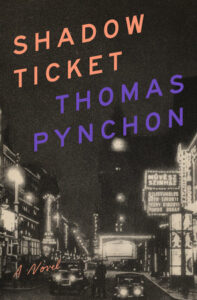
“Pynchon is now eighty-eight years old, and news this summer of his new novel was greeted with delight, coming as it did on the heels of a second Paul Thomas Anderson adaptation of one of his novels…Along with Don DeLillo, he survives as one of the granddaddies of the paranoid systems novel, and we are unlikely to read many or any more new novels from the pair. (Pynchon is of course the grandparent we’ve never laid eyes on, aside from the famous yearbook pictures, and know only from his words and the legends and rumors: Did he really serve as a crossing guard at his son’s school on the Upper West Side? Does he actually appear in a few frames of Anderson’s adaptation of Inherent Vice? Is that him with Richard Fariña and Joan Baez seeing Dylan go electric at Newport in 1965? As with DeLillo’s last (by which I mean most recent) book, The Silence, there is a temptation to call Shadow Ticket a work of ‘late style’ and point to certain economies of style evident in the swiftness of transitions, the plunging into familiar perennial themes, a certain doing away with gratuitous niceties in favor of something like playing new, pared-down versions of the greatest hits as if in medley form.
These characterizations aren’t wrong, but I don’t find them very illuminating. Shadow Ticket is first of all a very funny book. (Call me crazy but I think the same was true and underappreciated in the case of The Silence: an esteemed old man muttering football play-by-play commentary from memory in a Manhattan apartment on Super Bowl Sunday when the power has gone out all over America while his protégé is in the next room cuckolding him—that’s funny stuff.) There’s a high ratio of gags per page, which is nothing new for Pynchon. And there’s a beautiful casual lyricism to the narration (see those thumbs of Hicks’s mother and aunt going from their mouths to the wind) offset by the often dopey dialogue between Hicks and the lowlifes he meets in Milwaukee and the more sophisticated snoops and spooks he comes across on the other side of the Atlantic.
…
“I will be surprised if Shadow Ticket, a sentimental slapstick adventure novel, nostalgic to the point of gooeyness but never quite crossing over into the corny, a soft-boiled noir including a few too many jokes about cheese, isn’t met with general acclaim by reviewers. It wasn’t always the way. I’m old enough to have worked as a deckhand at a magazine where a critic gave up reading Against the Day out of exhaustion if not quite disgust and then had the temerity to admit it in print. Reviewing pages have been thinned by the forces of history and technology; few Pynchon skeptics anymore bother to take the time to read the novels and register their objections. Right-wing literary pages where these broadsides found a welcome home hardly exist today, and to the extent that they do they are probably as open to Pynchon’s fiction as they are to anything familiar if once radical that now counts as Americana.
…
“Contra Gore Vidal, I have always thought Bob Dylan’s lyrics superior to the ditties Pynchon puts in his books (which the author himself called ‘stupid’ in the flap copy for Against the Day), but at this late date in their life cycles a comparison seems appropriate. Both men emerged in the early ’60s with revolutionary designs on their art forms; both have been inscrutable tricksters, alternately eliciting critical adoration and spite; both have been mistaken for prophets or Judases; both have shown us the America we know and suggested the existence of Americas, ones either more sinister or more perfect than the Union we inhabit. No circus stays in town forever, and some comets never come back.”
–Christian Lorentzen on Thomas Pynchon’s Shadow Ticket (Bookforum)
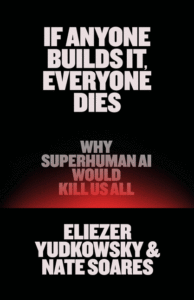
“The byzantine world of artificial intelligence often looks, from the outside, like an arcane religion, one with its own priests and worshipers. Devotees give their lives over to the dictates of their AI companions, and some even profess undying love to their digital counterparts, relationships that have led to tragedy. But the problem could get much worse than recent headlines suggest, or at least that’s the contention of philosopher and computer scientist Eliezer Yudkowsky and his co-writer, Nate Soares. In their new book, If Anyone Builds It, Everyone Dies: Why Superhuman AI Would Kill Us All, they lay out a fully apocalyptic account of the AI revolution. The projected results, while terrifying, are not all equally convincing.
…
“To Yudkowsky and Soares’s credit, their book mostly eschews such niche ideas, but they don’t entirely disavow the quasi-mystical dimensions of the community Yudkowsky has cultivated online. Each chapter in the book begins with a parable, warning of the dangers to come. These parables sometimes read like gibberish, talking both down and up to the reader. Their characters range from alien birds discussing the optimal amount of stones in nests to Aztec warriors unaware of guns to bumbling, chess-playing professors. Of course, writing critically about AI without sounding alarmist is difficult. Yudkowsky and Soares don’t particularly care. They believe it’s more important to save the world than to understate their case. If Anyone Builds It, Everyone Dies frequently reiterates the title’s refrain and draws parallels between AI superintelligence and the possibility of nuclear war. Yudkowsky even believes nuclear war might be preferable to the singularity.
…
“The authors devote chapter after chapter and parable after parable to demonstrating why they believe AI is so dangerously unpredictable and violent. Sometimes they lapse into repetition, and they are so insistent on driving their points home that they put certain thesis statements in boldface type. Nevertheless, they sometimes lose the conversational thread amid all the apocalyptic pomp. There are plenty of reasons to oppose AI development that they ignore, among them job loss, economic decline, environmental degradation and racism.
…
“If Anyone Builds It, Everyone Dies is less a manual than a polemic. Its instructions are vague, its arguments belabored and its absurdist fables too plentiful. Yudkowsky and Soares are certainly experts in their field, but this book often reads like a disgruntled missive from two aggrieved patriarchs tired of being ignored. It’s true that AI is here, and there’s no undoing that. Maintaining our humanity in the face of automated machinery is a tiresome test, one that will require a variety of tactics. Perhaps too few of them are to be found in this book’s pages.”
–Grace Byron on Eliezer Yudkowsky and Nate Soares’ If Anyone Builds It, Everyone Dies: Why Superhuman AI Would Kill Us All (The Washington Post)
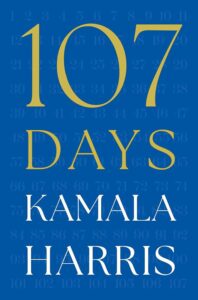
“Presidents cast long shadows. Vice presidents are usually doomed to live in those shadows. If presidents are stars on the stage of world history, vice presidents are nervous understudies hidden away behind the scenes. They live in interminable limbo, on call in case some catastrophe (a scandal, death, assassination) requires their elevation. As such transfers of power are not the norm, vice presidents can usually be found in unglamorous busy work, at best breaking tie votes in the Senate and at worst serving as White House gofers. The popular HBO show Veep, which starred Julia-Louis Dreyfus as a hapless vice president, wrung seven seasons of cringy comedy out of the inherent awkwardness and ignominy of the position. The pathos of being a veep pervades Kamala Harris’s campaign memoir 107 Days. Reflecting on her messy succession, she tells the story of how she ended up taking over the Democratic presidential nomination from Joe Biden last year and eventually losing to Donald Trump. Harris quotes the familiar gibe of John Nance Garner, Franklin Roosevelt’s first running mate, that the job of vice president is not ‘worth a bucket of warm piss.’
…
“Harris contrasts this destructive behavior against her own loyalty, which arguably also harmed her, since she was unable to separate herself from Biden. But here a lot of blame also falls on Harris’s shoulders. In painting such a devastating picture of Biden, Harris raises questions about her own political judgment. Why did she remain so loyal to Biden even when his own policies and decisions appeared to put the country and hundreds of thousands of people’s lives at risk? In this way, 107 Days is also, mostly unintentionally, an indictment of the kind of clubby elite liberalism that both Biden and Harris benefited from and to which they mostly adhered.
…
“That Harris tried to change Biden’s mind was a good thing, but it’s not hard to miss that when talking about Gaza, she reverts to the gauzy language of empathy without making clear what concrete measures she thought were necessary to end the slaughter. It’s even harder to miss how silent she was in public on the matter. Private pleas for Biden to show some heart were simply an inadequate response to the killing fields of Gaza, which anyone with eyes could recognize as a genocide.
…
“Like many liberals, Harris is quick to decry Trumpian ‘fascism’ but refuses to see that this wave of right-wing authoritarianism is driven by the dynamics of capitalist exploitation, social alienation, and economic inequality. She repeatedly praises her ‘politically astute’ brother-in-law Tony West, a trusted adviser and senior vice president at Uber. But she doesn’t acknowledge the reporting that West, to please Wall Street, helped water down her economic message by muting populist critiques of price gouging. This was surely a factor in her defeat, one separate from the selfish arrogance of Joe Biden.”
–Jeet Heer on Kamala Harris’ 107 Days (The Nation)
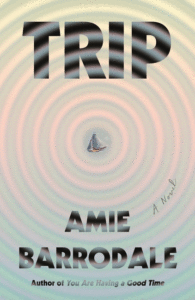
“Amie Barrodale’s funny, sad, heretical debut novel, Trip, which takes place in the non-place of the bardo, as well as in the tangibly real places of contemporary America and Nepal, is a magnificent and lovable work—both page-turning and coolly visionary … Much like in The Tibetan Book of theDead, mind-blowing events are depicted with disarming simplicity. Whether or not the work of Denis Johnson and Joy Williams has been important to the author (I’d guess it has), all three share a sensibility of deadpan supernaturalism, and Barrodale is worthy of inclusion in Johnson’s and William’s company. Happily, though, Trip also derives its success from something more conventional—it’s a rescue narrative propelled by one question: Will the kid be saved or not?
…
“It’s in Anthony the ungovernable addict that the imprint of Denis Johnson is most obvious. As demonstrated in her 2016 short story collection, You Are Having a Good Time, Barrodale, much like Johnson, observes her florid fuckups with a gaze that sees everything and judges nothing. Trip’s most obvious precedent, however, is George Saunders’s Lincoln in the Bardo, also a debut novel, albeit one that followed four beloved short story collections. In Saunders’s afterlife, various spirits join Willie, Lincoln’s eleven-year-old son who has died from typhoid fever, while his father grieves in the crypt. This is how Saunders writes about his bardo: ‘Only then (nearly out the door, so to speak) did I realize how unspeakably beautiful all of this was, how precisely engineered for our pleasure, and saw that I was on the brink of squandering a wondrous gift, the gift of being allowed, every day, to wander this vast sensual paradise, this grand marketplace lovingly stocked with every sublime thing.’
If Saunders is the huggable older uncle who can’t help but eagerly proffer such warm gifts of consolation, Barrodale’s sensibility is that of cool young aunt who lets you figure it out for yourself while she watches from a distance—possibly from behind sunglasses. Never once losing control, she writes with a tonal blankness that accommodates that sweet/sore spot where pathos and comedy meet.
…
“But an inadequate, albeit sensical reading of ‘nothing good or bad, but thinking makes it so’ could also take it as some shrugging indication of life’s fundamental amorality—if it’s all subjective, if it’s all just in your mind, who cares? It threatens a nullifying relativism. Barrodale does not let either her reader or her main character off the hook with anything as voiding as that. Instead, Trip confronts a problem Buddhism makes explicit: how to attain non-attachment, that serene, even magnificent state of ‘both-and,’ while remaining morally and emotionally attached to the objects of our love.”
–Hermione Hoby on Amie Barrodale’s Trip (Bookforum)

“It takes a historical memory that extends past a single country’s imposed borders and spans at least one average lifetime—or the tenure of the state of Israel—to arrive at Zionism as the cornerstone of the region’s ongoing instability. The beginning of a solution, Zionism’s dismantling, requires a more granular understanding of its founding logic. A new edition of The Foundations of Zionism by the Palestinian lawyer and scholar Sabri Jiryis, translated into English for the first time, provides a comprehensive account of Zionist history, spanning from ‘its inception in the mid-19th century’ in Europe ‘until the early period of the British mandate over Palestine in 1923.’ Jiryis offers the reader the ‘inner story of Zionism,’ written in the spirit of know-your-enemy.
…
“In The Foundations of Zionism, Jiryis is uninterested in the indignity of persuasion. Given that it was written decades ago, it is clear he has, since his law school days, decided to no longer address those who refuse to see his humanity. The text reads less like a catchy advertisement for, say, a table and more like an extremely thorough YouTube video on how to build said table—and how it might be disassembled.
…
“The Foundations of Zionism mostly adopts an academic’s distance. It is five hundred and fifty merciless pages of interwoven fact. The introduction and conclusion, both written since 2023, give the reader a small sense of our author. That Jiryis’s wife was killed by Israel slips through as a single sentence. Jiryis’s is a clinical study of Zionism, and if his life doesn’t belong here it is because Zionism does not accommodate the Palestinian—it cannot. The first of the most consequential decades for Zionism took place in Europe before the first settlers arrived in Palestine. After, they continued to face only themselves. Structurally, it is fitting that the Palestinian appears before and after, presiding over the main text, seemingly preserved in a fantastic, self-enclosed world. Zionists, like all colonizers, have labored to convince the colonized of their omnipotence, and here is a reminder that, as they see us and pretend not to, we too see them.
…
“In our mainstream media, we’ve come to recognize a familiar pattern: Palestinians reveal something about Israel. Months or years pass, Israelis confirm it finally, long after it is inconsequential, and they are celebrated in places like the New York Times for their bravery, by people who have no right to wash the blood off of each others’ hands. Jiryis is a scholar; he witnessed the start of the Nakba and its consequences, and is not writing for those who won’t listen.”
–Mary Turfah on Sabri Jiryis’ The Foundations of Zionism (The Baffler)