Our fist of furiously good reviews this week includes Hermione Hoby on David Foster Wallace’s Infinite Jest, Sam Worley on George Saunders’ Vigil, Diana Abu-Jaber on Nina McConigley’s How to Commit a Postcolonial Murder, Sarah Weinman on Sarah J. Mann’s Black Dahlia, and Simon Critchley on Peter Ormerod’s David Bowie and the Search for Life, Death and God.
Brought to you by Book Marks, Lit Hub’s home for book reviews.
*
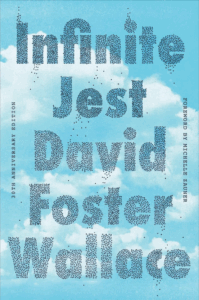
“David Foster Wallace’s Infinite Jest, a book whose notorious bigness comprises both physical size and reputational heft, turns thirty in February. The occasion is a moment to ask how a novel that mourns addiction and venerates humility and patience became a glib cultural punch line—a byword for literary arrogance, a totem of masculine pretentiousness, a red flag if spotted on the shelves of a prospective partner, and reading matter routinely subjected to the word ‘performative’ in its most damning sense. At a thousand and seventy-nine pages, Infinite Jest has become a one-liner.
…
“Encountering the novel in my twenties, I was unaware that I was committing a form of gender treason; I knew only that little or nothing I’d read had come close in terms of sheer pleasure. The book had more brio, heart, and humor than I thought possible on the page. It was bizarrely grotesque and howlingly sad; it was sweet, silly, and vertiginously clever. It was also, by virtue of its relentlessly entertaining scenes and the high-low virtuosity of its language, a work that enacted its own theme of addiction. When I finished, I experienced withdrawal: Where to go after Infinite Jest? It was, in short, a supposedly unfun thing I would do again, and did.
…
“This enormous cast of characters is diverse mostly in terms of the variegated peculiarity of inner lives. As for ‘diversity’ in the sense of gender parity and racial representation: not so much. The two main female characters, Avril Incandenza and Joelle van Dyne, both happen to be gorgeous. When it comes to the novel’s handful of Black characters, some of whom speak in a cartoonish version of Ebonics, perhaps the most tactful thing to be said is something like: It was a different time. And yet from this horde of fretting, feeling, interfacing selves a truth emerges: that loneliness is a universal problem experienced by each person in a unique way. The novel also suggests—mumblingly, without making eye contact, not wanting to be corny about it—that one’s own self becomes a little less hideous the more one attends to other selves. Not all of whom are entirely hideous.
…
“His great novel proposed that the compulsive, addictive character of America, not least its addiction to entertainment, could best be resisted through the engaged reading of fiction. Here is a book about addiction that offers itself as a kind of counter-addiction, an example of the compounding value of sustained attention. The infamous length of Infinite Jest is, in this sense, a central feature of its ethic: not bigness as brag but duration as discipline. In a distractible age, Wallace made an argument for the long novel that is won simply by being heard.”
–Hermione Hoby on David Foster Wallace’s Infinite Jest (The New Yorker)
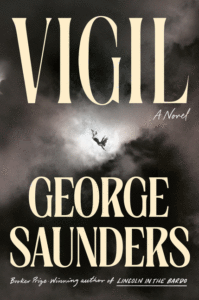
“In his best work—particularly his sublime 2013 collection, Tenth of December—Saunders excels at synthesizing human stories with biting, frequently very funny critiques of the structures that shape our lives: homes, workplaces, social groups, class positions, and really American consumer capitalism itself, whose stupid excesses he sends up in dystopian scenarios. What happens, though, when those excesses transcend the merely stupid, the merely unjust, to become existential? In recent stories and this new novel, Saunders’s fiction has begun to feel both darker and a bit frustrated, spiritually and artistically. You see the problem: What’s a satirist to do in times like these?
A work like Vigil may raise questions about how much empathy (or come-uppance) its villainous subject is owed. I’m agnostic on that, but I do think he should at least be interesting, and Boone is not. He’s a collection of tough-talking clichés, a fountain of conservative boilerplate.
…
“Part of the problem may be that Saunders specializes in losers, hapless folks groping their way through unfathomable social or economic systems, but Boone is a winner. A bigger problem has to do with those systems themselves. In Vigil, they’re practically nonexistent.
…
“…Vigil has no view of systems, no analysis of power. It’s not a polemic or even a calmer exploration of life in the Anthropocene à la Kim Stanley Robinson, who, conceding the scale of the catastrophe, allows for the possibility of organized human ingenuity. I started imagining an alternative version in which the same raw materials—the bloodless businessman, the ravaged environment, the afterlife—are assembled into something leaner, meaner, and more lively: like one by Joy Williams, a hater of the highest literary distinction. They sent a humanist to do a misanthrope’s job!
Vigil’s indifference to realism suggests the possibility of climate allegory, like Lydia Millet’s A Children’s Bible, but it’s too scattershot for that. As cartoonish as Boone is, Vigil is not much of a character study. Nature or nurture, it’s hard to care where he ends up.”
–Sam Worley on George Saunders’ Vigil (Vulture)
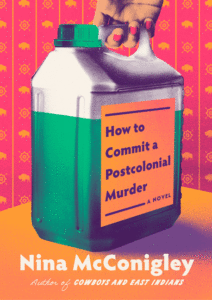
“‘Postcolonial’ is a loaded term. It implies that something—a nation, an era—has undergone a political and psychological change, paving the way for a liberation from an outside force. Now, finally, a population can reclaim its true identity. And yet, is such a reclamation even possible after one has been annexed or occupied? Colonialism affects every aspect of life, from language to religion, from dress to traditions, and those legacies don’t necessarily disappear after an oppressor is ousted. Nina McConigley’s How to Commit a Postcolonial Murder grapples with these ideas, riffing on the idea of overthrow by narrowing the focus from national boundaries to familial ones.
…
“Georgie calls her fractured narrative a ‘ventriloquist act,’ implying that the ‘Georgie’ of the story is a kind of cultural fabrication, separate from her more complex true self. She frequently addresses the (presumably American) reader directly, saying at one point: ‘You want me to perform culture in a certain way. To tell you a story a certain way. To tell you about stinky lunches and how hard it was to be us. When I think it must be hard to be you. Your culture so vague.’ By throwing her voice in this way, the narrator is split off from her story and identity; her selves are multiple and shifting. The effect is both disorienting at times and impactful. How to Commit a Postcolonial Murder is the story of a fractured family and a portrait of an era and place, but it is also a deeply thoughtful meditation on the lingering aftereffects of colonial violence.”
–Diana Abu-Jaber on Nina McConigley’s How to Commit a Postcolonial Murder (The Washington Post)
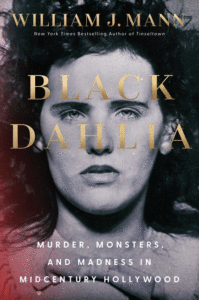
“A contemporary version of Elizabeth—dreamy, elusive, independent, and canny—might be called a flaneuse, someone curious about the world. But we’ll never know what kind of life she would have led; by the time her bisected body was found in a vacant lot, six days after she left the Biltmore, Elizabeth had ceased to be a person. From then on, she became ‘The Black Dahlia,’ an archetype, a myth, a riddle that countless people have attempted to solve in books, films, television shows, podcasts, websites, internet-message boards, and social-media posts.
…
“This kind of flattening happens all too often with murder victims, particularly young women and girls who die at the hands of a serial killer, usually male. (Never mind that more marginalized women, especially women of color, are less likely to merit any attention at all.) In Short’s case, the flattening is particularly egregious, because the inchoate facts of her life are shoehorned into the obsessions of amateur sleuths who continue to get those facts wrong. William J. Mann’s new book, Black Dahlia: Murder, Monsters, and Madness in Midcentury Hollywood, attempts a different approach: to weave the fragments we have into a narrative whole that prioritizes Short, in all of her contradictions, and tries to debunk decades’ worth of accumulated myths. Although Mann’s effort stands apart from the overlong run of books about the case, it, too, is undercut by the need to name a likely suspect, playing into the true-crime imperative it aims to leave behind.
…
“Look past the need for narrative and there, out on the horizon, is Elizabeth Short, walking down a California boulevard, trying to create a better story for herself. She didn’t have to remain forever a girl wounded by her father’s rejection, too proud to admit the truth about her life to her mother and sisters, yet resourceful enough to survive, for a time, in a world that couldn’t care less. Her luck ran out, and we don’t know why, or who killed her. But the brutality of Short’s death shouldn’t supersede her life any more than myth should overshadow a larger truth: that her murder will never truly make any sense.”
–Sarah Weinman on Sarah J. Mann’s Black Dahlia: Murder, Monsters, and Madness in Midcentury Hollywood (The Atlantic)
“It has become a tired cliche among fans to say that everything went wrong in the world after Bowie died in 2016. It also misses the point: rather than being one of the last avatars of a liberal order that has crumbled around our ears, Bowie prophesied the mayhem that has replaced it.
In his later years, he thought that we had entered a zone of chaos and fragmentation. This is what allowed him to be so prescient about the internet—not its promise, but its menace. There is no plan and no order. There is just disaster and social collapse. Those looking for reassurance should not listen to Bowie (please listen to something, anything, else). His world, from Space Oddity through to the background violence of The Next Day and Blackstar, was always drowned or destroyed or incinerated: ‘This ain’t rock’n’roll, this is genocide’ as he exclaims at the beginning of Diamond Dogs.
…
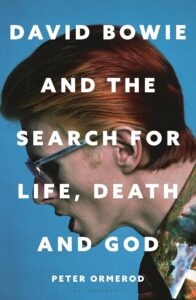
“Which brings me to Ormerod’s book. I was wrong about it. Because I have loved Bowie with an unwaning passion for 54 years, I’ve read too much about him and grown rather blase about his biography. Thus, when I began reading, it all felt a tad familiar. Ormerod tells the story of Bowie’s life and music through the lens of religion, which is absolutely terrific as a central theme, as Bowie was essentially a religious artist…But still, it all seems rather straightforward and the little stabs at philosophy (Kierkegaard, Nietzsche, and so on) feel a tiny bit Wiki.
But the book takes on a growing velocity when analysing Bowie’s later work, particularly in the chapter on Heathen (I’ve not read anything as good on that album). This momentum develops into fine, detailed discussions of The Next Day and Blackstar, and also Lazarus, his stunning final experiment with musical theatre. What makes these sections so good is that Ormerod deals with Bowie as text; as the occasion for close reading, which I think is what his work, like all good art, deserves.
By the end Ormerod had me singing in the choir with him. The book closes with the compelling argument that what drives Bowie’s work—and Ormerod is very good on the centrality of the concept of drive—flows from two essential sources: life and love. When asked whether he had a devotional practice, Bowie answered, ‘Life. I love life very much indeed.’”
–Simon Critchley on Peter Ormerod’s David Bowie and the Search for Life, Death and God (The Guardian)