
If you’re barely clinging to the safety of monogamy or the no-strings-attached joys of an open relationship, I don’t advise picking up my latest novel, Middle Spoon, where I write with painstaking pleasure about the complexities of balancing two romantic relationships, two children, two therapists, two social classes, and two generations, and in the process, lay bare the vulnerabilities required to shift from one paradigm to another. Everyone else, please visit your local bookstore.
I didn’t set out to promote an unconventional romantic structure. As my novel’s protagonist proclaims, I, too, once, “…equated [polyamory] with polygamy, nothing more than a relic of religions and cults, a tool for keeping women subjugated.” Although I no longer subscribe to this notion, my motivation was simply to write a story of heartbreak, specifically the suffocating, desperate, and life-altering grief that defines it.
To that end, I interviewed dozens of people—friends, acquaintances, strangers at holiday parties—about their experiences with love. I wasn’t prepared for the responses. It seemed everyone had lived through the harrowing ordeal of love lost. Or more accurately, love taken away. Just a few of my questions were enough to trigger their long-ago pain. I could cry just thinking about it was something I heard from multiple people, even those who were currently and happily partnered. Even those who couldn’t remember the last time they’d thought of the person who’d left them in shambles.
As I listened to the stories, I began to multiply. I realized that at any given moment, a significant portion of Earth’s eight billion inhabitants might be nursing broken hearts. As someone who views the world through a public health lens, the magnitude of collective grief astounded me.
A brown, queer boy cannot undo his brownness or his queerness. And so he has to decide who is wrong, himself or society.
I was reminded of this yesterday morning. I’d gone for a run, followed by a swim in the Atlantic. As I was coming out of the water, I noticed someone sitting on the steps to the boardwalk. The closer I got, the more obvious it was that the person was crying. Are you okay? I asked. She held up a finger, as if it to say, Give me a moment. Something about the softness of her face and her yellowish complexion reminded me of my aunt, my mother, and three distant cousins, so I tried another way, ¿Estás bien? This time she responded by pressing her hand to her mouth. The deluge was near. My nephew died, she managed to get out, before she stood up and pulled me into her. I tried to protest, not because I’m opposed to hugging complete strangers, but because I was nearly naked and soaking wet. My condition did nothing to stop her or to loosen her embrace. She held me tighter than anyone ever has, all the while sobbing. At one point she kissed my bare shoulder, in a manner that might have skirted my boundaries in other circumstances.
After the heaving subsided, she sat back down. I didn’t know what to say, but I knew I couldn’t leave, so I retreated to fact finding. Did it happen recently? I asked. Just a few hours ago, she responded. Through her tears, I pieced together that she’d gotten the call only thirty minutes earlier, that she was a home health attendant who’d asked for a ten-minute break so that she could gather her thoughts, and that her nephew was fifteen. I did my best to comfort her: I’m sorry, I’m so sorry, I’m very sorry. Before I walked away, she said, I know God put you in my path this morning because I left the house praying I would find someone to hug me.
I’ve been stricken with grief before—death and heartbreak. Her pain, although unique, was familiar, as was her desperation for comfort. Talking to this person reminded me of my motivation for writing Middle Spoon. I’d wanted to dissect, intellectualize, and dramatize the pain of loss. A pain I consider unparalleled.
In this book, I created a protagonist who airs every one of his preoccupations, doubts, fears, desires, and insecurities—sometimes they’re all the same—on his road to healing. My hope was that his vulnerability would engender vulnerability in others. I imagined people reading Middle Spoon and unfolding their own traumas—Covid-19, divorce, cancer, dementia, Gaza, Sudan, Minnesota, climate change—so that they might fold them anew and more efficiently, like one does periodically their sweater drawer. A literary EMDR if you will.
But my protagonist isn’t only grappling with his grief. He is, as are the protagonists of all my books, grappling with conformity. Of all the interrogatives, Why is the one that most guides me and my work.
Talking to this person reminded me of my motivation for writing Middle Spoon. I’d wanted to dissect, intellectualize, and dramatize the pain of loss.
My formative years weren’t particularly special. I, like every other person who didn’t attend a Montessori school, was simply trying to fit in. This is, after all, what humans do; we socialize. It’s our way of building trust and achieving safety. In an uneven society, however, where differences are synonymous with barriers, fitting in becomes conforming—style, ideas, culture, etc. And anyone who doesn’t conform becomes a target for ridicule, and consequently a warning to others. The problem, or in my case salvation, is that some differences are immutable. A brown, queer boy cannot undo his brownness or his queerness. And so he has to decide who is wrong, himself or society. Once society’s fallibility becomes apparent, everything else comes into question.
If everyone was wrong about homosexuality, for example, might they also be wrong about prisons or Israel? How about gender and marriage? And perhaps capitalism and the final scene in Do the Right Thing? And Israel? And possibly sharks and God and the pledge of allegiance too. Certainly then, tax breaks for professional sports stadia and abortion and Israel and monogamy and therapy and the Oscars and socialism and philanthropy and red-40 and drug criminalization and boarding the front of the plane first—completely illogical—and Sinead O’Connor and the United States. Right?
I’ve written before (here, in fact) about how my fiction isn’t veiled autobiography. But I will admit that I have some things in common with my protagonists. In addition to being human, I, too, spend an inordinate amount of time questioning whether we’ve subsumed our humanity, which is to say, our instincts for socializing and taking care of one another, in order to conform. I, too, wonder if capitalism’s grand achievement is duping us into believing that conformity is free expression and individualism by another name. I lose sleep worrying that conformity is a blindfold and an addiction. And that it’s allowing all manner of wrongdoing to transpire around us because we’re more worried about the repercussions of standing out, of not fitting in.
It’s possible, then, I haven’t written a book that promotes polyamory so much as it asks the reader to question everything.
__________________________
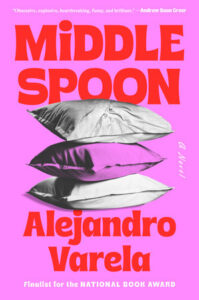
Alejandro Varela’s Middle Spoon is available now from Viking.

