“Go West, young man!”—a phrase that looms large in the United States’s history of westward expansion. It’s a history dominated by the displacement of Indigenous peoples, the exploitation and destruction of land, and a drive to claim more, more, always more: more resources, more gold, and more land, but also more control of the stories we tell. Kathleen Boland’s debut novel Scavengers is a funny, sharp joyride that plays within the tropes of the stereotypical Western in order to hold up a mirror to both characters and readers and ask them: Are you so sure about that?
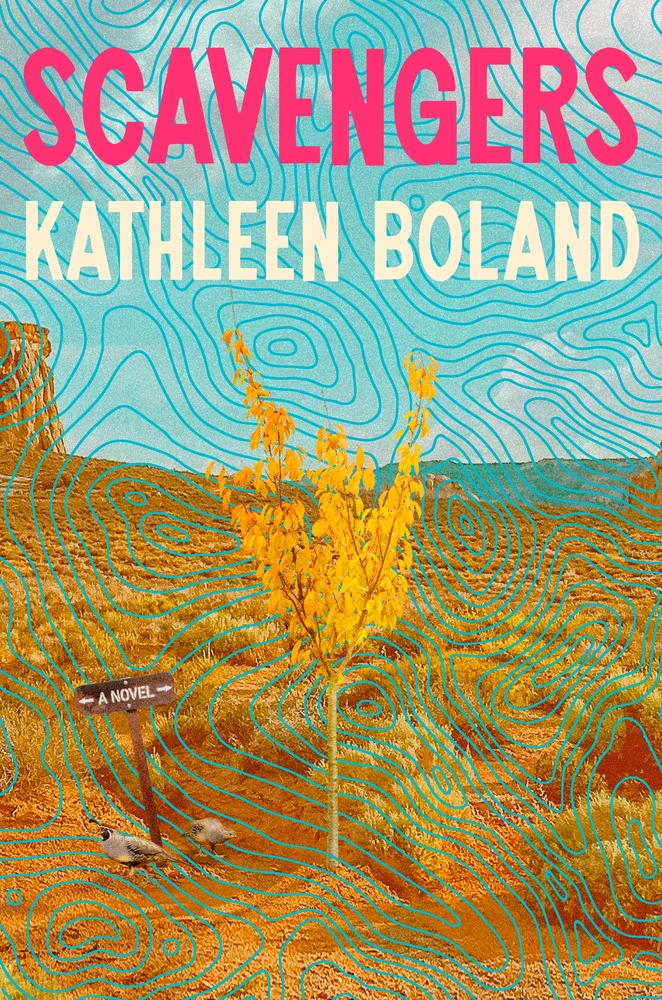
The novel follows buttoned-up Bea, who has just been fired from her job as a junior weather analyst on a commodities trading desk, as she escapes to Salt Lake City. That’s where her mother Christy, who has been “going with the flow” for most of her life, has been living (in an apartment Bea pays for) and, unbeknownst to Bea, participating in an online forum dedicated to a $1 million treasure hunt. Christy is pretty sure she’s close to finding the treasure, and as the hunt comes to a head and takes Bea and Christy to the small town of Mercy, the two find themselves deep in the wilderness, confronting the harshness and beauty of the landscape, and of the choices they’ve made to lead them to this point.
Scavengers has all of the elements you could hope for from a mother-daughter take on the Western adventure: It’s full of vibrant and eccentric characters, madcap hijinks, sizzling suspense, and laugh-out-loud humor. But dig a little deeper and it is, above all else, a deeply thoughtful meditation on the stories we tell ourselves and each other, about the things we value, and about our place in the vast, mysterious, and capricious world we live in. What happens, Scavengers asks, when we start to push at the edges of the stories we’ve always believed? What happens when we’re forced to consider that another story might have been happening this whole time? What sort of reinvention might we experience if we let go of what we thought we knew?
I had the pleasure to talk to Kathleen over Zoom about the West, reinvention, what wilderness is and what it means to us, and how we are always rewriting our stories.
Mary Pappalardo: One thing I loved about this book is that it is unequivocally a story about adventure and more than that, a “go West” adventure that follows two women. This is a genre historically dominated by male perspectives, so I’m curious how you see this book fitting into the history and lineage of that genre?
Kathleen Boland: I think one of the major impetuses for me to write the book, actually, was that—in terms of Utah in particular—I was reading so much incredible nonfiction and poetry about the state, but in terms of fiction, it was kind of just Edward Abbey. I think there’s a lot more to say about it. I was a young woman going to southern Utah and having all these adventures and falling in love with this landscape. And I wanted to know more about what other women thought and felt when they went to this place. I couldn’t find that really, in fiction in particular, so I decided to try to write it myself. I think also—especially in terms of a mother and daughter going West—there’s something to be said about the reinvention . . . that all Westerns kind of stand on. Reinvention happens all the time in terms of being a daughter and in terms of being a mother, and that’s also something I wanted to explore with Bea and Christy. Putting them in this landscape, taking them out of the Northeast and into the desert, it kind of felt like a how else are you going to really stare at yourselves and figure it out kind of thing.
MP: Could you say more about what made you want to write about mothers and daughters? What is so rich about that kind of a relationship that you were drawn to?
Reinvention happens all the time in terms of being a daughter and in terms of being a mother.
KB: As I was going through my twenties I had this experience, which hopefully is common . . . you start realizing that your parents are people too, and they’re not just Mom and Dad, but they have had full lives and full experiences before you were ever born. They have their foibles and idiosyncrasies. I think it’s a process of maturity. Suddenly you’re like, Wow, my mom/my dad is this full person and makes mistakes and wrong choices just as much as I do. And how that impacts not just your view of them, but your relationship with them . . . that was something I was exploring when I first started writing this book. And then I became a mother while editing this book, and that really informed a lot of the backward glance and editing in terms of Christy, of how you view your child as they get older. Putting them out in Utah, I think for me, Christy typifies this personality of the adventurer and the explorer. Whereas Bea is very committed to a much more square, stayed, stereotypical life. So what would happen if she is forced to reinvent herself because of her own mistakes? And then they have to go out together. And doing that all in Utah made sense to me because Utah is a fascinating, weird place, but it’s a place where people have always gone seeking for things.
MP: You seem to have a real relationship with that landscape. Could you talk about your relationship to southern Utah, and the West in general?
KB: Like Bea and Christy, I grew up in suburban Connecticut. I left and moved to Colorado after college. Around the same time, my parents, who also grew up in suburban Connecticut, moved to Utah. I would go visit them in Utah, and then I would go and solo hike and backpack around the Escalante Grand Staircase area. That was very formative for me because it was so unlike where I grew up. It was so open and wild and full of possibility, and I was completely enamored in the very stereotypical American West grand heritage. I just wanted to learn everything about this place. As I kept reading and going back there, I wanted to know more and more. I started realizing how weird Utah is. Other places get a lot of attention for being weird (Florida, for instance), but I think there’s a lot to be said for Utah. I think it’s a strange, wonderful place. It’s also a place that has a deep and fraught relationship with wilderness. I just could keep going back there and keep writing about it. You know, I’ve gotten the advice of write about your obsessions, and it was an obsession of mine.
MP: How do you feel about publishing this at a time where we’re seeing attempts to control land enacted as literal policy at local, state, and federal levels? When you started this book, did you think you would be writing a novel that intersects with the political as much as it does?
KB: Utah is really an epicenter for a lot of these conversations about national lands, wilderness, and what does “wild lands” even mean. Interestingly, when I was out there in the 2010s, locally there was a lot going on, especially with the Grand Staircase Escalante area. People were upset about government overreach. They were upset about the designation of it as a national monument. And now you have full senators and the Secretary of the Interior thinking these same things. I think the politics of the place were always of the mind.
Before I got my MFA, I worked on a commodities trading desk, a lot like Bea did. And while I was doing that work, I was always thinking about land use, about extractive industry. That’s what all of my research was about: The impact these things have on these lands and what that can mean. But at the end of the day, any attempts to control the land are just hubris. We can permanently change the land, absolutely. But can you control it? I don’t think so. I think that’s another reason why I talk so much about the weather in the novel, because I see it as on par with trying to control the weather. We can pretend that we do, but at the end of the day, there’s nothing humans can do about the weather. They can change it and influence it—right, climate change—but they can’t predict what will happen. And I am reminded over and over again, whenever I go out into the wilderness, that you can sit in your air conditioned home, have everything climate controlled, have all the food you want. But then if you go out there and you leave that behind, you are very quickly reminded that you are an animal in the world. There’s a lot more going on and forces that you’ll never be able to control once you leave that behind. So, I think the politics were always there. We’re obviously in a time where these things are now of a power and a scale that I don’t think I could have ever anticipated. But these debates were happening back when I was alone hiking through the slot canyons, so I was always thinking about them.
MP: These ideas of wilderness remind me of some of my favorite formal elements of the book: these interludes peppered throughout the novel that drape geological time or non-human perspectives over the narrative that propels the novel. Why did you include those?
KB: A big part is . . . What does it mean to value the land? Who gets to decide what’s valuable? Christy believes the land is only valuable to her to go find this treasure. Bea works on a commodities desk where everything she does is about estimating, projecting, and determining what the land gives in terms of value. Any time I’ve gone out to these spaces in southern Utah, I am immediately reminded that there are so many other ways to live and so many other perspectives in and from these places. I wanted to be sure that throughout this mother-daughter romp, [I showed that] there are real people and beings who live there, and that the desert isn’t the middle of nowhere, it’s not a wasteland. There’s so much life, and life is not only human life, right? I wanted to remind the reader of this and to have that perspective, because at the end of the book, every character is reminded that there is so much going on in this place that has nothing to do with them, has no care for them, and they could only hope extends mercy. There’s so much weirdness and wonderfulness about this part of the country that so many people don’t realize or don’t think about or underestimate. And I wanted to do them justice.
MP: You open the book with this meditation on bullshit. You write, “Look, people make shit up all the time. We’re all a bunch of filthy liars. We can lie about everything and we do.” What might authenticity mean in the context of this book, of literature in general, and maybe even just in the cultural moment that this is being published?
KB: I first started writing this book in 2016 and things were definitely changing, but maybe not on the level that they are now. I started the book there as a nod to: It’s fiction. All of this is made up. It was also a nod towards my feelings about the financial industry. Having worked in it . . . there’s so much bullshit that goes on in finance, and a lot of it is wrapped up in jargon and real material power, of course, but it’s still bullshit. It is a real job, what Bea did, to be a weather analyst for a commodities desk. And people are putting sometimes millions of dollars on the line by trying to guess what the weather’s going to be like in a couple of years, which is comedically insane. And that’s something I was thinking about, Do people really realize just how wild and bullshit these things are?
What does it mean to value the land? Who gets to decide what’s valuable?
I was also interested in poking holes in a lot of the presumptions I had about the West when I first went out there, and about what success means. You have Bea on one hand who thinks a way that, for me in suburban Connecticut, a lot of people I knew and even I adhered to. Where this is what success looks like and it’s the only way to do life. And then you have Christy who’s like, Well that’s bullshit. But is her way the right way too?
And then lastly, like I mentioned, the bullshit about the West, the bullshit about places like southern Utah, again, like “middle of nowhere,” or “the desert is a wasteland,” or “nothing lives there or grows there, it’s only good for coal and oil extraction.” These are all bullshit things that we create narratives from and then big decisions. I was always motivated by being like, Are you sure? Is that real?
MP: Can you talk a little about online message boards and the culture of forums that is so essential to this book? This felt like an earlier internet culture that you tapped into. What about that felt right for this?
KB: It’s a part of the internet that I don’t think fully exists anymore. One, it was me riffing off the inspiration of the Forrest Fenn treasure hunt; I knew that there’s this dedicated online community about it. But what I loved is that it was a way to show how many people there are all over the place hoping and wanting the same things. And no matter what, human nature is to find your fellow weirdos, in any way possible. I also wanted to have an homage to all these various forums that I discovered when I was in my late teens and early twenties. But also—and this was true with the Forrest Fenn treasure, three people died looking for that treasure, which is wild and tragic—how you can have an unearned confidence to go out into these places to look for these things. It goes back to what we were talking about before: When you leave “civilization,” or the “creature comforts” of organized society and go into these places, you are quickly reminded that you are depending on a lot of things for a lot of conveniences that do not exist in those areas. So, I wanted to be sure to underline that.
If you refuse to revise, you’re refusing to write.
It goes back to reinvention, the persona you can bring to an earlier internet where you could just be a username on a forum, you could inhabit any persona you want. I think there’s a lot of ego and persona in this forum [in the book], and then as those people become actual lived characters, you start realizing, oh, how far can that reinvention actually go? How much of it is actually bullshit and lies versus actual knowledge?
MP: This started back in your MFA days, and I was curious what the process of revision was like, both turning an MFA thesis into a book, but also what was that exploration process like turning that first version into the final book?
KB: We’ve been talking about reinvention and let me tell you, this book has been reinvented dozens and dozens of times. My thesis was . . . I wouldn’t even say it’s an early draft of this. I would say it’s a distant cousin. I first queried this book when I thought it was done about three years ago. And multiple agents were very generous with their time, but they were all like, The ending sucks. And that was hard to hear, but I kind of gave myself a three-strike rule: When three different people were like, ahhh, but your ending, I had to kind of sit with it, and I completely changed the last 40-50 pages. I just trashed the whole ending and rewrote it. What I learned over the course of that is that, I don’t think you have to kill your darlings. A lot of things that we’ve talked about today are my darlings. But I do think, for me, radical reinvention has to always be on the table. You can keep the characters, you can keep the setting, you can keep your obsessions, but at the end of the day I had to be telling someone a story. And most of the time it was myself. It wasn’t just me putting words on a page for the sake of words on the page. It was, Okay, how do you tell yourself a story that makes sense? And then what does that mean for someone else? I think that was learning how to write a novel and not just a novel-shaped pile of words. So constant reinvention and just a total and complete embrace of revision. Because writers would always [say] the real writing is revision. And it’s unfortunately very true. You have to keep editing yourself and you have to keep revising yourself. And if you refuse to revise, you’re refusing to write.
MP: Reinvention and revision . . .
KB: They’re both painful, necessary, and unavoidable.
The post A Mother-Daughter Novel That Transforms the Western appeared first on Electric Literature.

