A raven, poet Annemarie Ní Churreáin told me, is one of the few birds that will look at you as it sings. Ornithology has shown that birdsong patterns are passed down through generations, much like human language; they contain sounds that no longer have a source. Birdsong, in a sense, is an archive of the landscape, the culture, and simply the old songs. When a raven sings to us, then, what is she trying to tell us of the past?
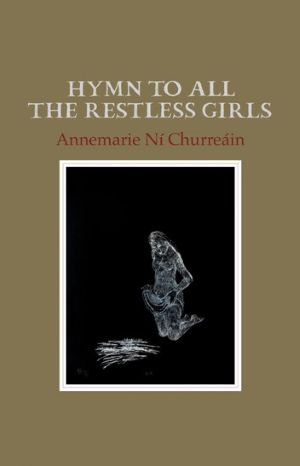
Ravens feature prominently in Hymn to All the Restless Girls, Ní Churreáin’s third poetry collection. Ní Churreáin’s ravens are both storytellers and a mode of attention. They insist on interruption and resistance. Perhaps they are guides for the titular restless girls who, it turns out, are our key to the history of women that the Irish Free State and the Catholic Church tried to bury.
To reinstate the histories excluded from official archives, Hymn to All the Restless Girls draws on Irish language, folklore, and physicalized speech such as lamentation and caoineadh (keening). Ní Churreáin is playful in form, extruding songs, mythologies, and even curses through formats like constitutional text, institutional procedure, and prayers. Poems such as “Archive 41.2” and “The Home for Unmarried Fathers” borrow structures and invert subjects to write against the official languages that have governed Irish women’s bodies, labor, and silence. The poems document the historical brutality against women and the absurdity of the mother-and-baby homes. The result is a collection that reframes the restless girls not as moral failures but as bearers of knowledge that might otherwise be lost.
One such type of knowledge is the fiachairecht, the ancient Celtic art of raven-watching, which Ní Churreáin gamely wandered into while writing Restless Girls. Or did the ravens lead her there? From Odin’s Huginn and Muninn, said to be memory and knowledge, to Lewis Carroll’s perennial riddler, ravens have a long literary history. They’re messengers, witnesses, perhaps tasked with remembering what cannot be neatly concluded. If the relentless “nevermore” of Poe’s raven forecloses the possibility of Lenore, Ní Churreáin’s ravens resurrect Ireland’s restless girls, insisting they will not be nameless for evermore.
Lucie Shelly: I’d love to begin with the animating idea in the title: restlessness. In Hymn to All the Restless Girls, restlessness takes many forms. Anger, lust, mischief, defiance, even glee. I found myself wondering, is “restlessness” in girls and women innate, or is it what manifests when some force or energy is suppressed? What does restlessness mean for you in relation to poetry?
Annemarie Ní Churreáin: I love that you’ve mentioned glee because for me there is a lot of joyful energy and seeking in this book as well as anger, frustration, and outrage. Perhaps this restlessness comes out of a quest for transformation. In the Irish mythic tradition, restlessness often signals a person who is on a sacred journey. The poets and warriors of our oldest stories are rarely at peace.
I also think that to be restless is to belong to more than one world. That’s something that Irish people understand very intimately, living as we often do between languages, traditions, and cultures around the globe. And maybe it’s something that women understand especially well. We haven’t always had the luxury of stillness as a pose for achieving self-knowledge, wisdom, or change. It hasn’t always been safe for women to be still. In a patriarchy, sometimes you have to be on the run, you have to be able to move fast.
LS: Poems like “Hail Queen of Heaven,” “Night Prayer at the Temple,” and many others invoke rituals or ritualistic language. There’s keening, charms, rites. Do you think of physicalized language—ritual speech, lamentation—as a way of recording suffering or remaking it into something powerful? Or something else entirely?
ANC: I really believe there is magic at play when we give breath to poetry. Audre Lorde, in her essay “Poetry is Not A Luxury,” writes of the illumination that occurs when we work with language as a tool for transformation. We all know that experience of manifesting change in your life by speaking it aloud. And certainly, there’s something [of that power] in poetry. Paula Meehan has spoken about how, in prison, two lines of poetry can save a life. Joy Harjo has written about the power of poetry to change the past. She articulated it so beautifully, I won’t paraphrase, but it’s this idea that poetry operates outside linear time. By the very act of writing or speaking poetry, you’re stepping into a dreamworld where you can transfigure even the past or the future. Yes, definitely—it’s about much more than recording history or suffering. It’s an invitation, also a portal.
LS: My feeling while reading was that not only did the poems move through historical time, they moved through worlds—the mythological world and the “real” world. We enter “the Donegal County Archives,” we even go into a Woodies Homeware store, but we also encounter these Gaelic mythological figures, Medbh, Gráinne Mhaol, banshees, omens. The blend made it feel, for me, like the mythic was reinstating the private, unseen female experience as historical.
To be restless is to belong to more than one world.
ANC: I’m interested in the worldview that is made possible through the Irish language, and about the land as a veil between this world and the Otherworld. Certainly, in the Gaeltacht regions of Ireland, where the Irish language is still spoken and folkloric traditions are very much alive, there’s wild respect embedded into the culture for powerful and restless female figures.
When you grow up with the banshee, the Cailleach, the bean feasa, or historical women like Gráinne Mhaol as part of your frame of reference, it gives you a place to retreat to when you have the Irish State and church and all of the awful legacies and internalised shame of a colonised country bearing down on you. I’ve always had somewhere imaginative to retreat to, and that is one of the gifts of having an ancient language or of being connected to indigenous stories. These figures live in the psyche as magic-makers, guides and connectors to land, the spirit world, and each other.
LS: For readers outside Ireland, and even those within, could you describe what it looked and felt like to grow up in a Gaeltacht region?
ANC: I grew up in the Gaeltacht community of northwest Donegal, and Irish was my first language. But a Gaeltacht is more than simply a place where the native language is spoken every day. It’s a worldview rooted in a special instinct for place, magic, and relationships. For example, the relationship between people and place, or that relationship between the spheres of the physical and the metaphysical. It’s a way of understanding that as humans, we live ‘ar scáth a chéile.’ Cree scholar Dwayne Donald describes colonialism as “on-going process of relationship denial,” and to grow up in a Gaeltacht is to grow up immersed in the parts of Irish culture that could not be denied or destroyed.
I came of age in the 1980s, when teenage girls in rural Ireland were having apparitions of the Virgin Mary—the moving statues. Later, I felt a little embarrassed about that phenomenon. I remember being at university in Dublin and looking back on the footage of thousands of people gathering to see these “magical presences” in the landscape, and feeling: Wow, we’re the subject of ridicule. Now, I can look back on that really differently. It was a folklore living in the culture, it was being torn between these two worlds. This hunger for mystery was so in the consciousness, and still popular to that degree, in 1985! It’s kind of incredible. In 1985 teenage girls and young women were being brutalized by church and state. They were living through the end of the theocracy. They were often not in control of their narratives or destinies, but three teenage girls went out one night in Sligo, and they ended up positioning themselves right at the centre of a hugely exciting public story. There’s a delicious power in all of that.
Maybe I took it [the Gaeltacht worldview] for granted for a long time. To a certain extent, I spent a lot of years trying to escape Donegal, wanting to explore other ways of living. Asking, well, what else might I be? But with this collection, I discovered a fierce desire to celebrate where I come from. It has shaped every part of my life. It doesn’t matter if I’m editing, or writing opera, or writing poems, that wellspring of Gaeltacht culture feeds everything, especially my poetry.
LS: I’d love if you could talk about some of the spiritual and mythical motifs that appear in the collection. In particular, I’m interested in fiachairecht, and Caoineadh.
ANC: Well, fiachairecht is the Irish traditional art of watching ravens for prophecy and omens. A powerful songbird, the raven (an fiach dubh), often appears in Irish poetry and features very prominently in our oldest warrior stories. Sometimes, the raven is linked to the [Celtic] Morrigan goddess. And the white raven in particular is an auspicious sign.
When you’re deep in a poem, your subject suddenly appears everywhere. Wherever I was, there seemed to be a raven watching me.
A few years ago, I was walking in Poison Glen in northwest Donegal, and a raven flew gracefully across the full moon, and I became enchanted by what it might be trying to tell me. The image imprinted itself on my mind. I filed it away until, later, looking through old copies of a journal called Eiriu, I came across two texts: one about fiachairecht, the art of raven watching, and one about dreanacht, the art of wren watching.
As is the case in many native cultures there’s a belief in Ireland that certain animals can act as guides, that we can acquire knowledge from creatures. I found a kinship between the raven, its behaviors, and the restless girls. There are so many beautiful beliefs around ravens—some of which I list in “Proclamation” and the Raven Chorus poems. These birds led me straight to many of the poems in this book.
LS: Did you have to learn the art and practice of how to watch them?
ANC: I suppose I did. When you’re writing poetry, you’re led down completely unexpected roads. I started naturally to watch ravens over the course of the book, and I made myself alert to their patterns of movement. When you’re deep in a poem, your subject suddenly appears everywhere. Wherever I was, there seemed to be a raven watching me or a raven in a tree trying to tell me something.
According to the old practice, you must track the direction a raven is flying in and listen to the particular sounds it’s making to decode the behaviour. If the raven calls from the northeast end of the house, robbers are about to steal the horses. If it calls from the house door, strangers or soldiers are coming, etc. Traditionally, they’ve been navigators, helping people plan routes and anticipate what the future holds.
Similarly, figures like Sinéad O’Connor, and other restless girls who have appeared throughout Irish history, have tried to guide us, though they’ve often been a kind of puzzlement to us. We’ve sometimes looked at them and wondered: What are they trying to tell us? What is their behaviour communicating? A lot of people watched Sinéad tear up the image of the Pope and they just didn’t understand what she was trying to say. In a way, I’ve tried to approach the ravens—these curious little creatures that sing so boldly—with that question: What are they drawing my attention to?
LS: It’s making me think, what is this restlessness but an attempt to communicate? And the Caoineadh, that’s keening?
ANC: Yes, Caoineadh is a form of lament historically performed by women at wakes or at gravesides. Actually, it’s not unique to Ireland and also exists in many other cultures. The keens were often disturbing, and contained raw, unearthly emotion, spontaneous words, weeping, and elements of song. The keener had the power to make an otherworldly sound that connected her to the metaphysical world. And within that sound, there existed not merely sorrow but sometimes rage too. A keen might, at times, berate the dead person! The keen might stray into comedy. The keening woman embodied and expressed the full, gnarly, and tangled spectrum of gut emotion. That’s something that I was very excited by in this book, the chance to let female figures be with the intensity of their emotions. Although the keening tradition has died out of contemporary life, it’s no wonder that we’ve held fast to the cultural memory of it.
LS: That rage feels in conversation with the current moment. The collection explores how the Catholic Church and Irish State governed women’s bodies, but I read it at a time when reproductive rights and female autonomy are under attack in the U.S. Across pop culture, from Lily Allen to Rosalía, there’s a renewed interest in the Madonna-whore complex. Many of your poems, like “Gospel of the Magdalenes,” “Wedding Dress for a Restless Girl,” can be quite sensual even in political or religious moments—there’s a sense of rapture, or rapturous anger. I’m interested in your lens on this contemporary moment. How has Ireland’s past informed Irish women’s relationships with their bodies today?
ANC: In Ireland we’ve had decades and decades of systematic surveillance, of having our female bodies judged, hidden, and punished in ways that are too numerous and complex to list. Caelainn Hogan’s Republic of Shame is essential reading for anyone who wants to understand how Ireland punished so-called “fallen” women and their children.
The conservative estimate is that 85,000 women and children went through mother-and-baby homes. And the word “home” in this context is misleading. Many homes were sites of incarceration akin to work camps. We’re only really now beginning to process the scale and legacy of what’s happened in Ireland over the past 100 years.
In Ireland we’ve had decades and decades of systematic surveillance, of having our female bodies judged, hidden, and punished.
Now, there’s new autonomy and freedom for Irish women. It feels like we’ve cut ourselves loose. The cloud has lifted, a gate has opened, and new horizons are visible. But in that space, there’s so much to be figured out.
I’m asking: what do we locate ourselves in relation to now? Where do I take my spiritual sustenance from? For so long, poetry alone has provided that for me. But now it feels safe to also explore other possibilities—whether that’s ancestral worship, Paganism, or centering a mythological figure like the Cailleach in my life. Definitely, it means drawing again, in new ways, from the Gaeltacht culture.
I think we’re going to see more of that spiritual enquiry emerging among younger Irish poets. Twenty years ago, spirituality felt like a really dirty word. Women had to be brutal in cutting ourselves loose from the Church because it had been so toxic.
LS: I learned recently that the word “matrimony,” the state of being married, is etymologically directly connected to motherhood, the state of being a mother. But poems like, “All Her Marriages,” “The Home for Unmarried Fathers”—which is such an amazing inversion of the mother-and-baby homes—showed a difficult history and relationship between being a mother and being a married woman in Ireland.
ANC: My own relationship with motherhood is through the lens of having a mother rather than being a mother. I’ve chosen to not have children, and honestly, I think I was frightened out of motherhood by what Caelainn Hogan aptly termed the “shame-industrial complex” that was created by the Irish State and the Catholic Church. I often jest that I’ll have gathered the courage to be a mother probably by the age of about fifty. A real pity that I’m not a man!
The mother–daughter bond is fascinating to me. Poems like “Vision at Valentia Island,” and others, reference my estrangement from my mother, trying to locate myself in relation to her, trying to locate myself in that absence. So many of my female peers have complicated relationships with their mothers and yet so many of us report a much more straightforward relationship with our grandmothers. My grandmother, Mary Thaidhg, is still very central in my life. She’s been dead twenty-five years but she visits me in my dreams several times a week. We’re in an ongoing conversation.
This book also feels like a coming-of-age book for me. I’m trying to figure out my relationship to Donegal, to Irish history, as well as my maternal lineage, and to this feeling that I am on some kind of threshold, I suppose. I’ve been thinking a lot about the ceremony of marriage and what it might mean to wed myself to certain places or experiences. Do you remember when British artist Tracy Emin married a stone? That doesn’t seem so crazy to me at all.
The post A Poetry Collection to Resurrect Ireland’s Restless Girls appeared first on Electric Literature.