
The picnic of literature is crawling with aunts. Often an aunt bustles in and replaces a dead mother. Other times the aunt stands to the side, offering subversive remarks that skew the family’s official line. Aunts may be deeply embedded in the family, or helpfully aloof. Think of glamorous Auntie Mame or eccentric Aunt Augusta in Travels with My Aunt. An aunt may provide crucial access to travel or education, like Aunt March in Little Women or Aunt Dot in The Towers of Trebizon. Or she may need to be rescued, like No Name Aunt in The Woman Warrior. But you can always count on an aunt to nudge her way into the story and mentor the protagonist. In Song of Solomon, Milkman isn’t getting anywhere until Pilate lights his path. Here are three of my favorite books that celebrate the power and industry of aunts.
*

Jane Austen, Mansfield Park
Timid, pious, and empathic to a fault, the heroine of Mansfield Park spends a good deal of time trembling and blushing. Once she nearly faints out of compassion. Compared to the spontaneous, high-spirited, and witty heroines of Pride and Prejudice, Sense and Sensibility, and Emma, Fanny Price is a prig. But Mansfield Park is a retelling of the Cinderella story, and arguably everything Fanny does—every stiff remark, every moral qualm, every quake and quiver—stems from the horrible experiment that is practiced upon her. Because her aunts decide her mother is too poor to raise her children, Fanny, age ten, is delivered like a parcel to Mansfield Park where she is given a large prosperous family who treat her with varying levels of indifference and contempt.
Mansfield Park contains a slow burning love story with Fanny’s cousin Edmund and delicious subplots concerning two charming, selfish siblings, but of chief interest are Fanny’s two aunts. Mrs. Norris has “a spirit of activity” and is forever hatching plots to undermine Fanny and to enhance her own stature. She is a self-deluded busybody and sponger. So acute is her need to feel important, she fantasizes her brother-in-law may die so she can be the one to inform his wife and children of his death. But she is actively cruel to Fanny. Fanny’s other aunt is a more subtle piece of work. To say Lady Bertram is inactive is an understatement. She is, in fact, ridiculously inert, too indolent to trouble herself about anyone’s welfare. She spends much of her time on the sofa with her pug, and her absence of imagination is both funny and troubling. Austen wrings a great deal of humor from Lady Bertram’s dopey languor. (A crisis occurs when she is asked to choose a card game.) But she is an excellent foil for Fanny.
In keeping with the Cinderella story, Fanny learns to withstand her active Aunt Norris’s cruelty. But in a way that’s more interesting, she responds to Lady Bertram’s placid empty-mindedness by growing into a self-conscious, hyper-observant, attentive companion to others: “always a very courteous listener, and often the only listener at hand.”
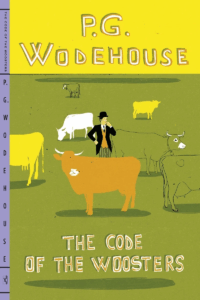
P.G. Wodehouse, The Code of the Woosters
One doesn’t turn to Wodehouse for unflinching satire, politically correct views, or even reality. Set in a perpetually sunny, idealized England vaguely between the wars, The Code of the Woosters concerns the misadventures of man-about-town Bertie Wooster (stupid, amiable, rich) and his impeccably helpful valet Jeeves. Ordered by his Aunt Dahlia to retrieve an eighteenth-century silver cow creamer, Bertie finds himself entangled in a clockwork plot, brilliantly conceived but too lunatic to summarize. Believing Bertie incapable of recovering the creamer alone, and finding she needs it sooner rather than later, Aunt Dahlia crashes the party at a country house and goads her nephew into further boldness. As biographer Robert McCrum remarked, “Girls in Wodehouse are essentially characters from musical theater. Always decorative, often fatal, they are there to complicate the life of the Wodehouse male, whose job, in turn, is to avoid being lured into the snares of matrimony.”
The “surging sea of aunts” in Wodehouse might seem not much better, but Aunt Dahlia is a perfect delight: bossy, blunt, always up for a brandy. Intent on recovering the creamer for her collector husband, she is indifferent to the charm of other people’s collectibles and remorselessly smashes her host’s terra-cotta figurine simply to relieve a mood. Readers of other Wodehouse novels will recall his Aunt Agatha, “who eats broken bottles and wears barbed wire next to the skin.” Bertie’s world is ruled by aunts, women whose sentimental bonds never prevent them from naming him as a “vapid and frivolous wastrel.” During family crises, when “Aunt is calling to Aunt like mastodons bellowing across primeval swamps,” Bertie tries to side-step the clan, but the tide of aunts always overpowers, knocking him off his feet and pulling him under.
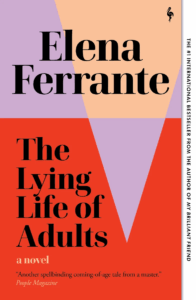
Elena Ferrante, The Lying Life of Adults
The Lying Life of Adults begins when a sixteen-year-old girl overhears her father say she’s becoming ugly. What he specifically says is, Giovanna is “getting the face of Vittoria,” his estranged sister whom Giovanna has never met, even though they all live in Naples. Giovanna is an only child, and her aunt has been erased from her parents’ seemingly tidy, intellectual life. Her parents don’t talk to Vittoria and have inked her face out of photographs in the family album.
Wounded, confused, and armed with a teenager’s rapacious curiosity to learn who she is and who she might become, Giovanna sets out on a quest to meet her aunt. The journey takes her from her upper-class neighborhood on a hill down to the working class “Industrial Zone” where her father was born. There she meets Vittoria, a shape-shifter figure (is she even ugly? Possibly is she beautiful?) who welcomes her into her squalid apartment by saying, “if you call me aunt again, you’d better turn right around and get out of here.” Vittoria is the first adult to speak frankly to Giovanna about sex and family. Which isn’t to say that her stories are true.
As Giovanna becomes obsessed with Vittoria, her life begins to spiral. Ultimately Giovanna learns that, to a certain degree, all of the adults in her life are lying—to themselves as well as others. For those who love The Days of Abandonment or the Neapolitan Quartet, The Lying Life of Adults may feel like familiar territory, but it’s set in the 90’s, narrated by an unreliable teenage girl and features a vibrant, unsettling aunt who sometimes seems undomesticated and free, and others times downright deranged.
__________________________________

The Hitch by Sara Levine is available from Roxane Gay Books, an imprint of Grove Press, a division of Grove Atlantic.

