Rock climbing, the niche sport where people scramble up jagged cliff faces and large stones using only the tips of their fingers and toes, is, improbably, having a moment. Dedicated gyms are mushrooming up in stripmalls, warehouses, converted churches, and oversized basements. Pretty much every major city now has a veritable buffet of options for the amateur climber to train and dream of traveling to cliffs in Yosemite, in Arco, in Flatanger. The ultimate stamp of approval came six years ago when the sport was inaugurated into the Olympics. And just last week, one of the popular faces of climbing scaled a Taiwanese skyscraper in a death-defying, ropeless feat, livestreamed on Netflix. Thankfully, Alex Honnold didn’t fall.
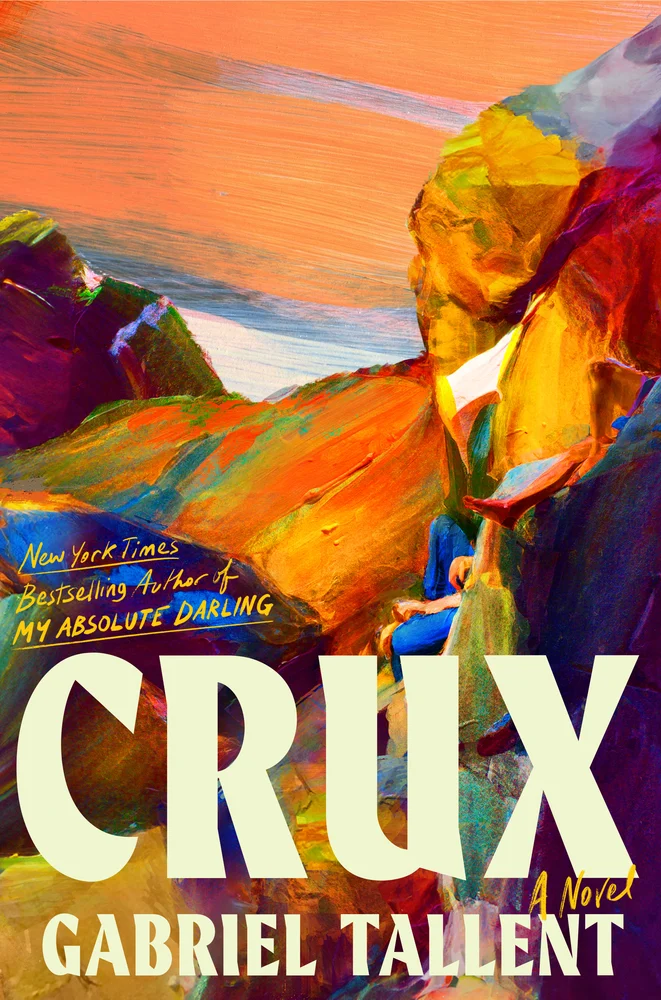
Into this chaotic, churning landscape Gabriel Tallent has landed with what is, to my knowledge, the first climbing novel in this new era of the sport. Crux, which is climbing speak for the hardest part of a particular route, is the story of Dan and Tamma, two outcast high schoolers living the Mojave Desert and doing their best to finish school, escape toxic home lives, and keep each other alive. On weekends, at night, whenever they have access to a car, they go into the desert to climb in the most brutal, unsafe conditions because they don’t know any better, and don’t have any money anyways.
But let’s not pigeon-hole Crux. Yes, it turns a sport many people don’t understand into the stuff of riveting high drama, but more than that, it’s a tremendous novel about friendship, family, community, and what it takes to make room for yourself in a world that doesn’t have room for you. Tamma and Dan’s story is about finding paths in a landscape and a life where paths don’t seem to exist. It’s about how we make decisions when there are no good decisions to be made. And it’s about realizing what we truly care about, and then caring deeply enough to not let go, even when it’s impossibly hard. Crux is a big, ambitious book that manages to blend the hard stuff with the wild humor of characters who say things like: “there’s just fundamentally not enough rat shit to be worth your time.”
Gabriel graciously met me via Zoom to talk about climbing, writing, and all the nitty gritty things in between that fed into his sophomore novel.
Willem Marx: Haruki Murakami talks about his daily routine: He writes for four hours, runs 10 kilometers, and somehow that fits together as a life, being a runner and a writer. How does rock climbing fit into your life as a writer?
Gabriel Tallent: It doesn’t fit at all. It’s in total tension. They’re both pastimes that soak up as much time and love as they can. They are not a good compliment.
I stupidly thought that to write a climbing book, one of the most important things was to get extremely strong. It didn’t help. I was working out four hours a day, five days a week, and you can’t sustain that when something happens in your personal life. You can do two things, right? You can have your family and you can climb, or you can have your family and you can write. So, I haven’t gotten back to climbing the way I was when I wrote the book just because of [the birth of my twins] Milo and Kobe.
I also weightlift and that fits much better. I’ll write from nine until one and then lift for an hour, and solve a lot of the problems like that. Climbing is totally different. I’m a terrible climber, so while I’m climbing, I’m just trying not to die. It demands my full attention, which is rewarding in the same way writing is rewarding, but not complimentary.
WM: Thinking about it separately then, what is climbing to you?
GT: I love going out and having adventures. This has always been part of my life. As a young person, I was in the outdoors a lot. So, leaving school, I was like, what the fuck do I do? I was studying cultural history of the 18th century in university and passionate about it and people were like, “You should pursue this.” But there was a part of me that had been abandoned. I wanted to return to that adventuresome part, to the something that was missing. That is what climbing is in my life. It is this outlet for adventure and excitement and to learn more about myself. It’s sort of always what I wanted to do. I always want to be out in the backcountry, seeing new places, and climbing gives that to me. It makes my life rewarding. It isn’t a good fit with writing, but it fulfills a fundamental thing that I want in my life.
WM: Is that a similar impulse to the impulse to write? Do they come from a similar place?
GT: Yeah, I think so. There’s a twist to it, which is that when you’re writing, you’re trying to put down the lesson—a lot of times, what I want when I’m writing is I have some insight and want to put it down on paper. I want it to be legible to another person.
But you’re also filling out the idea, learning more about it, experimenting with it. And that’s kind of what you’re doing as a climber. As a climber, you train, you work on yourself, and then you go out and you climb some big objective. It’s sort of the test of a theory of yourself. It stress tests the person you want to be.
Novels are like a portable wilderness. They’re a wilderness that you have in your pocket—you open it up and you are in some ways on an adventure. Climbing is an adventure in a parallel, though not identical way.
WM: In writing Crux, did the climbing come first, like, I’m going to write about climbing, and then a story comes? Or was it more complicated?
GT: It was horrible. I’ve always wanted to write a novel about climbing and after My Absolute Darling, I undertook to write a giant climbing book. And it was muddled. I didn’t have my story straight, I didn’t understand what the heart of it was. I wrote this huge, 800-page book . . . and it was too much climbing. Climbers complete an objective and then they want the next objective. But when you’re reading that, you don’t care about the third big objective. That, as a story, doesn’t work. So, I set it down and wrote another book about cardiothoracic nursing. Then my editor was like, “What the fuck is this?”
Novels are like a portable wilderness.
And then Hayden was born. When I was going to have a kid, all these writers were like, “You can’t have a kid,” “Every kid takes one novel,” or “Love means nothing compared to novels,” you know? And then I was talking to Benjamin Whitmer, and he was like, “You’ll hold a baby in your hand and you’ll look down and realize what love is. You’ll love him more than you’ve loved anything else in your life, and it will be a transformative moment.” And Benjamin Whitmer, alone of all those people, was right. He was the only person who didn’t pit love and your life against your writing.
[Having a kid] changed how I thought about what a life means. I was thinking about how to articulate what is important in life, and it wasn’t what grade you climb, it wasn’t whether or not you ever climb Fallen Arches. You don’t hold a baby and think, God, I’ll love him one day if he climbs 5.10. That’s not it!
I went back to basics. I was like, what matters about climbing? You can do that and slide into nihilism, right? Because you could be like, “It doesn’t matter what grade you climb . . . maybe climbing doesn’t matter at all.” But that isn’t how I feel. And so, where does the meaning lie? I went back to my gigantic novel, and in it I had this little flashback to the moment before the characters were epic, hard-sending climbers climbing at the limit of the sport. They were just idiot kids climbing sketchy boulders in Joshua Tree without any idea of what to do, and I was like, I’m going to make that the book. Because that’s where I can make the meaning most legible.
WM: I found it interesting that Crux actually doesn’t have romantic love. It centers a friendship, which gives a different tone to the emotions and desires and strivings of the characters. How did you come to make the book about friendship while avoiding romantic love?
GT: Friendship is so central and important in our lives, and it feels underexplored in literature and culture. My climbing life has been defined by great friendships. You go out and you’re hazarding your life with some guy. That strikes me as extraordinary and important in a way that enriches our lives. Collapsing everything to romantic relationships and to nuclear families can have this very isolating effect on ourselves and on our communities.
And I feel like it ups the stakes. We have narratives about risking everything for romantic love and there’s a sort of a knee-jerk way you can think that is a good thing in an unconsidered way. If Dan and Tamma are in love with each other, then the cultural narrative enfranchises the perspective that you should risk everything for this person. But risking everything to undertake something with a friend is a trickier proposition. Also, romantic relationships collapse the logic of things—if you’re doing something for your romantic partner, you’re kind of doing it for yourself too. Doing something for a friend has more of a reckoning with the importance of other lives even if they don’t necessarily owe us anything.
WM: There are a lot of climbing terms and ideas that run through the book—”exposure,” especially, gets woven in as a theme. But what stood out to me is the way you enter the story as an authorial voice to introduce and define climbing language. What was the thinking behind this way of being in the story and handling the terminology?
GT: Well, you try a bunch of different things. How I articulated the problem was, there’s the Hemingway method, like The Sun Also Rises—a novel about bullfighting, where bullfighting is not, for the most part, explained. It’s narrated, beat by beat action, and Hemingway does it in a marvelous, careful way, so you feel like you get it. Then there’s the Melville strategy, where you vamp and explain and elaborate.
Collapsing everything to romantic relationships and to nuclear families can have this very isolating effect.
I don’t think I ever committed to a path [between Hemingway and Melville]. I chose somewhere in the middle because I don’t have a 50-page section about the importance of different ropes, which would be cool. I didn’t go full Melville, but I felt very willing to explain because I just wanted everyone to understand [and] to feel welcomed into the world without watering down its wonder.
WM: That makes me think of this idea of sharing insights or morals with a reader, because I did feel your presence in the book. I felt that there was a person who could step in and sincerely explain something to me. Somehow, that gave weight to the book.
GT: It’s trickier than morals. I do care about things, I do have an argument, but a lot of the things that you would want to explain to someone are killed by saying them. They mean nothing. But if you tell the story, it becomes communicable. I guess what I’m trying to do is create an experience that you can undertake. I’m trying to have a conversation; I’m not trying to tell you something.
WM: I like how you say, “I do care,” because that’s what comes through—this sense of care, this sense of presence and generosity.
GT: I started writing to keep my friends alive. My friends were committing suicide, that’s why I wrote My Absolute Darling, and that has carried down. You are writing for people in trouble. You want people to have a good fucking time, but essentially, there are people out there who are in crisis in their lives, and you want to write a book that takes that seriously.
WM: Tamma and Dan both come to climbing from very bad family situations and in a lot of ways it becomes an escape. But over the course of the book, we see their relationships to climbing, and to themselves, diverge—Tamma approaches a more fruitful place while Dan becomes destructive.
GT: They both go through crucibles. Tamma comes out the other side with some fundamental realizations about her life, how she’s going to undertake things. Dan gets stressed out and panicked about his life. He’s alone and loses sight of what matters. He’s falling apart and undergoing the onset of a major mental illness. But he could ruin his life doing anything, right?
The book is a lot about making choices. I think that works well with climbing because you’re making choices under tremendous duress. Which is an interesting fictional and human problem. Dan comes to this crux in his life and fundamentally doesn’t want to make the decision. He wants to put the decision on something else like, “If I can climb this climb . . .” When we make climbs other than they are, it becomes a wonderful opportunity to die. As soon as the climb stops just being a climb and becomes some testament to who you are, then things have gotten more dangerous. I see people do that with writing, and all of a sudden, you’re fucked up about it.
WM: At a sentence level, you write in these long, rhythmic, lyrical sentences. Sometimes it feels acrobatic, and it’s extremely recognizable. Does that style come in revision and rewriting? Or is it just how the language comes out?
When we make climbs other than they are, it becomes a wonderful opportunity to die.
GT: Who is it that said all style is just imperfection in your communication? I don’t know that it’s something I am trying for as much as much as it’s a fucked up way my weird brain works that I can’t help. The things that I am trying for are clarity and to chase an emotion. I’m always trying to get closer and closer to exactly how something feels. I don’t know that I’m like trying to create a specific style. I feel that it’s accident—something I can’t help about the writing. I’m trying for, and not achieving, transparency.
WM: Another thing that stands out in your writing is how much dialogue you use. It’s everywhere in Crux. There’s one moment when Tamma is talking about how much she loves climbing through bat shit, and says: “Wake up and smell the hantavirus, BITCHES!” I was laughing out loud.
GT: I write hundreds of pages of dialogue and then cut it down to the best. I’ll spend all day writing dialogue and then cut it down to an eight-page chapter. I write an enormous amount of it to catch the rhythm, the best things. Then stop, do like five sets of twelve deadlifts, and the whole time in your head you’re just trying to catch some character.
You’re trying to show something, like: In this chapter I need to show how much Dan and Tamma need each other, almost a certain asymmetry, which is that Dan is willing to die and Tamma is not willing for him to die. You chase that with dialogue, and you try to get funnier, and funnier, and funnier and then cut out all the stuff you don’t need. The primary way that I access the characters is hearing them talk, so I really lean on that.
WM: Reading Crux, I had the old phrase “Great American Novel” popping into my mind. It’s about America in a lot of ways—about who we are, who we were, who we could be. All those themes are there. Do you see the book in that kind of lineage?
GT: I do think a lot about America. To me, America appears to be in crisis. I move in very liberal circles, but for a very long time people have been like, “America is not special.” There’s a sort of anti-American, politically left, progressive discourse that attacks the specialness and the centrality of our institutions. I hate that. I don’t want to lean too much on it, because every country is fucking special, right? But you also have to fucking love your country or it doesn’t work. It is a dream, and only so long as we hold tight to the dream of it does it become a place that it is inhabitable. So, I don’t know that I’m trying to write an American novel, but I am obsessed with the problem.
Not everywhere in the world is doing great, and states fail, right? If we cease to believe, we can lose it. I’m writing about that.
The post A Rock Climbing Novel That Rewrites the Story of the Sport appeared first on Electric Literature.