None of this is supposed to be easy. Not writing, not life, not love.
Louise Glück’s debut, Firstborn, was published in 1968. One poem that didn’t make the cut was “The House on Marshland.” Glück said it was “terrible.” She grew up in Woodmere, Long Island, and wanted to write about her “marshy” surroundings. She had an idea: “The knowledge that houses, these structures which are supposed to be consoling and stable, were being built on land that was itself profoundly unreliable seemed to me very moving.” It should have been a good poem.
“I tried to write this poem over and over and over again.” She thought the poem “should be large and important,” and perhaps that ambition stifled her. She put aside the poem, but was haunted by the idea.
Then, in the spring of 1971, she started drafting a new poem. The first few lines “came intact and perfect.” Yet she struggled with the rest, and spent that summer “absolutely obsessed” with those lines of the poem, and could write “nothing else.” Each morning she woke and “heard” those lines. Only in late autumn of that year did she realize that she might use the detritus of her drafts for “The House on Marshland” for this new poem, “To My Mother.”
While it’s easy to fetishize the trope of the struggling artist, art results from failure overcome by determination.
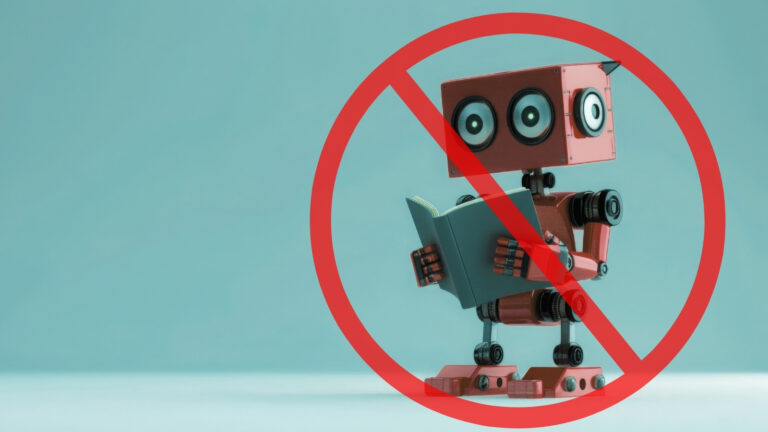
The poem was the point, yes, but perhaps the struggle was also the point. When we create, we are deeply human. The emergence and evolution of generative AI is a threat to creativity. It is a threat to humanity.
*
Artistic ego is the best chance we have of battling against the rise of AI in creative spaces. When we write something and decide to share it with others, we are affirming the worth of our own words, which is an action of the ego. Although that art might be kenotic in nature, steeped in humility or in the passion to do good, we are also affirming that our voice is worth the time and attention of others.
Great art is impossible without some measure of ego.
Most writers, I think, are imperfect people like us. We can forgive them certain foibles and sins (as we might wish for similar grace ourselves) and recognize that their actions of ego are in service of a greater good; a collective catharsis. All of this is slow, mysterious work: the type of gestation that makes art.
AI tools like Sudowrite, Novelcrafter, and Squibler promise full-length books in minutes—or seconds. AI-produced books have begun to flood Amazon, and range from kids and coloring books to derivative novels and faux biographies repurposed from Wikipedia pages. It’s a mess, and it is only going to get worse.
One AI service claims users “can streamline the book creation process, from conception to publication, making it easier to bring your ideas to life and share them with the world.” Such rhetoric is gentle, inclusive, and misleading. Great art isn’t supposed to be easy. While it’s easy to fetishize the trope of the struggling artist, art results from failure overcome by determination. The artistic ego, in asserting itself, is a human action. When we cede creation to the machine, we are not making art.
Reddit posts abound in which people turn to AI to ease their writer’s block, as if it is a temporary inconvenience. The struggle, in fact, feeds the art. Joy Williams once wrote of Jane Bowles: “Each word is built, each step painful, each transition a rope bridge thrown over a chasm. She makes it look as hard as it is.” Williams could feel Bowles’s struggle, but it was a furnace of her creation. Reading Bowles, Williams concluded, “I am always enchanted and unnerved, a little sick, actually, with love for her gloomy waterfalls, her morbid gazebos, her ghastly picnics, her serious ladies and frail whores—her tortured, awkward, groping, uncompleted souls.”
There’s something powerful about the artistic ego; the stubborn belief that we—despite our cosmic insignificance—can create something original that makes others laugh, cry, and think.
In 1962, Tillie Olsen gave a largely extemporaneous talk at Harvard’s Radcliffe Institute. Although she revised the taped transcription into an essay that later appeared in Harper’s, her talk on silence is rangy and raw. “Substantial creative work demands time,” she claimed, and lamented how often women, their lives devoted elsewhere and to others, were consigned to “atrophy; unfinished work; minor effort and accomplishment; silences.”
Olsen also documents the “toil” inherent in great art. My favorite is the testimony she shares of Honoré de Balzac:
To pass from conception to execution, to produce, to bring the idea to birth, to raise the child laboriously from infancy, to put it nightly to sleep surfeited, to kiss it in the mornings with the hungry heart of a mother, to clean it, to clothe it fifty times over in new garments which it tears and casts away, and yet not revolt against the trials of this agitated life—this unwearying maternal love, this habit of creation—this is execution and its toils.
You may think, like Henry James, that Balzac sounds like “a Benedictine monk leading his life within the four walls of his convent.” Perhaps he was. James admired Balzac, for
his subject of illumination was the legends not merely of the saints, but of the much more numerous uncanonized strugglers and sinners, an acquaintance with whose attributes was not all to be gathered in the place of piety itself; not even from the faintest ink of old records, the mild lips of old brothers, or the painted glass of church windows.
Balzac transcended his room, his mind, through the difficult work of his art.
In 1904, the poet Rainer Maria Rilke wrote to a younger writer that “it is clear that we must hold to what is difficult; everything alive holds to it.” He said that “everything serious is difficult, and everything is serious.” In his 1950 Nobel Prize speech, William Faulkner lamented how younger writers of his time were (understandably) worried: “When will I be blown up?” They didn’t have access to AI, of course, but they had other distractions, and Faulkner worried that their art was missing “the old universal truths lacking which any story is ephemeral and doomed—love and honor and pity and pride and compassion and sacrifice.”
Being a good artist is no excuse for being a bad person. Faulkner’s genius doesn’t erase his vices. But there’s something powerful about the artistic ego; the stubborn belief that we—despite our cosmic insignificance—can create something original that makes others laugh, cry, and think. “I don’t think poetry is going to make anyone a better person, and it is not going to save you,” Rita Dove said in an interview. “But writing is a constant for me. There’s an edge that needs to be explored, the edge between being unconscious and then suddenly being so aware that the skin tingles.”
I have felt that electricity. It requires work, and patience, but what a glory when the words sing. “There is that moment in the writing of a poem when things start to come together, coalesce into a discovery.” It is not mere understanding, for “the more I write the less I know of myself.” Yet Dove affirms that “territory is being covered—excursions into the interior.” Art begins with “intimate revelation,” which must then be made “visible—palpable—for others.”
We owe it to ourselves, to our children, and to those who come after them—God willing—to write ourselves into eternity. AI is making most things easier, but not better; art can be our last refuge, a way to affirm that our humanity matters.

