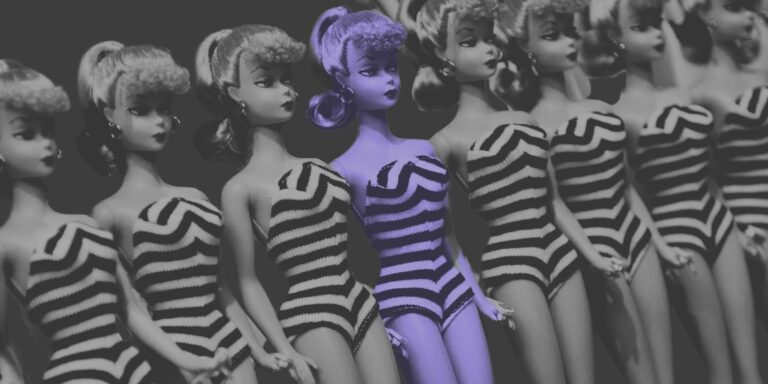
It was easy for toy magnate Louis Marx to picture Barbie’s downfall. He’d orchestrated many a toy’s obsolescence. How many times had he seen a solid product, remade it in cheaper plastic, using cheaper labor, and sold his own for less? “He was the big bully on the block,” Hot Wheels designer Fred Adickes once said. “He’d go to a toy fair, see what was there, and he’d knock it off quickly.” There was a reason all his friends were generals and baseball players and not designers or inventors. “He made very few friends in the toy industry,” a British toy executive remembered. “He always believed that if he got friendly with his competitors he couldn’t knock off their products.”
Barbie was a particular sore spot for Marx. He had been making tens of millions before rival toy company Mattel even launched their first toy. He had been on the cover of Time magazine only a few years before, in 1955. It was, by Barbie creator Ruth Handler’s own admission, “unthinkable” that Mattel would ever catch up. But something had changed. “We were on our way up into the hundreds of millions, and he was standing still or doing less,” Ruth said. The Handlers had gotten “the taste of growth, success,” she confessed. “We felt we could do no wrong.”
Now Marx was the one who felt ripped off. He told colleagues that he—not Reinhard Beuthien or Rolf Hausser or Ruth Handler—was the one who first thought up Barbie. In the 1950s, the story went, he had run into the Handlers on the Queen Mary, the same ocean liner they took to Europe. One night after dinner, Marx found himself chatting with the couple, talking over the Nuremberg Toy Fair, where all three were headed. Marx’s reputation preceded him, the toy maker would say, and the Handlers wanted advice on how to pick a “red hot hit,” as he’d done so many times. Marx supposedly mulled, crunching the numbers, running down trends. “A doll,” he offered. “The world is ready for a pretty girl doll.”
Ruth would have guessed the subtext: that not all of those “imitations” were “unauthorized” because it was Marx who was making them. And he was planning to make more.
If Marx believed the world was ready for an adult-looking doll, he hadn’t yet bothered to make one himself. But over in Germany, the Haussers certainly had. When Barbie debuted on the American market in March of 1959, Lilli had been circulating Europe for nearly four years. The Haussers had been planning to bring her to America: they’d applied for a U.S. patent a year after she launched. But unbeknownst to the Germans, their international plan had been usurped. The machinations of American bureaucracy were too slow to keep up. As the Haussers’ patent inched along toward approval, the Handlers had forged ahead without one. By the time the Haussers got their patent in February of 1960, Mattel had sold nearly $1.5 million worth of Barbies her first year alone.
The Haussers had not yet heard of Barbie. They found out their doll had been copied soon after—from Louis Marx. The toy king saw that the patent gave the Haussers an opening, albeit an imperfect one. It did not cover the full Bild Lilli design; just the mechanism that allowed her legs to move forward and backward, “simulating human walking movements.” But Marx suggested he could use it to challenge Mattel’s right to make Barbie. The Haussers listened. In May of 1960, their lawyers reached out to Mattel about the twin dolls. But the Handlers were in no rush to respond. They had since filed for their own patent, signed by Jack Ryan, though it wouldn’t be approved for more than a year. Why pay for this foreign doll—foreign hip joint really—when they were already making millions without it?
The Haussers were more pressed for time. Convincing Barbie knockoffs, and by extension Bild Lilli knockoffs, were already being made in Hong Kong. That June, Marx and his wife met the Haussers in Germany, laying out a contract to last for ten years. Marx would get the exclusive rights to sell Bild Lilli in America, Britain, Canada, and Hong Kong. He could call her something more American, or at least less German. In exchange, he would pay the Haussers $3,000 and a licensing fee for each doll sold.
After the deal was finalized on July 4, Marx owned Lilli’s likeness in the United States, and by extension, arguably, Barbie’s. The partners implied as much to Mattel’s American contacts, warning wholesalers and distributors that Marx owned the Bild Lilli license and suggesting that this new hit doll was not the Handlers’ invention, but was stolen from abroad. The Hausser firm “is now conducting a campaign of harassment and intimidation,” the Handlers in turn complained, pestering their clients about something so inconsequential as a patent. One buyer forwarded Marx’s letter to Mattel. “I would guess that the enclosed letter was sent to hundreds of accounts in the United States,” the buyer wrote. “I don’t know all the facts in this case, but I would assume that some action must be considered to stop the importation and sale of the Barbie doll.”
Suddenly, the Handlers seemed much more interested in Bild Lilli’s patent. That September, one of Mattel’s German associates contacted the Haussers about making a deal. But now it was Marx who owned the exclusive rights; Mattel would have to go through him. It’s not hard to imagine how this news hit the Handlers: their longtime rival coming into a legal claim on their most popular product. Ruth must have understood Marx’s not-so-veiled threat: “It would seem advantageous to settle the matter promptly,” the lawyers wrote, “in view of the many unauthorized imitations already started in Hong Kong and elsewhere, and which may soon flood this country in great quantity if the Hausser patent is not respected.”
Ruth would have guessed the subtext: that not all of those “imitations” were “unauthorized” because it was Marx who was making them. And he was planning to make more.
*
Marx delivered on the promise: he started selling Lillis that fall. He didn’t stop with the original. He flooded the market with Lilli dupes, made for cheap in Hong Kong. “Bonnie” was a Lilli clone with Barbie’s proportions; she could borrow her clothes. “Miss Marlene” resembled Barbie but in the smaller Lilli’s size, sporting a similar blonde hairstyle, with a pointed widow’s peak. And then there was “Miss Seventeen,” a beauty queen who came with a crown and red cape. At around fifteen inches, she towered over the other dolls even in flat feet.
The savvy collector could easily distinguish these dolls from Barbie: Miss Seventeen was taller, Miss Marlene was shorter. Their faces were painted by different hands. Some had thinner eyes, or wider noses, or varying amounts of makeup. The hostile circumstances in which Marx made his imitations led some to see his dolls as symbols of depravity. (“If Barbie was tawdry, Miss Seventeen was downright mangy,” M. G. Lord wrote in her history Forever Barbie, “as slutty as Lilli, but not nearly so healthy”—her skin “jaundiced,” her eyes unfocused, “as if bleary from drugs.”) But the similarities overwhelmed the minor variations. To the untrained eye, Barbie, Lilli, Bonnie, whatever—they were essentially the same girl.
Marx wasn’t the only toy maker who tried to replicate Barbie’s success. Ideal Toy Company’s Mitzi turned into Tammy, who spawned Misty, Pepper, and Samantha. Eegee’s Babette became Miss Babette, who begat Annette. Larami Corp. put out Janie, while Elite Creations Inc. threw in Bonnie and Wendy. At least three Hong Kong firms put out Lilli clones, and another four made more in Japan. And yet Marx remained Mattel’s toughest competition—“not because she was captivating,” Lord argued, “but because she didn’t fight fair.”
Was Marx’s approach any less fair than Mattel’s? The Handlers hadn’t bothered with the Haussers’ rights at all. Marx had gone through the legal channels. He had a license, good for ten years. It’s true that Marx had no delusions that customers would care, that they would gravitate toward the legal owner on principle. His deal with the Haussers had planned for contingencies. In addition to Lilli’s likeness, the contract also granted Marx the right to defend it from copycats. The partners clearly had one offender in mind. “It is known that the patent infringements have been committed by Matell Inc. [sic],” the agreement read. “If a lawsuit should become necessary,” Marx and the Haussers would split the proceeds in half.
A lawsuit soon became necessary. Or rather, multiple lawsuits. In early 1961, the quasi-identical dolls went to court. Mattel and Marx seemed to have decided on legal action at precisely the same time. On March 23, Marx got served at his office in Toy Center; Mattel was suing him in New York. The next day, Marx and the Haussers filed their own suit in Los Angeles. The cases got complicated quickly: Marx countersued Mattel in New York, while Mattel countersued in Los Angeles, alleging that Marx had not only ripped off Barbie, but that he had ripped off their Burp Gun too. Claims and counterclaims and various legal motions piled up on both coasts, but the core dispute remained, more or less, constant.
As Marx saw it, Barbie was obviously a “direct take-off ” of Lilli—the “design, posture, facial expression,” and the “overall attractive and distinctive appearance” made Barbie, beyond a shadow of a doubt, a flagrant “copy.” Mattel had “willfully, knowingly and deliberately” infringed upon Lilli’s patent and falsely advertised the doll as their own. In so doing, Marx alleged, Mattel had committed a “fraud and a hoax upon the public.”
The Barbie defenders disagreed. The Haussers’ patent wasn’t even valid, Mattel argued, because it “failed” to describe “anything which was not already within the public domain.” The doll construction described in the patent was, apparently, not original at all. Contra Ruth’s story about the radical novelty of Barbie’s adult body, this silhouette was actually widespread, “common knowledge” already described in no fewer than nineteen other patents, so widely disseminated that it made one wonder what Barbie’s innovation really was. As they told it, Barbie had not even been inspired by her German doppelganger. Ruth’s real muse had been a book on wooden dolls from nineteenth-century Vermont.
If anything, Mattel claimed, it was their opponents who were playing dirty. It was Marx and the Haussers who were “aiding and abetting one another,” who had lied their way into legal ownership. (The “lie,” Mattel later claimed, was based on an unsubstantiated tip that Rolf Hausser had known about a similar patent before getting his own, “but concealed it from the Patent Office.”) It was the Lilli camp who had intimidated their customers and threatened them with lawsuits; who had “conspired” to market an “inferior doll” of “confusingly similar appearance” and leech off Barbie’s big name. Marx and the Haussers had “subtly manipulated and contrived to compete unfairly,” the Handlers’ lawyers wrote. They had tried “to confuse and mislead” the public by hawking “imitations” and passing them off as Barbie.
The war dragged on for nearly two years, neither side ceding ground. But in the early months of 1963, both sides unceremoniously surrendered. The cases were dismissed on all claims, with prejudice. “This was legal jargon for ‘A pox on both your houses,’” Lord wrote. Though in truth, Marx and Mattel had quietly reached an out of court settlement. Mattel had agreed to sublicense the Bild Lilli patent for just $2,000 a year—a fraction of what Barbie made in a month.
Marx had been, on a basic level, outgunned. Patent law, in the American mid-century, was less sympathetic to inventors than it would one day become. And Mattel understood that Barbie was bigger than any one part, that legal ownership was almost immaterial to the conversation. Americans now associated those same shapes and curves with a single commercial source. When Barbie debuted, Mattel had plastered ABC, an ad partner with commercials from coast to coast. They had spent almost as much on TV advertising that year as they’d made in Barbie sales. More than any other children’s product before or since, Mattel’s own ad agent wrote, “the Barbie doll is testimony to the influence of television advertising on children.”
*
The following winter, Rolf Hausser got a call from an associate of Mattel. The company was now, apparently, interested in acquiring the worldwide rights to the Lilli doll. While Rolf chatted through the terms, he probably didn’t recognize the man on the other end of the line. But they’d done business before, if through a subsidiary. The Mattel man arranging the deal was Paul Guggenheim, the Swiss dealer who’d sold Bild Lillis in the States.
Owning the rights to the German doll gave Mattel multiple advantages. It protected their ability to reproduce Lilli unimpeded. It also gave them the power to ensure few else did.
In February of 1964, four Mattel employees arrived at the Haussers’ office in Germany. One of them was Guggenheim. Another was Mattel’s general counsel, R. Kenton Musgrave, a former lawyer for Lockheed Aircraft. Over the course of a week, they negotiated a contract that would grant Mattel the rights to the doll—her patents, trademarks, copyright, and the Lilli brand itself in all but four countries granted to Marx. Once the contract was signed, the Haussers would be barred from ever producing the doll again. They would also surrender any claim to her name. For all this, the Haussers would walk away with four lump-sum payments totaling 100,000 deutsche marks, 15,000 of which went to Axel Springer, and another 15,000 of which wouldn’t arrive until Marx’s license expired in 1970. The Haussers would take home about $21,600. Basically pennies for Mattel, which just weeks earlier, had announced sales of more than $85 million over the prior nine months. But Rolf, he admitted later, had only a loose grasp of Mattel’s profitability.
He finished negotiating the deal at the Frankfurt airport and signed it that Valentine’s Day, officially waiving any claim to Barbie. The contract was the beginning of the end of the Hausser empire; the company filed for bankruptcy in 1983, and for years after the fact, Rolf Hausser would regret the day he ever signed it. He would spend the last years of his life writing Ruth long, single-spaced letters, wavering between morose pleas for recognition and bitter rants against the “evil role Mattel played” in stealing “millions of dollars” by copying Bild Lilli. In one letter, he compared Mattel to Serbian authoritarian and war criminal Slobodan Milošević.
In the end, Rolf ’s only victory was his story. He had wondered many times whether his version of events would ever reach the press. And by the nineties, it had. The critic M. G. Lord dug into Lilli in her book, Forever Barbie, which came out in 1994. And Ruth Handler told her own version of the story in her own memoir, Dream Doll, which she released, in an expert maneuver of narrative control, the very same year as Lord’s. But few books or outlets have investigated very deeply into Bild Lilli’s backstory, aside from her then-known link to Barbie. And perhaps for a reason. Owning the rights to the German doll gave Mattel multiple advantages. It protected their ability to reproduce Lilli unimpeded. It also gave them the power to ensure few else did.
Even after Lord’s book came out, investigations into Lilli had a habit of disappearing from the public record. A four-part series on the doll in Barbie Bazaar was abruptly cut short over what one coauthor described to me as “bad blood between Hausser and Mattel.” The final installation, though written in full, never ran. Stefanie Deutsche’s collector guide, Barbie: The First 30 Years, included a chapter on Lilli when it came out in 1996; by the second edition, the chapter had been removed. Around the same time, Miller’s, a homespun Barbie fan magazine run by a married couple in Washington published an interview with Rolf Hausser in what it promised to be a two-part series. The second part never came out either. Mattel sued the spouses for trademark infringement in federal court and won.
The German doll collector Silke Knaak encountered something similar only a few years later. In 2003, she wrote what was to be the most comprehensive history of the doll. She named the book something simple: Bild-Lilli. The editors didn’t think it would cause any problem. They would, of course, have to pay Mattel a small fee to use the trademarked name. “We have been successful in doing this on all our Barbie projects, which Mattel also owns rights to,” the American publisher wrote. “This is why [we] did not foresee any trouble with obtaining a license agreement to do your book.”
But when the publisher tried to get permission, Mattel refused. “I spoke with Mattel’s legal department today and they simply will not grant us permission,” the imprint told Knaak. “Without their permission, we are not willing to publish this book.” Knaak sat on the manuscript for over a decade, before releasing a different version herself, with a lighter focus on Lilli. She gave it a new, more anodyne, name: German Fashion Dolls of the Fifties and Sixties.
Marx, for his part, got somehow still less than the Haussers. Mattel continued to pay his licensing fee. He still had the American rights to Bild Lilli until 1970, and despite Mattel’s effort to persuade him to part with it, he would hold it until the day it expired. But the toy king had been deposed. The Louis Marx Company was sold to Quaker Oats just two years later and filed for bankruptcy shortly before the Haussers. Barbie, meanwhile, was ascendant. Not long after the settlement, an internal memo warned Ruth: “Talk from the Marx camp is that Louis Marx has declared war on Ruth Handler!” But it didn’t matter. He had already lost.
__________________________________
Excerpted from Barbieland: The Unauthorized History by Tarpley Hitt. Copyright © 2025 by Tarpley Hitt. Reprinted by permission of Atria/One Signal Publishers, a division of Simon & Schuster, LLC.

