During the spring of 2020, as the world locked down and people were dead and dying and breaking apart and mourning and afraid and hiding, the British author J.K. Rowling decided to publish an open letter about trans people. In brief, as wasn’t surprising: She doesn’t like us.
J.K. Rowling’s tendency to say transphobic stuff, especially on Twitter, had long been a concern to trans and gender-nonconforming people such as myself, perhaps especially to us sometime Harry Potter fans. But when she published that letter I realized the situation was no longer one I could ignore.
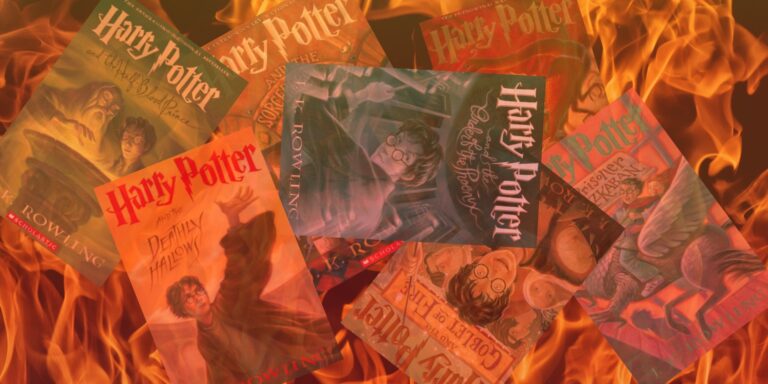
Here was an extremely wealthy and culturally powerful woman who, for some reason, insisted on making her bigoted views about people like me openly and widely known. And so, having long debated what to do about this situation, I dug a fire pit in my backyard and burned my complete set of hardcover Harry Potters.
The books were ones I had treasured since childhood. Throughout my young adulthood I’d lugged them around the country as I moved from city to city, apartment to apartment, until I finally settled here in rural upstate New York. I never reread Harry Potter but I always afforded them a large space on my crowded bookshelf, part of the careful selection of the children’s books I insisted on having with me.
I read that first Harry Potter book in a night, transfixed. I returned for the second and repeated this exercise.
It was late spring. The lawn was hard to dig into at first. My shovel kept hitting rocks and I ripped at clods of turf with my bare hands. I eventually dug a wide enough circle and set some stones around the perimeter. I balled up some newspaper, stacked kindling, and lit the fire. Darkness fell.
I picked up my first hardcover, The Sorcerer’s Stone. Inside the front cover of my Sorcerer’s Stone—as we American readers called it, the long-ago fan inside me still feels I should explain—I saw the sticker I’d affixed there as a kid. It said: ‘[my deadname]’s library’, with a picture of a cartoon cat.
I studied my young handwriting. I glanced once more at that name. I tossed the book onto the flames.
*
I often recall the moment—I was in sixth grade—when the librarian at the public library back in Marin first told me about Harry Potter. I loved that library, deep in the shade of redwoods, a creek running behind. I read nearly everything the children’s section had to offer. The librarian seemed surprised I’d not heard of Harry Potter. This was the late nineties and the second book in the series had just published or was soon publishing. The librarian handed me The Sorcerer’s Stone, her face alight.
I read that first Harry Potter book in a night, transfixed. I returned for the second and repeated this exercise. I often think of myself, a bookish lonely little trans boy living in my own version of a closet under the stairs. I think of myself being rescued, if only for a while, by Harry Potter.
As a kid, I wasn’t really a Harry, not externally, not according to everyone else at least. I was a Hermione. Like Hermione I was too smart for anyone’s liking, perpetually mocked, often alone. My family was going through something most others weren’t—on this basis I felt an outsider like her (for those who don’t know, her family are muggles, not wizards). I always felt an outsider. I made easier friends with teachers than other kids. Even other unpopular kids would abandon and pick on me occasionally, maybe to make a point.
I often thought of myself as a Matilda kind of kid back then (however much I wasn’t, for reasons I can now call “gender”). I loved Matilda. I loved all Roald Dahl, especially James and the Giant Peach and The BFG. I liked books about kids who got to escape their isolated everyday lives, their cruel or hard homes. I liked stories about kids who survived hardship, sometimes in the literal elements, stories about kids who struck out and lived on their own in the woods—The Boxcar Children, Hatchet, My Side of the Mountain.
Books gave me a sense that maybe there was something else out there. A whole other world that was both right here and all the time hidden from most everyone else.
I liked stories where children got to go to far off schools—like Sharon Creech’s Bloomability, which is about going to a boarding school in Switzerland. In early middle school, I remember campaigning half-heartedly for a while to attend a boarding school (somewhere? in Switzerland?)… a no doubt financially unimaginable notion nobody took seriously. How I envied what happens to Matilda at that story’s end, her mom and dad signing her emancipation papers without giving it a second thought (papers she had ready in her backpack). Believe me, this concept of child emancipation… I was intrigued.
As a child, I didn’t have a term like “domestic abuse” at my disposal—let alone the term nor really the concept “trans.” I had felt my indelible truth, my being actually a boy, since my earliest memories. Even as I also realized it was a then-unsayable truth. My hours at school were pretty tough (though the learning part I loved). My hours at home were often tougher. So I fled to other worlds. My homework was usually finished fast and I watched TV, whatever was on—we only had five channels out in my isolated beach-side village. Hence I read books for fun.
Books gave me a sense that maybe there was something else out there. A whole other world that was both right here and all the time hidden from most everyone else. Maybe an actual place one could go to find others like oneself, become powerful rather than isolated and destined to be forever sad.
Is it even remotely surprising I was an early adopter of Harry Potter?
*
Whenever a new Harry Potter published, I’d buy it immediately. I’d read it privately, often in a single gasp. I’d add it to my bookshelf’s growing section of such books, those American covers with their muted gemstone shades, a pleasure to hold in my young hands. Reading such increasingly long books also gave me a feeling of accomplishment. Harry and his friends in the series and I happened to be about the same age, those years Rowling was churning them out at a steady clip.
But as I remember, I didn’t discuss the books much with anyone back then. Maybe my nerdy best friend, until she abandoned me in seventh grade, taking our small and unpopular mutual friend group with her. Being into Harry Potter, back when it was first publishing, would have been horribly uncool, at my middle school at least. The sort of uncool even someone very uncool like me would have known enough to conceal—me who wore khakis and played oboe and had braces and yes for a phase had basically no friends.
A little after midnight, we bought the Harry Potter, a single copy to share. The kid in front of us was interviewed on the news in Slovenian, holding his Harry Potter, grinning.
Come high school, this one very unpopular girl gave a speech about how much Harry Potter meant to her, how the series had saved her life. I believe she cried and everyone laughed and laughed. No doubt I probably pretended I didn’t feel the same way as her back then—that I too read, even adored the series, that I totally got what she meant. I was silent about all my struggles then, as I’d been conditioned to be. And I was desperate, as a teen, just to fit in. By sixteen I started wearing a sort of woman-drag, however well, one I wouldn’t shed until I was about 30.
It privately surprised me when the books eventually became the phenomenon they did, which started happening when I was in late high school. More and more people started reading them—even adults, which at first amazed me.
The beginning of the series’ end, the sixth book, published the summer after I’d just graduated high school. I was in the Slovenian Alps, on a long train trip around Eastern Europe with my first boyfriend, the night it was released.
My boyfriend was by then also hooked on Harry Potter (as everyone on earth was, seemingly). We waited in line at the one bookstore in the capital city of Ljubljana, one braced to sell the book at midnight. We were second in said line, behind a bright-seeming kid, English fluent (obviously). This kid seemingly couldn’t believe who we were, Americans—Californians, no less! It was like we were telling him we were from a mystical far-off place, like we lived inside the Hollywood sign with Mickey Mouse and Dorothy. A little after midnight, we bought the Harry Potter, a single copy to share. The kid in front of us was interviewed on the news in Slovenian, holding his Harry Potter, grinning.
My boyfriend and I spent the next few days passing the book back and forth. I finished it on a topless beach by Lake Bled. I learned of Dumbledore’s death, tits out, weeping. My boyfriend was upset my reaction had spoiled it for him. We mostly drank and fought, by then.
A few weeks later I flew “back east”—as us Californians say—to college. My boyfriend and I spent my freshman year breaking up and drunkenly reconciling and then breaking up. Only then did I start to reckon with how much I didn’t know anything about life. Only then did I realize university wasn’t Hogwarts and that there wasn’t ever going to be some magic owl who was going to show up and save you.
*
You have to save yourself is the rotten truth nobody explains… except in books like Harry Potter—which got deeper and more serious as the series progressed, edging up to the reality that, hey, “adult” life is hard.
Specifically: Sometimes society itself is going to be overcome by forces of what we might call evil but which I think might be more accurately called wide-spread intolerance of some “Other,” and said intolerance, no matter how truly bullshit and just-a-moral-panic-it-is is probably going to cause lots of real-life misery and death for those on the less-powerful side of some random binary (muggle/wizard; cis/trans).
I’d often look at that Harry Potter blockade and wonder why I was clinging to them, especially if their author thought so little of my humanity.
In reality, the number one lesson of the Harry Potter series was, ironically: We’re all humans deserving of equal rights, even the “weirdest” amongst us, even those most discarded by our families and/or by society, even those who’ve been caught up in histories we ourselves don’t yet understand. We’re all people deserving of love and respect and dignity.
Gladly spoiling the entire thing for any non-fans reading: At the series’ beginning, Harry is a boy who’s living with his adoptive aunt and uncle after his parents’ untimely death. In truth, he’s a wizard, and a “chosen one” destined to fight an especially powerful but evil wizard. This evil wizard, it turns out, killed Harry’s parents and is, big picture, just a self-loathing guy who’s gotten really toxic and fascist about it. In the series’ end, Harry and his sometime school comrades and allied teachers and others, fight off said tormented self-loathing wizard as, simultaneously, fascistic muggles rise, opposing the mere existence of their kind. (Truly so familiar!)
Given that this is what the series is, I’d been pretty pissed off some years ago when I started picking up on J.K. Rowling’s transphobia. It at first felt ironic and surprising given her series’ appeal to queer and trans and gender-nonconforming people. Her views, expressed online, were puzzling to me at first. They struck me as both lacking in self-awareness and quite dangerous. I hoped she’d come around. I was then coming out as nonbinary and soon after trans in my late twenties and early thirties—during the end of Obama’s presidency and the beginning of Trump’s. This coincided with Rowling’s unabashed displays of hatred online.
What to do about this situation, I myself had not been sure. I was an adult and not especially “into” the series (as some adults are). I’d still comfort-binge the movies if they were marathoning on a hotel TV perhaps and I felt the right sort of depressed. But now I’d walk into my office and see her books there on my shelf—and feel sick about the whole situation.
As an author now, not just a reader, I bought books constantly, and so my bookshelf space had become prime real estate. I’d often look at that Harry Potter blockade and wonder why I was clinging to them, especially if their author thought so little of my humanity.
If anything she seemed to love the attention she received for performing hatred of… me—and it seemed to not tarnish her, which was dispiriting; not in what it said about Rowling, but what it says about everybody else and how little they think of me.
*
Perhaps I hung onto the books so long for mere nostalgia. Not that I’d ever re-read the series or be able to now without feeling anything but indignation and heartbreak. Or a sort of overwhelming impractical desire to sit down with J.K. Rowling and have a conversation like, truly, friend, what gives? Or to travel back in time to whenever Rowling was a little Harry under the stairs so to speak, see if I could have a conversation with that kid inside… (Or to other points of her life, given what I know of her now, her own history with domestic abuse.)
Cynically, one hopes Rowling realizes it’d be great for business, if she just surrendered. These days I do sense even cis people are pretty tired of her crap.
But regarding my own transness for example and how it alienated me: I used to wear a cloak of self-loathing (to borrow her image), one I hoped would make me invisible to everyone; maybe mostly myself. When I was that closeted, I possessed a hatred towards myself and also anybody else whose own transness or gender deviance might make me face that truth I was always avoiding.
What motivates a seemingly once-brilliant person who appeared to share my values (as an artist, a writer, a thinker), to double, triple down on intolerance? Then of course there are the likeminded so-called leaders who build brands off of persecuting trans kids (and adults), amongst other vulnerable minorities. That some bigoted “leaders” will literally sacrifice certain groups of seemingly less-powerful people for their own benefit isn’t itself surprising, if one has read history (or Harry Potter).
As another example, I’ve often contemplated those once-beloved comedians who are so apparently fixated on bullying trans people that they’re willing to sacrifice their careers to it. (Just the other night, I couldn’t make it more than a few seconds into the Eddie Murphy doc when I saw Chappelle and had to stop.)
I do (still) fantasize about Rowling one day just waking up and saying, Hey you know what? I was wrong and I’m sorry. I felt backed into a corner and it made me say some really terrible stuff. I hope I can work to learn better and to put my resources to good use.
Imagine how people would celebrate Harry Potter, if she just got real with us, said, whoops, mea culpa.
Cynically, one hopes she realizes it’d be great for business, if she just surrendered. These days I do sense even cis people are pretty tired of her crap. I read this summer about a bookstore back home in San Francisco that at long last stopped selling her titles, given she now publicly donates and coordinates anti-trans persecution campaigns. Given how much her evil’s already affected her country—and beyond.
*
The flames took a moment to catch my Sorcerer’s Stone, the fire working its way through the pages. I grabbed the next book. I threw it on. Only now I started worrying about the wind and the forest nearby, the one behind my own lone house here out here in the dark country night. I watched the burning paper dancing, nervous.
But I threw another book on. Now that I’d started I couldn’t stop. I watched as their lovely covers slowly warped and melted. Each book was longer than the last and took more time to burn. But I kept going. As the previous one turned to embers, I threw on another book.
True: I could have sold or given them away. I had fantasized often about doing such instead. I’d imagined, though, some unfortunate kid reading them. What if said kid came out as trans or queer someday and faced this same disappointment as me?. Or perhaps my inner child was indeed this upset.
I watched as my once beloved books blackened to nothing, and I wondered what I was doing even. I contemplated the black forest behind me, the orange fire, the earth.
I surely could have just thrown them out, it’s true. Why bother burning them? Why all the drama? I want to emphasize: I have two English degrees. I do not loathe books; if anything I respect books more than basically anything else. But I needed this burning to be the most defiant gesture I could conjure, author-to-author, nerd-to-nerd.
Because she was worse than trash. She was Voldemort—a name I spell out with glee, in order to piss off any remaining Harry Potter fans still reading. She’s VOLDEMORT, she’s a fucking self-loathing piece of shit whose eugenicist, anti-trans rhetoric is endangering the lives of thousands of innocent people
That night I burned her books I had no intention of writing about it or posting online about what I was doing. By that spring of COVID lockdown I’d begun shedding myself of social media—in no small part because of all the hatred directed at trans people on Twitter.
I’d now been learning the bad way how as a slightly “visible” trans person, if I posted my work on Twitter, some horde of a-Guardian-UK-contributor-and-her-followers would chase me down, bullying me as a pack, and then I’d cry a lot. I didn’t have the time or energy for this. So, I’d quit devotedly anti-trans social media platforms like Twitter, pre-Elon—before it was fashionable, as I’d later “joke.”
*
I watched as my once beloved books blackened to nothing, and I wondered what I was doing even. I contemplated the black forest behind me, the orange fire, the earth. I contemplated the billionaire author alone in her castle. I contemplated the whole flaming mess. I realized: Maybe I was performing magic.
Perhaps that was the only word for it. And, perhaps fellow sometime fans note, this is not unlike the destroying of the inescapably cursed Horcruxes that are the focus of the series’ finale. I was performing some sort of rite. Burning her books because yes, I irrationally wanted that plume of smoke to travel up into the heavens somehow, and somehow convince her to stop.
Rowling’s bigotry has only gotten louder as she continues to accumulate wealth from her toxic IP: the books, the movies, the merchandise, the parks, all that continues on just fucking fine.
Again, I swear I didn’t then intend to write about all this, when I burned them. I frankly feared the idea of it, not wanting to deal with reactions from whoever might decide my act upset them—Harry Potter diehards or transphobes or book lovers decrying an act of book burning (which I do understand, honestly, though these were and are unusual circumstances and I do ultimately choose human life over books). Again I can’t really imagine being driven to this otherwise, and perhaps that era, the spring of 2020, the timing of her horrific letter, that was part of what drove me to do it.
I have thought about publishing this essay in the subsequent years; even sold it once and then pulled it from a prominent magazine. I hesitated to publish this, as I watch the banning and indeed destruction of books (and other media) by politicians eager to demonstrate their commitment to intolerance, as parents buy into this moral panic, amongst others.
I have tried to ignore J.K. Rowling through these last years, as no doubt many still try to ignore all of this. But it’s also impossible not to notice she continues to be absolutely fine, even as she is relentless in her persecution of my people.
Her bigotry has only gotten louder as she continues to accumulate wealth from her toxic IP: the books, the movies, the merchandise, the parks, all that continues on just fucking fine.
I was in Manhattan earlier this year and all around me were advertisements for the Harry Potter show on Broadway; they followed me on billboards as I drove home on the thruway. Tourists bustling around Union Square carried bags from some Harry Potter café. Every day, more news about the impending show on HBO.
As a trans adult just trying to live life it’s impossible for me to even glance at the news without being consumed by dread. Given what’s coming for all trans Americans these days. Where on earth might I be safe? Like many of us, I wonder this now, a lot.
It makes me want to scream at everyone else: “Wake up! My people are in danger right fucking now! And not the fake, moral panic sort-of-threatened that small-minded bigots like J.K. Rowling let themselves feel because trans people like me merely exist! No, I’m talking about an actual threat, especially to innocents, the sort we were warned of in books like Rowling’s, that can be read of in the darkest chapters of history!”
Instead, Harry Potter remains ubiquitous, unavoidable even in my own home deep in the woods; I’m resigned to this being (my) reality. Mention of the series is actually unavoidable, no matter how much I try to cut myself off from the possibility.
I’ll hear gay cis podcast hosts discussing the new Harry Potter theme park, blissfully unaware or just not caring about any of this. Or I’ll be scrolling some app for queer people and see someone identifying as a Hufflepuff and my blood pressure will spike. (Always Hufflepuffs, I swear. Us Gryffindors? We would never.)
Once at a doctor’s office, the receptionist behind the front desk asked what I do for a living, just chatting.
I’m an author, I answered. She found this amazing (as some people on occasion do, as if an author is as mythical to them as a dragon).
What sort of books do you write, she asked, like… Harry Potter?
*
I try to be patient with all of this. I try to be patient with the people, adult and child alike, who still love the series. Especially those who really don’t know better. Or who maybe still insist somehow on selfishly separating the art from the artist in the name of their love of the series, perhaps because it means so much to them (or their kids).
I try to remind myself how much the books once meant to me. I remind myself how everybody’s on their own timeline and journey with these issues—not just this series and JKR’s hatred of trans people but the issues around fixed-and-assigned sex/gender castes and the rotting (and one hopes failing) patriarchy and what comes next… If only we could all just imagine some better future now, and fight for it together.
I want to come clean: Despite long knowing my spouse really didn’t like Roald Dahl, I’d kept my paperback Matilda around anyway.
I try to remind myself I was just lucky by virtue of my age and being a big reader that I got exposed to Harry Potter early, as the books were new, way before the movies were ever a thing. I got to enjoy it all before the author herself got a Twitter account. Before she felt that first transphobic rush, I suppose. A high so pure she’s never wanted to come back down.
Is it even so wrong to love Harry Potter still? A friend of mine told me about her wife, who was adopted from a country where it’s literally illegal to be queer and who is a survivor of terrible abuse, unrelated to that—and who re-reads Harry Potter every Christmas season, to help survive that extra depressing time. I myself am estranged from my family of origin and I loathe Christmas. My friend’s wife finding solace in this material, though? How could I ever argue with that?
*
My spouse is Jewish and so has long disdained Roald Dahl because of the late author’s antisemitism, which: Fair enough. I was born as blonde as a Malfoy, so who am I to judge such a decision. My people were mostly “liberal” types whose views, I realized in hindsight, were often homophobic and sexist and racist, antisemitic, too; I found much of this bigotry “normal” as a kid.
Back then nobody talked about Dahl’s antisemitism, and over the years I’d tried to justify my love for his work by separating the art from the artist. Of course since his death, Dahl’s estate has worked to try to reckon with his bigotry, however embarrassingly—and I’ve wondered what this matters. (And the author in me rolls preemptively in my grave, imagining people later messing with my texts.)
My spouse was raised quite observant, though not conservative; reformed, their family Democrats. My spouse grew up learning about the Holocaust, really being made to understand that this was some serious shit.
I probably really only got told about the Holocaust my sophomore year of high school, from one particularly good social studies teacher. And though no doubt I’d have heard mention of queer people in the Holocaust history I’d read I didn’t really get it-get it until I was in my late twenties and researching my first book. It focused on psychiatric disability and the cruelty of our society towards those diagnosed with “schizophrenia” in particular. During those same years as I labored to finish that project, I was slowly gaining the courage to come out. First as “just” nonbinary and then trans, first to myself—and then to everyone else.
Near daily I think of billionaire Rowling, and I just feel sad for her. As much anger as I feel towards her—and towards all transphobes, however active and powerful—I feel sorry for her.
Meanwhile I watched with horror as this eugenicist president and party rose to power. The whole story looked very familiar, reading as I often was about the decimation of people with psychiatric disabilities and queer and trans lives in Europe in the 1930s and 40s. I’d sit in the bathtub reading Steve Silberman’s NeuroTribes or whatever, just bawling. I’d look at my own trans body and sense exactly where we were in history—and where I was amidst it all.
*
I want to come clean: Despite long knowing my spouse really didn’t like Roald Dahl, I’d kept my paperback Matilda around anyway. It just meant too much to me, that book. Its yellow cover had sat by my bedside when I was a profoundly isolated kid; it was my friend.
Over the decade we’d been together, I’d sometimes have the audacity to even ask my spouse if they’d watch the Danny DeVito-produced Matilda, because it’s one of my absolute favorite nostalgic movies.
A couple years ago, they finally agreed to put it on. We sat on the couch. We watched the opening scenes, wherein DeVito—who also plays her cruel father in this Americanized rendition—narrates young Matilda’s life.
We see Matilda in her abusive home, the themes and vibes of which were so familiar to me. This was probably the only movie I really only identified with, I thought as we watched, in terms of how the family treated her.
We see Matilda’s fierce young will and resistance, in the face of utterly unfair circumstances. We witness her brilliant mind. We watch her walk all the way to some sanctuary called “the library.” We meet this amazing figure “the librarian,” keeper of the keys to some whole other apparent reality.
Wagon full of books, young Matilda walks to and from the library. The narrator, closely paraphrasing the original Dahl line says, “These books gave Matilda a hopeful and comforting message. You are not alone.”
I’d seen this movie countless times—and yet I now burst into sobs. I sobbed so hard we had to pause, take a break.
It was too much. I sobbed because of my love of books, even my love of yes Harry Potter still. I sobbed because of my gratitude towards Rowling for writing them, still, despite her obnoxious misguided war against me and my community.
I sobbed because I was grateful to her for casting her books off into the sea back in England—so I on the other side of the earth in California could step aboard. Life-rafts for me who was so lonely, who desperately craved some cause for hope, nights alone in my bedroom, listening to the screams. Who thought frequently about killing myself starting very young and yet here I am, still breathing.
Near daily I think of billionaire Rowling, and I just feel sad for her. As much anger as I feel towards her—and towards all transphobes, however active and powerful—I feel sorry for her, is my truth.
I sobbed watching Matilda because I hadn’t given up yet, on books, on art, even on people. Because underneath all the horrible fear—and I feel such fear, so intensely I can often barely breathe—I feel something even more pernicious: Hope.
Even as United States v. Skrmetti crashes with such tremendous violence into American lives, like a great tsunami I’ve long seen coming from my trans-adult vantage up on a mountain… I can still feel that hope inside.
Hope we can still turn it all around, somehow. Hope that it still matters what we instill in young minds—and really in all our minds. Whether we teach intolerance. Whether we teach bullying and persecution of some Other, some target of whatever bullshit witch-hunt—or if we teach something else, something better.

