Congressional Candidate Kat Abughazaleh on Parable of the Sower, and Her Love of Sci-Fi


I’ve been following Kat Abughazaleh’s career for years, starting with her work as a researcher and journalist for Media Matters. Her insights on politics and the American right, and her ability to trigger the worst people on the internet, made Abughazaleh a prominent and essential guide through the often frightening and always too online world of post-Trump America.
Now, she’s running for Congress in Illinois 9th district with a progressive, community oriented campaign based in direct mutual aide within her district.
The other day she posted on Bluesky that if she wins her race, she wants to be sworn in on a copy of Octavia Butler’s Parable of the Sower:
For the record, I will be swearing in on Octavia Butler’s Parable of the Sower after I’m elected.
— Kat Abughazaleh (@katmabu.bsky.social) 2025-12-09T16:41:29.177Z
Abughazaleh, I found out, is a big reader and a huge fan of sci-fi.
“I say it like three times a week: I think the best thing that humans have ever created on this planet is stories, that’s why I read so much fiction,” she told me earlier this week, “I think the most beautiful thing that we’ve created, and the thing that’s lasted the longest, and the thing that’s helped us the most is stories.”
You can hear more of our conversation about sci-fi, fan fiction, and the political right’s misunderstanding of books on the Lit Hub podcast, but here are six books that have influenced, inspired, and in some cases ruined Kat Abughazaleh.
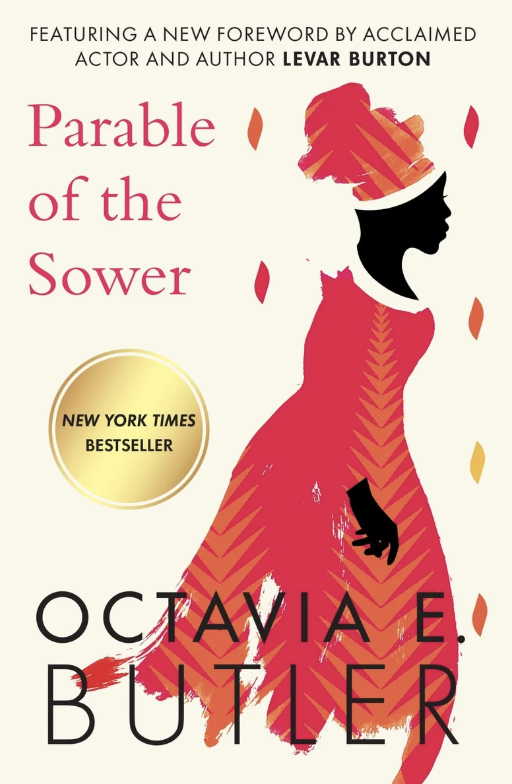
Parable of the Sower, Octavia Butler
Abughazaleh’s swearing in book (which maybe we should adopt instead of “desert island book”?) comes from a place of deep love. Encountering Octavia Butler’s classic work of sci-fi was transformative.
“The first time I read it was almost a religious experience,” Abughazaleh told me. In the book, Butler’s protagonist Lauren resists the worst actions and impulses of her world’s leaders by creating Earthseed, a philosophy and religion based around the transformational power of change, which resonated so deeply with Abughazaleh that she puts “verses of Earthseed in my planner.”
“I write them on different days,” she said, “They’re just really great reminders of what we as humanity collectively can do and can be, how we can fight darkness through change, and how nothing lasts forever.” It’s a belief that’s evident in the way she’s run her campaign, based in solidarity, mutual aid, and community organizing.
To Abughazaleh, Butler is “the queen of science fiction” who “doesn’t run into the same pitfalls that many particularly white male, straight sci-fi authors do.”
“I think that sci-fi has really struggled with writing women and women of color and people of color. And so oftentimes, I look for science fiction that’s written by women, queer people, or people of color,” she said.
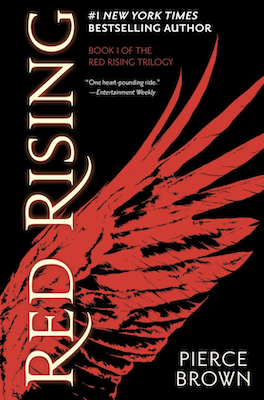
Pierce Brown’s Red Rising series, a trilogy and soon to be completed tetralogy, is big in Abughazaleh’s personal canon. “I would love to do a separate interview just about Red Rising,” she said.
The books, which Abughazaleh described as “a real love letter to the genre,” are set on a dystopian Mars, and delve deeply into issues of class. Brown has said he was inspired by the experience of Irish immigrants and the plight of the working classes. Red Rising is a book that seems to confuses some politically right-leaning readers, something which frustrates but doesn’t surprise Abughazaleh.
“It’s so funny watching dudes on Reddit be like, ‘I identify with the guy that’s clearly the white supremacist,’” she said, “This is an anti-fascist book. It’s crazy that they just miss the point every single time. They love missing the point, but this is something we see all over and over again. The right loves to not understand that ‘the baddies is them’ in a book.”
The Red Rising books are dense, but that’s the appeal. “The second book of the Tetrology,” Abughazaleh said, “there’s so much book in that book, it will ruin your life.” But as any reader knows, the life ruining is the point, and Red Rising is a book that Abughazaleh presses into a lot of people’s hands.
“It changed my brain chemistry and so my job now is to expose other people to the same pain I went through, and then laugh maniacally as they have to deal with the same things I dealt with,” she said.
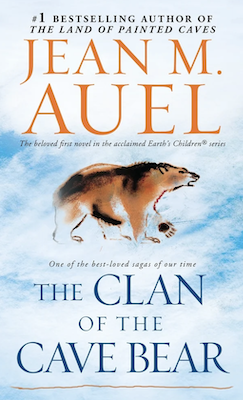
Clan of the Cave Bear, Jean Auel
We also talked about an early experience she had with a difficult book, and how it informs her thinking on what kids can handle in fiction, if handled maturely and with trust. Growing up, Abughazaleh had free reign on her parents bookshelves.
“My parents let me read anything that was in their library, because they very much believed that you can talk to your kids about stuff,” she said, “and kids are smarter than you think.”
She pulled out a copy of Clan of the Cave Bear, a book set in the Paleolithic that follows a young Homo sapien girl who is taken in by a group of Neanderthals. The book tackles, head on, some very big themes.
“It goes into a lot about essentially racism,” Abughazaleh said, “And there’s a lot about gender. It was the first exposure I ever had to the concept of sexual assault. And I was 11 when I read it and I asked my mom, ‘I’m kind of confused about what happened in this scene. I don’t really know what happened.’ And she was like, ‘Okay, let’s talk about it.’ And we talked about it like adults, and I felt like my mom trusted me to understand things.”
That trust that Abughazaleh was formative, in hindsight, about how books can help us see a wider world of experience. She told me that, “books are a way to explore the darker realities of our world, for anyone of any age, without having to experience them ourselves first. And I think we lose that a lot when we try to limit what children are allowed to see and what children are allowed to know.”

The Flag and the Cross, Philip Gorski and Samuel Perry and Marx for Cats, Leigh Claire La Berge
Abughazaleh recommended two books of nonfiction that she’s been into lately, too. The Flag and the Cross, a book by two sociologists about white Christian nationalism in America, was a book that Abughazaleh cited in an hour long explainer about white Christian nationalism and Project 2025.
“It’s a really good explainer on how the right has spent years prepping for this moment,” she told me, “If people are interested in knowing how we got here and why.”
She also had a sillier, but just as interesting suggestion: Marx for Cats, a book that borrows the medieval bestiary form to view history as “cat struggle.” Abughazaleh picked it up because she loves cats, but got into “the background of cats as revolutionaries.”

One Direction Fan Fiction
Abughazaleh is also a writer, and not just as a journalist and researcher.
“This is actually kind of a bit on the campaign because I wrote One Direction fan fiction in middle school,” she said, though the archives have proven difficult to track down. “I couldn’t find [the fan fiction] and I felt really bad because it sounds like I’m bullshitting and I’m not.”
Her love for fan fiction is deeper than just wanting to reimagine Niall, Liam, Harry, Louis, and Zayn. Fan fiction is a community—Abughazaleh met one of her best friends through the fan fiction world—and an inspiration for a more interesting internet.
“I think fan fiction is really special and it’s one of the few things that’s not gate-kept,” she said, “[archive of our own] is a very cool concept because it’s one of the few places on the internet besides Wikipedia where there are no ads, where it’s made out of passion and care.”
The creative potential and openness is also what draws her to sci-fi and to fiction, especially from voices that have been historically. It’s a belief that something better is possible.
“Science fiction is so creative,” Abughazaleh said, “I am an optimist at heart, and the entire form requires some type of optimism, some type of looking forward.”