A series of essential advice.
The first time I tried to ski was a catastrophe. I’ve always been unathletic and clumsy, the kind of person who hates being cold, hates waking up early, hates going fast, hates excessive gear, and generally has a bad attitude. Nonetheless, for reasons of infatuation, at thirty years old I lied about being a skier and accompanied my new boyfriend on a trip to Vermont, where I found myself, at 9 a.m., clutching my poles, frozen in terror, at the base of a mountain called the Beast.
I couldn’t latch the skis onto my boots without falling. I couldn’t climb onto the ski lift without falling, or glide three feet without falling. I wobbled and collapsed and bonked my helmet, over and over. I have never felt so undignified or so near to grave injury. I panicked and cried. My new boyfriend picked me up, over and over, and eventually it became hilarious. I made it down the bunny slope. I vowed never to do this again.
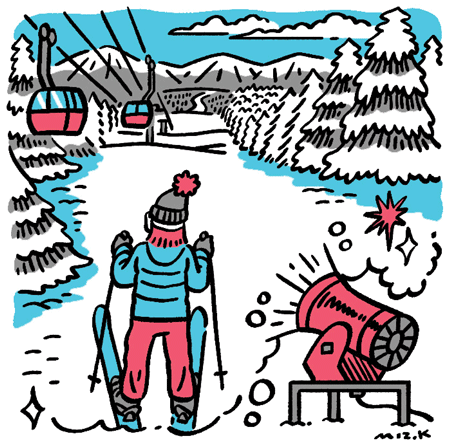
At the end of the day, I managed to take the gondola to the top of the green (easy) slope, and before taking my final run, remembered to look up at the landscape rather than down at my feet.
The mountain, I saw, was glorious. Even late in the day, it was glistening, gleaming, and smooth. How was it so perfect? Although thousands must have skied down it, the snow’s surface was flat and calm, as if the day had just begun. The mountain had a mechanism to renew itself. I was in awe, and experiencing a weird high: alone on a peak, air hushed, sky vast, surrounded by perfectly manicured snow.
Six years later, I’ve skied on many mountains—always badly—in pursuit of that kind of feeling. I now understand that the sublime presence is not the divine but the labored outcome of people and machines. There’s hardly an inch of a ski run that has not been blasted with fake snow and carefully tended by rolling machines. The sublime is manufactured, which, to me, makes it even more sublime. I’m fascinated by just how unnatural that pristine nature is.
Recently I decided to find out in practical terms how a mountain is made. How the illusion is maintained and the sublime is simulated. I contacted the press team at Killington Resort, that “Beast” in Vermont where I first tried to ski, and via my vague request to “ask someone how they make snow,” I got in touch with Dave Lacombe, Killington’s Snow Surface Manager.
Killington is one of the most popular ski resorts on the East Coast, thanks to its steep runs and unusually long season. Lacombe and his crew make enough artificial snow to stretch the winter from early November all the way through May and sometimes into June. What pads out those extra days? Piles and miles of expertly fake snow. Some is natural, but snowfall has never been regular, and it’s becoming less dependable every year. If you want a perfect winter, you have to make one.
When we spoke, Lacombe told me that he ended up a snow-maker by chance. As a teenager in the ’70s, he started working nights on the mountain as part of a work-study program in a vocational school for forestry. He didn’t know he was going to find his passion—but he’s been working there ever since.
When he started the job, it was the early days of snowmaking—a snow gun was basically a sawed-off pipe soldered to a fan. The “barbaric” nature of the machinery was part of why Lacombe got hooked on the work. “It was new to everybody,” so “if we wanted to make something, we’d have to put our heads together and draw it on a napkin.” They innovated and invented, and eventually other ski resorts were buying their machines.
These days, Lacombe oversees the whole operation. During peak season, he wakes up around 5 a.m. and checks his phone for news about what happened during the night. A sudden thaw? A freak freeze? An exploded pipe? By 7 a.m. Lacombe is in the control room, overseeing the equipment, infrastructure, and workflow. A team of eighty-five snow-makers continually operate 2,100 snow blowers, which freeze nine million gallons of water and spray the flakes across six hundred acres of trails, creating snowfall about twelve inches deep. Equally important is snow grooming, the process of spreading and aerating the snow. At Killington, forty-five snowcat tractor drivers swap shifts to groom trails around the clock. The mountain must be ready by the time thousands of snowsuited enthusiasts rush in, hoping to find a mountain covered in the famous “powder,” a fresh dusting of dry, puffy, natural snow. But even with no recent snowfall, thanks to Lacombe’s smooth-running operation, they’ll find the next-best thing. If something goes wrong with the production that day, Lacombe says, “we treat it like it’s trauma.”
Artificial snow is more durable than natural snow, and it can make for better skiing because it’s designed from the ground up. “We start out with what we call a base snow,” he explains—“a heavier, wetter, dense snow that clings to the earth” even if the ground isn’t frozen. Lacombe and his team vary the consistency with each snow gun, adding lighter layers and then drying them, lest they end up with “gray, sloppy snow that is just a mess.”
Properly maintained trails, Lacombe says, help stabilize the environment, and return balance to an ecosystem that needs snow. (New England winters are three degrees warmer than they were a hundred years ago.) But manufacturing artificial snow also has a high energy cost. Lacombe is at the forefront of a new wave of geoengineering that maximizes energy usage while mitigating environmental change. Carefully layering snow, he explains, can prevent runoff in springtime, staving off collapses and floods. “Sustainability and proper maintenance, being good stewards of the land, is critical,” he says. Acknowledging that global warming has made weather changes more erratic and extreme, he explains that, on the mountain, “weather patterns have always been variable.” For large commercial ski mountains, small changes have always been noticeable—and snowmaking has always been a necessity. Ski resorts know how to make a winter; one day, everyone will have to.
In recent years Killington’s led a massive effort to lower its energy usage, adding thousands of new, extremely efficient snow guns. “The old technology had a high volume of air, and high-pressure water,” Lacombe explains. “Now we take the snow guns ten to thirty feet in the air, so the mist of fine particles of water can freeze before it hits the ground.” The higher the snow tower, the less energy is needed to freeze the mist, because it has time to naturally freeze as it falls—creating an ever-more-perfect simulation of old-fashioned snowfall from clouds.
When he was young, Lacombe worked on a farm. He tells me that, coincidentally, snowmaking is sometimes called snow farming. “You wouldn’t plant corn until you’d plowed the field,” he says, by way of comparison. Lacombe often speaks of the snow as if it were alive. When I look at a map of Killington’s intricate trails and lifts, it seems like the mountain is so entwined with its infrastructure that it’s more like a cybernetic organism than a blank slate. But again, that’s the magic. The best engineering conceals itself. It takes extraordinary effort to make something feel effortless.
For more essays, interviews, reviews, and more, please visit our friends over at The Believer.

