Still Life with Plaster Head, 1947 by Vanessa Bell. Oil on board. 53.5 44.5 cm. Estate of Vanessa Bell. All rights reserved, DACS 2025.
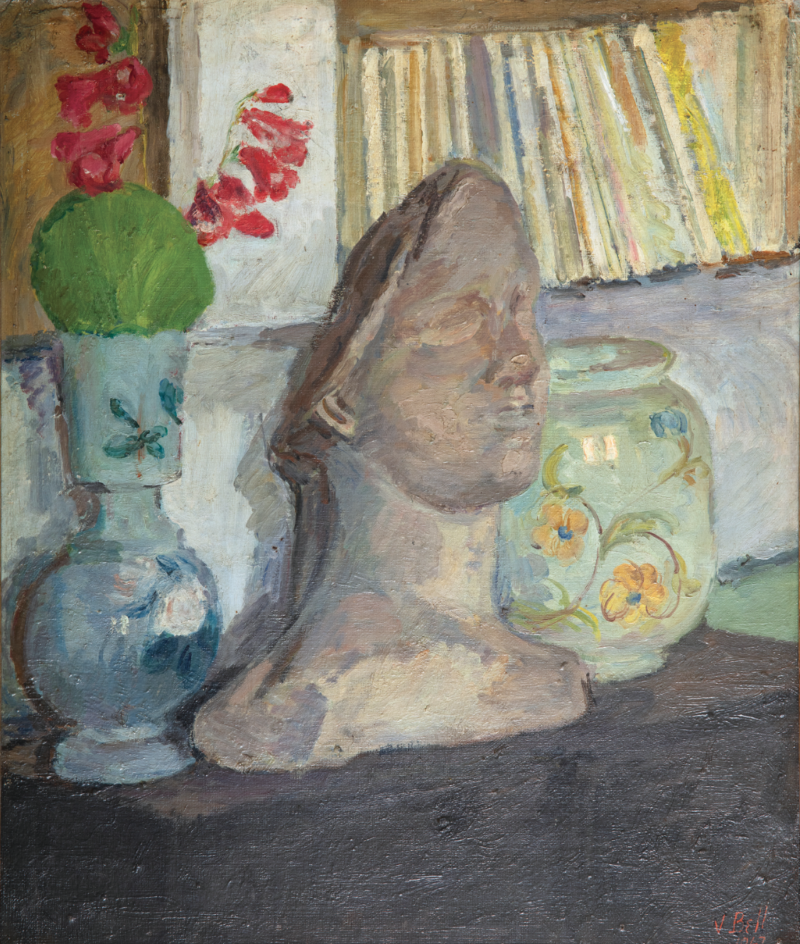
The artist, long dismissed for her domestic interpretation of modernism, is finally getting her due. But can her queer arcadia be replicated in the context of a museum?
In Virginia Woolf’s novel Mrs. Dalloway, which celebrated its centennial in May, the title character remembers a friend mocking her years before; the young Clarissa had the makings, jeered Peter Walsh, of the perfect hostess. Both Woolf and her older sister, Vanessa Bell, knew well the dangers of becoming stuck in that role, forever passing tea and buns about the room, never speaking beyond decorum’s limits. As female members of a respectable upper-middle-class Victorian family, they were trained in the domestic arts, excluded from the Cambridge education provided to their brothers and half brothers. Forced by the oldest of their siblings, George Duckworth, into attending society gatherings, the sisters dreaded the life he imagined for them as Peter Walsh’s perfect hostess. When left to their own devices, they practiced their other future vocations: writing for Virginia, painting for Vanessa. Once, the young artist took a piece of chalk and began writing on a black door, “When I am a famous painter…,” before setting the chalk down and erasing her clause. As it turned out, Vanessa Bell would manage to occupy both positions, that of a famous painter and that of a perfect hostess, though in forms neither George Duckworth nor Peter Walsh would have been capable of imagining.
In enthusiastic reviews of the largest-ever solo exhibition of her work, Vanessa Bell: A World of Form and Colour, which ran from October 2024 to February 2025 at England’s MK Gallery in Milton Keynes, critics lined up to complete her chalked sentence. After decades of appearing as the lesser half of the sisters, or as the subordinate artist to her lifelong companion, Duncan Grant, Bell is enjoying a moment of attention as a major modernist figure in her own right. Her oeuvre is large and varied, from her experiments in abstraction to her decorative work for the iconic Omega Workshops; from her bright, splotchy portraits of fellow members of the Bloomsbury Group to the instantly recognizable book covers she designed for her sister. The exhibition’s title feels apt. The impressive catalog spans nearly six decades of artistic creation, and the gathering of over 150 works tells a story of more than a single life; together, they make a whole world.
But here I must make a confession: When I initially heard of the exhibition, I did not feel entirely celebratory. Part of me was indignant, proprietary. You might call me anxiously attached.
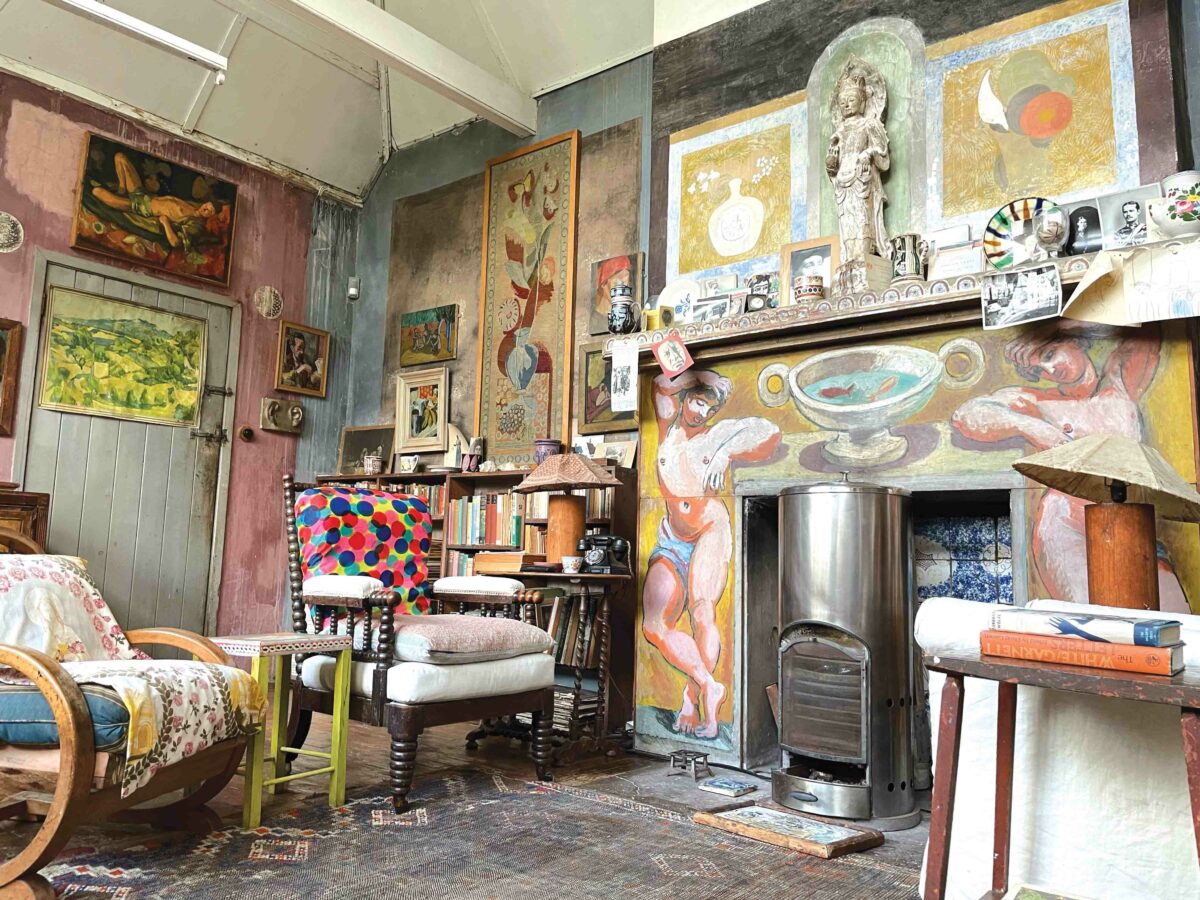
My first in-person encounter with Vanessa Bell’s art occurred in September of 2021 at Charleston, the old English country house dubbed a “queer arcadia” by its current head of collections and research, Darren Clarke, and which is now a public museum. It was here that Bell and Duncan Grant lived—with intermittent time spent in London and elsewhere—painting everything from the usual canvases to the walls, the lamps, each other’s beds. Bell loved Grant deeply, though she was married until her death to the art critic Clive Bell, with whom she had two sons. She and Grant had a daughter, who was not told of her biological father until she was an adult. Bell also had a serious affair with the painter and critic Roger Fry. Grant, meanwhile, mostly had relationships with other men, including the economist John Maynard Keynes (who would later have his own bedroom at Charleston), and the writer David Garnett, who lived with Grant and Bell during the years of the First World War. The house teems, not only with the colorful paint and fabric of Bell’s and Grant’s prolific making, but with a network of human relationships. Even now, that network feels radical, offering a potential model for other ways of imagining life: open, curious, slipping out of the straight and square world’s attempts at a disciplining gaze. Charleston (if you will permit me to anthropomorphize the house’s unmistakable personality) does not care that critics once sniffed at Bell and Grant’s interest in interior decoration, marking it as inferior to their own preferred vision of modernism as a heroic, masculine movement. Those critics esteemed Le Corbusier and his claim for the right to “health, logic, daring, harmony, [and] perfection” “in the name of the steamship, of the airplane, and of the motor-car.” How could Vanessa Bell look at the sloppy domestic circles she painted around her fireplace and think she could compete? (Art historian Christopher Reed has written brilliantly on this subject.)
Perhaps because I was exhausted by the pandemic’s endless onscreen grids and their boxing-in of bodies that I longed to touch, when I finally arrived in person at Charleston in 2021, I was primed to fall in love. I was enchanted by its glorious mess of colors and patterns, its promiscuous layering of years, its demonstrations that art and life could be—indeed must be—intertwined. I came home and painted my own table. I renewed my artistic vows. The personal devotion the house inspired in me meant that when I first saw an image from MK Gallery’s exhibition—a photograph of the two bedroom doors Bell painted for Grant, hung up on a blank museum wall—the word sacrilege bloomed in my mind like spilled communion wine on thick liturgical cloth. Put them back! I thought. They don’t need this! Elsewhere on the museum’s website, I spied a painted fireplace surround, which, unlike the ones I’d worshipped at Charleston, framed not a place for burning, but rather a flat, empty space. If you hang a fireplace on a white wall, I fretted, don’t the flames go cold? I booked tickets so I could find out.
Vanessa Bell’s painted living room at Charleston. Photograph by the author.
I like to think of art as a social occasion: a cocktail hour, a playdate, a dinner party. An artist is a host who fashions space and time for others to enter. Some are shy hosts and absent themselves. Some bully you through the house, forcing you to notice their symbolic decor in a predetermined order. Some register your presence and smile before wandering into the kitchen, where they are trying to repair a dripping faucet. Some stare at you with aggravation, certain you were not invited. I enjoy the metaphor in part because it lets the artist occupy a position easily dismissed as frivolous and feminine. Think back to Mrs. Dalloway, the light-hearted party preparations with which the novel famously opens: Clarissa Dalloway “would buy the flowers herself,” and “the doors would be taken off their hinges.” When the novel was first published, some critics sniffed at the insignificance of its subject, willfully ignoring the book’s wide-ranging concerns. Yes, from one angle it’s the story of a party thrown by a socialite, but—if we consider the idea that artists are themselves hosts—it would be impossible not to notice that at Woolf’s party she has arranged war and death alongside the flowers.
Two opposing stories exist about Vanessa Bell as a host in the most literal sense. In one, she is formidable and remote, fiercely guarding her artistic practice. After years of sharing studio space with Duncan Grant at Charleston, she retreated to paint in the attic, which even now is closed off to visitors.1
If one were to knock on that door, would she answer? In Bell’s younger years, while she was still living and working in London, she once fought off a phone call from her half brother: “I am afraid Mrs. Bell is out,” said the artist.
“But you are Mrs. Bell,” said the caller. “I am your brother George.”
“I am afraid Mrs. Bell is out,” the artist repeated.
“But, Vanessa, I know your voice,” insisted George.
“I am afraid Mrs. Bell is out.” She would speak no other sentence. Sir George Duckworth hung up.
In the other story of Vanessa Bell as a host, she is the quietly powerful social figure around whom Bloomsbury (and British modernism) grew. It was she who insisted on the need for a weekly salon to discuss visual art, to complement her brother’s more literary gatherings. It was Bell who chose to approach marriage with nonmonogamous flexibility, opening space for a burst of lines between lovers in Bloomsbury’s messy circles. And it was Bell who made Charleston a place with room for those who shared her nontraditional instincts. (Duncan Grant and David Garnett began their lives there working the farm, so that, as conscientious objectors, they would not be conscripted into the First World War.)
Recently, I was put in touch with a woman whose mother, Constance Bull, had been a guest at Charleston back in 1941, and I felt a little thrill at catching a new glimpse of Bell’s life as a host. On a hot summer day, Michael Bagenal—who’d grown up playing with Bell’s children as the son of another Bloomsbury artist—brought Connie, then his new girlfriend, to visit Charleston. It was a dusty, sweaty walk from the train station. When Connie and Michael arrived, they found Duncan Grant and others swimming naked, as usual, in Charleston’s pond. Only twenty years old, and an aspiring artist herself, Connie had been thrilled at the prospect of meeting these great and famous painters, but when the nude Grant hopped out of the pond to shake her hand and introduce his dripping self, she was shocked and overwhelmed. She mumbled her excuses and ran into the house. Inside, she bumped into Vanessa, who had not yet joined the others in the pond. Connie stammered that she was looking for somewhere to change, to which the painter replied, “Oh, fancy that. I’m going to do that as well. Why don’t you come into my room and we can both get changed together?”
When they stepped back out again, Grant must have laughed. He asked Vanessa, “Why are you wearing that?”
“I like swimming in my costume,” she said calmly. “Come on, Connie, let’s go into the pool.”
When Connie’s daughter told me this story, she marveled at Bell’s kindness. “You know, it’s [the act of] the perfect hostess, isn’t it?”
“It is, it is,” I agreed.
Read the rest over at The Believer.

