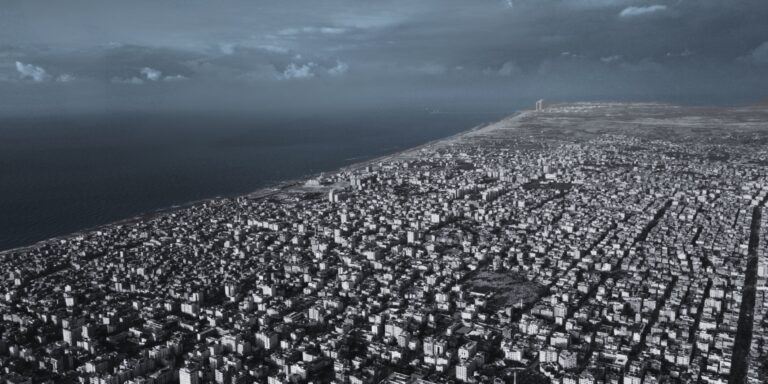
I feel sad about Gaza.
This is not a profound thought, nor an unusual one—especially in South Africa, where I’ve been working lately—or even a new thought for me.
But it is an honest thought.
I feel sad that after tens or even hundreds of thousands of people lost their lives, Palestine is still not free.
I feel sad that after at least 270 reporters were killed, the few remaining among the dead journalists’ colleagues are still living in a hell as lethal and depressing as ever—and that the ghost Instagram accounts of dead journalists keep announcing more deaths, as Hossam Shabbat’s Insta recently announced the death of his brother, Hassan.
I feel sad that after being jailed inside the world’s largest, densest outdoor prison, nearly two million Palestinians are still living inside the world’s largest, densest outdoor prison… except now, as Israel’s military chief brags about controlling a new, smaller border dictated by Trump’s “yellow line,” Gaza’s Palestinians are squeezed into half the space they were on October 6, 2023.
I feel sad that after Palestinians in Gaza were displaced five, ten, fifteen, twenty times over the last two years, more than 53,000 tents were flooded and 13 buildings collapsed in the recent rains, leading to even more death, disease and immiseration.
I feel sad that even as they are tortured, killed, starved and denied medical care, Palestinians are now also denied any of the benefits or pleasures of farming their land to provide nourishment—land which has either been stripped of its fecundity by American-made bombs, cut off by further military occupation by Israel, or both.
I feel sad that after every university has been destroyed and 200 professors killed, Palestinians are still having to teach and learn in makeshift tents.
I feel sad that Israel has officially killed at least 370 people since the “ceasefire,” while CNN and the New York Times keep saying the ceasefire has merely been “tested,” while Israel kills anyone with impunity it says has merely traveled on the wrong side of an invisible yellow line—a line in their land!—while my medical contacts in Gaza tell me that “this ceasefire is even less of a ceasefire than the last ceasefire.”
I am angry that 77 years after it first did so, the UN would once again condemn Palestinians to colonial rule.
I feel sad that aid is being withheld as more than 9,300 children have been diagnosed with acute malnutrition and while a dedicated physician like Hussam Abu Safia—the director of Kamal Adwan Hospital who tended to his patients until he was kidnapped and held hostage for the last 10 months—is unable to attend to those kids
I feel sad that a woman who literally wrote the words which came out of Barack Obama’s mouth, Sarah Hurwitz, feels comfortable going out in public, repeatedly, and whining about how it is too hard to defend Israel through a “wall of dead children”—with no regard whatsoever for the children.
I feel sad that her proposed solution isn’t to stop the genocidal machine creating all the dead and maimed children(at least 65,000 of them so far) or to stop creating orphans (40,000 of them) by killing their parents. Rather the answer, according to Obama’s wordsmith, is to take cell phones away from American children who are seeing this carnage on social media and who are rightly horrified.
I feel angry at Barack Obama for not addressing this obscenity except, in his silence, by endorsing it. And I feel angry at Hillary Clinton for also blaming this genocide on social media. Her claims were so egregious that “the Lemkin Institute for Genocide Prevention (named for Holocaust survivor Raphael Lemkin, who coined term ‘genocide’),” Zeteo’s Prem Thakker pointed out, “call[ed] Clinton’s remarks” ‘genocide denial.’ ‘Young people in the US are not stupid or gullible. They simply reject genocide—something the Secretary might consider doing as well.’”
“Where are they getting their information?” Clinton asked. “They’re getting their information from social media, particularly TikTok.” Well, yes, but they also got it from the International Court of Justice, which ruled in January 2024 that there was a “plausible” case that Palestinians needed to be protected from genocide. And while South Africa’s case did include videos from TikTok of Israel’s own soldiers admitting to war crimes in clips they uploaded, the 14-to-1 decision of the ICJ was read by its president, United States justice Joan E. Donoghue, who was nominated to the court in 2010 by then Secretary of State Clinton. So when Clinton says the kinds of videos included in her appointee’s ICJ ruling are “totally made up,” she’s lying, gaslighting us, or both.
Either way, it pisses me off.
I am angry that after at least 126 UN workers were killed in Gaza—more than in any other war in the organization’s 80-year history—and after United Nations Secretary-General is António Guterres invoked Article 99 for only the third time in those eight decades to call for an immediate ceasefire, and after the UN General Assembly voted overwhelmingly for a ceasefire, and after the U.S. (via its Black overseers, ambassadors Linda Thomas-Greenfield and Robert Wood) vetoed a Security Council ceasefire resolution repeatedly, the Security Council voted on the “Trump peace plan,” which only further subjects Palestinians to more humiliation and more policing and more (fast and slow moving) genocide than it was experiencing on October 6, 2023.
I am angry that 77 years after it first did so, the UN would once again condemn Palestinians to colonial rule, deny their right to self determination, and absolve the world powers of ethnically cleansing Gaza.
And while I in no way regret standing for Palestine over the last few years, I am sad, and angry, that so many of us—workers, students, educators and writers—have sacrificed our careers and livelihoods.
I am angry that while the US was happy to veto any ceasefire resolution for years, neither China nor Russia—the latter engaged in a proxy war with the US in Ukraine!—would veto this shameful sham of a “peace plan.”
I am sad that the horrors of Gaza are being seen less in the West; not because they are no longer happening (that would make me ecstatic), but because Meta and YouTube keep purging the work of slain journalists like Saleh Aljafarawi (and taking down videos documenting abuses by the entity), Hillary Clinton is just one player in a plan to Zionize TikTok, and because Hossam Shabat, Anis al-Sharif, and 270 others can no longer report to us, because they are dead.
And while I in no way regret standing for Palestine over the last few years, I am sad, and angry, that so many of us—workers, students, educators and writers—have sacrificed our careers and livelihoods, homes and nations… and still, Gaza is more under siege than it was on October 6, 2023.
But, there is something that made me very angry which also gave me a lot of hope:
Northwestern University’s deal with Trump.
After suspending me, denying me tenure, firing multiple staff, and blocking 300(!) students from enrolling, Northwestern agreed to pay a $75 million fine, in order to get back $790 million in funds frozen by Trump.
To call this a “capitulation” is wrong. Universities are winning these cases, but schools like Northwestern, Cornell (payoff: $60 million) and Columbia (payoff: $200 million) are not “capitulating.” These schools’ boards seem to like what Trump is doing, are happy with his agenda, and see their payoffs as money well spent to get rid of pesky faculty dissent, and student protests, transgender youth healthcare.
(It is fitting that two of these schools, Columbia and Northwestern, are home to two of the most prestigious journalism schools in the country; seemingly, their respective deans, Jelani Cobb and Charles Whitaker, have presided over these schools while their universities have not just undermined their own students’, but 340 million Americans’ constitutional rights to free speech and freedom of assembly.) Cornell, Columbia and Northwestern’s boards are stacked with warmongers whose profits are threatened by student protesters.
And when it comes to protest, Northwestern has outsourced managing it to the United States federal government. The University will maintain a “Prohibition on on-campus displays, including flyers, banners, chalking, and 3-D installations outside of areas specifically designated by Northwestern” and, chillingly, “Northwestern shall not revise or modify these policies and procedures without the consent of the Assistant Attorney General.”
When I gave a speech called “Our work is love” to Northwestern’s Gaza Solidarity Encampment on Deering Meadow—a meadow which the university had dedicated to student protesters killed at Kent and Jackson State University in 1970—I congratulated the students on their courage because “in essence, a colonial war of occupation is playing out on this lawn. The empire has not just struck back at our efforts; it has hit extremely close to your homes. And when the university became an imperial battle site, the administration wanted to side with the warmongers instead of with you, the peacemakers.”
And how true that was. The five-day encampment ended with the “Deering Meadow agreement,” struck between students and the university, and though I had nothing to do with negotiating the agreement, it was an agreement made in good faith, resulting in modest gains: It was fitting, if a bit on the nose, that on Thanksgiving weekend, Northwestern tore up the deal and reneged on it, keeping with a long American tradition of the US federal government reneging on agreements made about indigenous matters.
But rather than make me sad and angry, Northwestern’s actions made me angry and hopeful. As Audre Lorde says, “Anger is loaded with information and energy.”
And my anger at Northwestern here revealed just how powerful the students were—and how powerful all of us who have been and still are sad and angry about Gaza.
Is the empire striking back? Yes.
But it is doing so out of desperation.
It is notable that people standing with Palestine are so frightening to the United States government that at Northwestern University, it was not enough to get rid of me, nor to fire staff, nor to betray the university’s teaching mission by blocking 300 students from classes, nor to betray its core research mission by handing research over to Trump. No, none of that was enough: the largest military force in the word had to rip up a student agreement from 18 months ago, and to make matters involving student protest on campus literally a matter of federal policy.
Now, questions like Can a student put up a flier in Kresge Hall? or Can they turn on their bluetooth speaker while saying ‘Stop Climate Change!’ are matters of national security!
The ruling class are shitting themselves over where students can put up fliers because they are scared while we are powerful.
And leads me to why I am hopeful, as I write from Johannesburg, where South African apartheid is in the rear-view mirror (at least on paper).
Even if our governments are not the people of the world are solidly in support of Palestine. Israel’s’s time is limited. And this has been achieved with the blood, firings, maimings and sacrifices of the last two (and 77) years.
Now, the people of the world must isolate Israel internationally just as the people of the world isolated South Africa in the 1980s: diplomatically, financially, culturally. We must take our sadness and petition our governments. And if that fails, we must petition FIFA and Eurovision and universities and businesses until Israel is as wounded financially, economically and politically in its genocidal mission as we are wounded in our hearts.
So, feel the sadness. It’s completely logical. Feel the anger. It’s more than justified.
And then, let them propel us forward in organizing pressure against every government and business and news organization abetting these atrocities… until Palestine is free.