
Boz
Pen name of Charles Dickens (1812-1870)
Charles Dickens is one of the most recognizable names in English literature, but for many years he also published as Boz.
Dickens grew up in poverty, and during his childhood he had to work to help support the family during periods of financial hardship. He left school aged fifteen to work as a clerk in a solicitor’s office; he found it dull but it would later provide material for his writing. From 1828 Charles and his father John, a former naval clerk, moved into journalism, working as court and parliamentary reporters.
In the early 1830s, in his spare time, Charles Dickens was writing sketches and songs, staging amateur dramatics and finding time to study in the British Museum Reading Room. In December 1833 a short sketch he had written was published anonymously in the Monthly Magazine. He submitted further contributions and in the August 1834 issue debuted the pen name Boz, which he continued to use when he was offered a job writing for the Morning Chronicle that same month. Dickens’s pen name was taken from his brother Augustus’s childhood nickname—a mispronunciation of “Moses.”
Evans understood the literary world and knew that an author’s gender affected how their work was judged.
Dickens was encouraged by the novelist William Harrison Ainsworth to publish a collection of his articles, and Sketches by Boz, with illustrations by George Cruikshank, came out in 1836. An invitation followed from the publishers Chapman & Hall to write a serial. This resulted in The Pickwick Papers, which ran over twenty months and was published in book form in 1837. It was extremely popular and read by people from all walks of life. In 1836 Dickens married Catherine Hogarth, and when their first child was born in January of the following year he was given the middle name Boz.
Although some Dickens stories in serial form continued to appear as “edited by Boz,” the title pages of his novels and novellas started to feature “Charles Dickens” from the 1840s.
A “Boz Ball,” attended by 3,000 people, was held in New York in 1842 to welcome Dickens to America. This comic song captures the excitement his American tour attracted:
They’ll tope thee, Boz, they’ll soap thee, Boz,
Already they begin!
They’ll dine thee, Boz, they’ll win
They’ll stuff thee to the chin!
They’ll smother thee with victuals, Boz,
With fish, and flesh, and chickens!
Our authorlings will bore thee, Boz,
And hail thee, “Cousin Dickens!”
While ladies—spite thy better half,—
Blue, yellow, foul, and fair,
Wilt coax thee for thy autograph,
And likewise locks of hair!
Dickens had taken a nom de plume in the tradition of journalists and periodical writers, but there was no need to conceal his identity. Although he continued to be associated with the pen name Boz, now as a literary celebrity he was well known as Charles Dickens.
George Eliot
Pen name of Mary Anne Evans (1819-1880)
The author best remembered for Middlemarch, her renowned portrait of English provincial life, went by several names during her lifetime. But the pen name she adopted in the 1850s, George Eliot, has endured and is the name under which her books are still issued.
Her famous pseudonym was invented after the publication of the first of her stories in the series “Scenes of Clerical Life,” which appeared anonymously in Blackwood’s Magazine in January 1857. Evans was an essayist and editor, and “Scenes” was her first fiction. George Henry Lewes, a fellow writer and Evans’s partner, initially acted as a go-between so that her identity could be concealed even from the magazine’s editor.
In February 1857 Evans wrote to William Blackwood that the name George Eliot could be used as “a tub to throw to the whale in case of curious inquiries”—that is, to deflect attention from its real author. Scenes of Clerical Life was issued in book form the following year under the name George Eliot. In later life she explained “George was Mr Lewes’s Christian name, and Eliot was a good mouth-filling, easily-pronounced word.”
Evans’s reasons for using a pen name are complex—inextricably linked to her writing practice and feelings about authorship, but also addressing the practical problems of publishing as a woman in the Victorian period. Evans understood the literary world and knew that an author’s gender affected how their work was judged. In addition, her private life could undermine her critical and commercial success. She was in a romantic relationship with Lewes, who was separated from his wife but unable to obtain a divorce. Moral judgements on her home life were likely to affect her literary reputation.
Names were important to her, and she renamed herself throughout her life. Christened Mary Anne Evans, she later called herself Mary Ann or Marian. When she and George Henry Lewes set up home together in 1854 she wished to be known as Mrs. Lewes.
If writing under a pen name is a form of deception, or akin to leading a double life, Cornwell was more suited to it than most writers.
The success of Eliot’s second book, the novel Adam Bede (1859), increased public speculation about its author. Although the identity of George Eliot was not revealed to her publishers until early 1858, they had guessed. It was also becoming increasingly clear in literary circles that Evans was known to be the author behind the pen name. Nonetheless her novels continued to appear under the name George Eliot. Although she lost the benefits of anonymity, George Eliot became a celebrated novelist.
In 2020, to celebrate the twenty-fifth anniversary of the Women’s Prize for Fiction, the “Reclaim Her Name” project published digital editions of works by women originally issued under male or gender-neutral pen names. This included the first edition of Middlemarch ever to appear under the name Mary Ann Evans. Despite the project’s good intentions in highlighting gender bias in publishing, it drew criticism. The chair of the George Eliot Fellowship commented: “They did not grasp that George Eliot chose that name and chose to retain it, as was her right, and that her integrity as a writer and her own feelings about herself as a writer are bound up in what she called herself.”
John le Carré
Pen name of David Cornwell (1931-2020)
Adopting a false identity is common in the shadowy world of espionage, so it seems appropriate that David Cornwell published his celebrated spy novels as John le Carré.
The success of John le Carré’s third novel The Spy Who Came in from the Cold changed his life and blew his cover. David Cornwell had quietly been publishing novels as John le Carré while working in his official day job as a diplomat and his unofficial job as an agent for MI5 and MI6. Soon after the book was published in September 1963 it became the book to read. The press began to speculate about who John le Carré was and how did he know so much about tradecraft, the term for espionage techniques that his books would popularize? A Sunday Times journalist phoned Cornwell in Hamburg and asked if he was le Carré. Cornwell confirmed he was, but insisted that he did not work for the secret services and had merely observed them at work.
His double life as an author was known to his employers; Cornwell had informed his superiors that he hoped to publish a novel and was told that the official view was that he should use a pen name. His publisher Victor Gollancz suggested a rugged unpretentious name like Jack Smith or Herb Brown, but he was adamant that it had to be le Carré.
Cornwell’s full name was David John Moore Cornwell, so we know where the John comes from, but why le Carré? It means “the square” in French, and for many years the author insisted that John le Carré was the name of a shoe shop he had seen from the top deck of a London bus. He later confessed this was a fiction, and he did not remember its origins, but with its distinctive structure and accent and mixture of the familiar and exotic it worked well as an authorial brand. If writing under a pen name is a form of deception, or akin to leading a double life, Cornwell was more suited to it than most writers. Deception ran like a thread through his life.
He and his brother had been sent to Sherborne School so they could join the establishment as English gentlemen. This was financed by their father Ronnie, who had abandoned the family when David was three. Ronnie was a convicted fraudster and associate of the Krays, and often paid the fees embarrassingly late. It made the young David feel like a fraud and an outsider. Cornwell then led a double life as a diplomat and a spy in West Germany at the height of the Cold War.
Later, his public image was of a contented husband, but his extramarital affairs have been the subject of recent media attention. His mistresses are said to have inspired characters in his novels, including Tessa Quayle in The Constant Gardener. Le Carré was a complex character and much in his life was marked by duality.
E.L. James
Pen name of Erika Mitchell (1963-)
Erotica is a genre in which men write as women, women write as men, and everyone uses a pen name unless they publish as “Anonymous,” E.L. James started her writing career publishing fanfiction online under an alias, and went on to change the literary landscape under her now instantly recognizable pen name.
Historically, erotica was a hidden genre, subject to censorship and tucked away in the back corners of bookshops. Erika Mitchell changed that with her bestselling Fifty Shades trilogy. She did, however, stick with tradition by publishing under a pen name as E.L. James.
In 2008, four years before her books became an international publishing phenomenon, Mitchell (now Erika Leonard) was leading an ordinary middle-class life in a London suburb with her husband and their two sons. She relaxed by reading romances and erotica on her daily commute to work, removing the front covers if they looked too racy. Mitchell’s life changed when she saw the film Twilight (2008), an adaptation of the first in a series of romantic novels by Stephenie Meyer featuring vampires. Mitchell loved it, and her husband bought her the books for Christmas. She devoured them in five days and decided she wanted to write romantic fiction.
Mitchell discovered a website where fans of the Twilight series posted fanfiction inspired by the books; she began to contribute to it under the unlikely name “Snowqueens Icedragon.” She would post a new chapter of a work in progress every week: thanks to its cliffhangers and steamy sex scenes it quickly built up a following. The story lost the elements it borrowed from the Twilight novels, instead telling the story of the love affair between billionaire businessman Christian Grey and hardware store employee Anastasia Steele. Mitchell published Fifty Shades of Grey (2011) on an Australia-based publishing platform, and when it began to sell a few hundred copies a week she quit her job. She followed it up with two further novels featuring Grey and Steele.
Random House bought the rights to the trilogy in 2012, and it quickly became a word-of-mouth commercial juggernaut. The books sold 30 million copies in four months—they are estimated to have sold more than 160 million copies in total. Mitchell turned down requests for newspaper and television interviews, as the books did not need publicity.
Mitchell has been called a recluse by newspapers, when what they really mean is someone who prefers to maintain a low profile. She had decided to use a pen name because of the sexually explicit content of her work and so that her children would not know what she was writing. Although Mitchell rarely gives interviews, her real identity and the fact that she is a married mother of two have never really been secret. Her readers can relate to her, and this is in large part the key to her success. The books she has published as E.L. James have given her readers permission to enjoy a genre of fiction they might previously have avoided. Today many of them share online their own fanfiction about Christian Grey and Anastasia Steele.
__________________________________
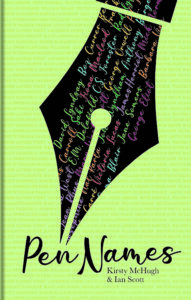
From Pen Names by Kirsty McHugh and Ian Scott. Copyright © 2025. Available from Bodleian Library Publishing and University of Chicago Press.