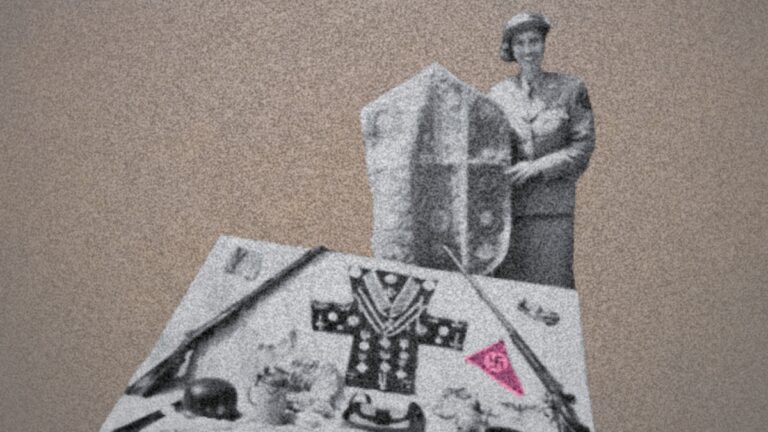
The first time I met my mother-in-law, Patricia Hartwell, she displayed her World War II trophies, the highlights being Hermann Goering’s medals and his tiny Minox camera, Goebbel’s silverware, a couple of scary-looking Lugers, Hitler’s napkins, and blank orders he’d signed in case anybody was around after his suicide. I was thirty, I had my own war, Vietnam, and this detritus was from a conflict thirty years old that my generation associated with fuddy-duddies. So what if she was the only woman reporter to cover both the Pacific and European fronts? That war was covered.
Then she plucked a 5” x 7” publicity photo out of a stack on the floor. There, she said, those were Hitler’s ashes. The picture showed her pointing to a pile of them.
After her third son, another journalist, said he wasn’t going to write a book about her, I took on the job of sorting out the truth.
Even I knew Hitler died in his Berlin bunker, not Berchtesgaden where she had been embedded with the 101st Airborne. The US government told her to say that she, as a civilian, had seen these ashes in order to quiet the mystery around Hitler’s death. It’s true, she said.
Really?
I wasn’t the only one to wonder. Three of her sons tended toward blushing skepticism, would shake their heads and roll their eyes, embarrassed to witness such a blatant display of her accomplishments. I was recently engaged to her firstborn at the time, and prone to side with him. He shrugged. That’s my mom.
Over the nearly twenty years I knew her, we seldom discussed her past. I was busy with two children and writing a novel about barely surviving life in a Sudanese cattle camp, and producing a PBS series on poetry. We were not in competition. In addition to being a star reporter during WWII, Pat was the first woman for CBS radio news on a team with Edward R. Murrow, first woman at Dachau and Iwo Jima, first and only civilian to govern a postwar German town. She then became third in command at UNICEF, vice president of one of the largest PR firms in the world, fundraiser of millions for the Overseas Press Club, engineering the building of the Scottsdale Art Center, and helming the Hawai’ian Arts Council in its early years where she protected the 1% for the Arts legislation and investigated art fraud.
Central to Pat’s legend was a 15th century painting by Cranach the Elder called Cupid Complaining to Venus that hung in her living room for twenty years. She said the 101st Airborne had given it to her in a burst of gratitude. Or else she won it in a poker game. Who owned it before Hitler hung it in his study?
That was one too many mysteries.
After her third son, another journalist, said he wasn’t going to write a book about her, I took on the job of sorting out the truth. Carolyn M. Edy, author of the definitive The Woman War Correspondent, the U.S. Military, and the Press: 1846–1947 opens her essay “Trust but Verify: Myths and Misinformation in the History of Women War Correspondents” with “We [journalists] all know, too well, the saying ‘If your mother says she loves you, check it out.’ But what if your mother is a journalist, or even a historian? The short answer is you approach her statements the same way.” This led me to question truth in terms of the usefulness of propaganda keeping soldiers safe during war, and why countries use public relations firms. I discovered that what is true within families is sometimes different outside them. I considered why truth matters now.
What I’ve done is to try to release Pat from the suspicions around her legend. The result is a lot of footnotes that support nearly all her claims.
But the real question beneath all that is why I didn’t take my mother-in-law at her word. I was acting under the patriarchal premise that a woman couldn’t have done all that, and that surely some inferiority complex had compelled her to say what she did. I am not alone in working from my prejudices. After she attracted 25,000 people to Scottsdale’s first art fair in the sixties, Pat was quoted in the newspaper—“To this city, art is as important as police or fire protection,” but uncredited for organizing the fair.
A few years later, she was given nine months to review museums all over the country, develop plans, and hire an architect to build the Scottsdale Art Center, including luring Louise Nevelson to Arizona for a commission—but she wasn’t named director. In 1978, after she organized a huge Captain Cook festival on Oahu and neighboring islands, the New York Times’ headline was “Gov. George Ariyoshi has appointed an unpaid coordinator of the Cook bicentennial.”
Consider, too, what happened to Martha Gellhorn’s astonishing account of D-Day. She’d been denied permission to go, and snuck aboard a hospital ship headed for Omaha Beach, where she hid in the bathroom and posed as a stretcher bearer when they landed. Colliers gave her five pages, but the magazine’s cover line cited, not Gellhorn, but her husband Ernest Hemingway, who wasn’t allowed to go ashore at all.
I should have gotten down on bended knee and thanked my mother-in-law for banging her head against that patriarchal ceiling.
I understood this erasure because it hasn’t ended. My mother attributed my raising a half million dollars for the PBS series to my husband, along with the making of fifteen art videos that circulated mostly in Europe. After all, he was in the Directors Guild. She even credited the publication of my books to him, albeit circuitously, that as a first reader, he had definitively shaped them. My father wasn’t much better. When a journalist came to the family home to interview me, he hardly let me get a word in, and insisted on being in the photo. And that PBS series? Soon after I raised the money, wrote the script for the pilot on Whitman, hired a director and shot the film, I was fired because I finished it before the executive director’s film on Ezra Pound.
What I’ve done is to try to release Pat from the suspicions around her legend. The result is a lot of footnotes that support nearly all her claims. Did she dance with Hermann Goering the night he surrendered? Did I cross the Nile with my suitcase on my head and a swarm of crocodiles at my heels when in Sudan translating Nuer song? Everyone who could corroborate the details of our feats is dead—but she and I were at the right place and time, with the means, the motive and the moxie.
The postwar 1950s was all about men. Returning triumphant warriors, they restarted the economy not only of their homeland but also their foes’. What that took was pushing the women to produce more consumers, not new companies or works of art. Few remember how hard it was for mid-century women in the Mad Men era. The 1960s were not much better than the Fifties: women shortened their skirts and loosened their morals, but really only for the convenience of men.
Like truth, belief is another difficult concept, it has gradients and repercussions buried deep in the unconscious.
What happened to the other star reporters in these patriarchal decades after the war? Sigrid Schultz, the first female foreign bureau chief of a major U.S. newspaper who’d interviewed both Hitler and Goering, published only one book—of recipes. Some, like photojournalist Lee Miller, became alcoholics. Helen Kirkpatrick was in line for an important State Department job but turned it down because she knew her gender wasn’t wanted. Only Martha Gellhorn, who was always more of an essayist than a journalist, continued to write until her death. I should have gotten down on bended knee and thanked my mother-in-law for banging her head against that patriarchal ceiling.
Three of Pat’s sons don’t want to read the book. They don’t want to know what drove her, how human she was, how she struggled with her life and her work, and them. Of course they have their own perspectives, unfootnoted but remembered from a past when I wasn’t around—and they certainly don’t want that changed. That’s why it’s my mother-in-law, and not their mother. They don’t have to believe what I’ve documented. Like truth, belief is another difficult concept, it has gradients and repercussions buried deep in the unconscious. My mother-in-law never said I should go to hell, she just gave me that look.
__________________________________

Hitler and My Mother-In-Law by Terese Svoboda is available from OR Books.