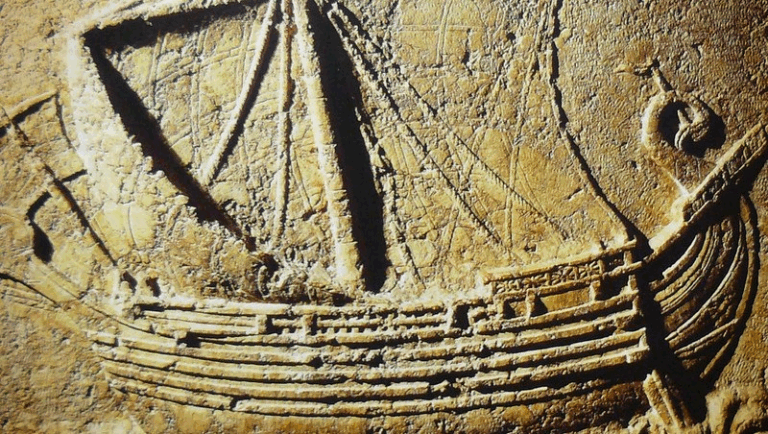
Beyond the stories passed down to us through ancient Rome, of Dido and Hannibal and the conquest of the north African coast, the facts about the foundation of Carthage are only slightly less dramatic. A trail of early Phoenician-speaking merchants and travelers from the coastal cities of the Levant leads to the western Mediterranean over the ninth to seventh centuries BCE. The reason behind this movement was a complex combination of the shifting need for resources, population pressures and external political factors.
The city-states of the Levant that made up the region we refer to as “Phoenicia” turned to trade and colonialization as a way of alleviating issues at home. This led the population of these places to establish many cities in the western Mediterranean, and chief among them was Carthage. Deep excavations into the earliest layers of Carthage now confirm that a city was founded at a time that corresponds with the ancient sources who claimed these events occurred in circa 814 BCE.
Carthage sat on a prime location for a connecting city: midway along the north coast of Africa near the island of Sicily, which formed a kind of natural land bridge across the central Mediterranean linking Africa to Europe. Since successful maritime navigation in antiquity was based on the winds and ocean currents that could be devastating if miscalculated, ships moved from port to port and always kept land in sight. From Carthage there were easily predicted currents and visible land that carried ships from Carthage to Sicily in the best sailing months. The location also meant that whoever occupied Carthage could control the comings and goings across the Mediterranean’s central zone.
To understand Carthage, we need to understand who the Phoenicians were and why they moved into the Mediterranean and settled in these regions.
If you go to Carthage and stand on the Byrsa hill looking out to the Bay of Tunis today, you immediately see that the geography was ideal, as it is both open and protected. The city sits out on a small peninsula, tucked away to face slightly southeast but at the same time with full access to the sea. In antiquity, the peninsula was entirely surrounded by water and the link to the land was much narrower than what we see today.
Much of what is currently visible to the north and the south of the narrow peninsula is reclaimed, silted-up land. There was the ideal mix of sea, shelter and agricultural land and as a location for a city it was perfect—and also perfectly Phoenician. In the early period of Carthage’s existence, from the ninth to the seventh century BCE, the sea was a very dangerous place to be settled upon and coastal towns were vulnerable. So there needed to be a balance of location that allowed for maritime travel and protection from the potential damage caused by piracy, invasions and the equally destructive power of storms.
In fact, every time I have visited another Phoenician city culturally linked to Carthage, places like Cádiz, Palermo, Tyre or Motya, I have had that same feeling of being both a vulnerable coastal site, but also a location protected by the very sea surrounding it. There is an inherent similarity between these cities founded by early Phoenician explorers in the Mediterranean, and the only way to really understand early Carthage and its foundation is to look more closely at the other Phoenician-speaking peoples and their role both in North Africa and across the seas.
Since in these early years Carthage was only one of many cities in the western Mediterranean, how it evolved out of a group of related Phoenician settlements, colonies and trading posts to become a power is a key part of the story. To understand Carthage, we need to understand who the Phoenicians were and why they moved into the Mediterranean and settled in these regions.
The people we call Phoenicians are believed to be related to those called the “Canaanites” of the Hebrew Bible, from the land of Canaan of the second millennium BCE. In the late Bronze Age, the Canaanites played an integral role in the movement of goods around the eastern Mediterranean and the Aegean. Evidence for this travel and trade comes from shipwrecks, one in particular found just 50m off the shore near the town of Uluburun along the southern coast of Turkey in the Bay of Antalya. At a depth of close to 50m but clearly visible to divers in the blue Antalyan sea was the ship’s cargo, scattered across the seabed. The detritus of a Bronze Age ship can tell us about the people on board and the routes taken by these intrepid travelers over 3,000 years ago.
On board this ship were 10 tons of copper ingots, ceramic jars full of wine from Cyprus and oil from the Levant, glass beads, an Egyptian scarab of Queen Nefertiti of Egypt, and Aegean pots. From the range of these objects, we can tell that the ship had been on a circular route around the eastern shores of the Mediterranean, picking up and dropping off cargo. The Canaanites disappear from historical view in the late second millennium BCE. The theory is that at the beginning of the new Iron Age (i.e. in the tenth/ninth centuries BCE), they reemerge in the historical record as the people we now call Phoenicians. These “Phoenicians” lived in cities along the east coast of the Mediterranean and would have referred to themselves by their city of origin, including the flourishing urban port centers such as Sidon, Tyre, Beirut and Byblos.
We only call them Phoenicians because the later Greeks did—they never referred to themselves that way. The name comes from the Greek word phoinike, which is associated with the color purple and linked to the extremely valuable purple-red dye they were known to produce. The manufacturing of this dye was a key industry in ancient Phoenician cities, with the precious ink coming from a process of grinding the now almost extinct murex shell. There are references to the word Phoenix/Phoinix very early in Greek literature, and a man named Phoinix turns up in Homer’s Iliad as an elderly councillor of Achilles.
Elsewhere Phoinix is, in the Greek tradition, the eponymous founder of the Phoenician peoples. In the earliest Greek texts, Phoinix was also the father of Europa, who, in mythology, was a princess, raped and carried off by Zeus and brought to the island of Crete. Europa is another of the female Phoenicians of myth and legend who has resonated through Western culture and art. These stories show how contemporary Greeks came to understand and embed Phoenicians, their culture and practices into their mythology.
Early in the first millennium BCE these Phoenicians living along the coast were expanding westwards. Evidence of a rapid growth in cities between the twelfth and eighth centuries BCE and of food shortages as early as the tenth century BCE suggests that the population may have outstripped the productivity of the land. The narrow fertile strip that formed the Phoenician cities’ homeland runs about 200km north-south along the coast. It is well watered and protected from the east by mountains known as the Lebanon Massif and the Anti-Lebanon Range that extend over 3,000m high. The geographical features block the coastal strip from any easy eastward land expansion.
These mountains had always supplied plenty of fresh water and famously excellent-quality timber in the form of Lebanese cedars for building ships. As a result of finite agricultural potential and a growing population, the people we call Phoenicians set out for new horizons into the Mediterranean. They were the earliest to reconnect with traditions of interstate economic activity that had flourished in the Bronze Age and began to take advantage of what we see as growing commercial links in the Mediterranean in the early Iron Age (tenth to ninth century BCE). They moved westward out of the eastern Mediterranean and Aegean to the very edge of the Mediterranean, and perhaps beyond.
The Phoenicians acquired a reputation as great seafarers and developed some of the first decked warships in antiquity. There is a famous image of a bireme, from a relief found at the Assyrian palace at Nineveh (in modern Iraq, near Mosul), that clearly illustrates the use of a decked warship with two levels of oars. So, in this period we have Phoenicians becoming known as traders and also merchants, artisans and farmers, but even more significant was their role in navigation and naval warfare in the eastern Mediterranean.
At the beginning of the Iron Age, Phoenicians set out westwards, searching for valuable natural resources to be brought back and traded in the urbanized world of the eastern Mediterranean. They acquired raw materials that were then brought east, both as essential commodities and for the production of luxury goods such as gold amulets and carnelian scarab rings, jeweled earrings, bracelets and armbands. New technologies and industries of the Iron Age had shifted the supply chain and demand for raw materials. The ironore deposits of the western Mediterranean became key to the prosperity of those civilizations in the east. Exploration in the western Mediterranean, particularly in the Iberian Peninsula (modern Spain and Portugal), Sardinia and Etruria (central Italy), led to the Phoenician exploitation of rich natural resource deposits and an increasing reputation for great wealth.
A combination of all these factors seems to have driven the settlement of the western Mediterranean by Phoenician-speaking peoples. The early Iron Age kingdoms of Neo-Assyria, Egypt, Israel and Judah, and their relationship to the Phoenician cities, underlie our understanding of these events. There is a famous relief from the palace of the Neo-Assyrian king Ashurnasirpal II (ninth century BCE) at Nimrud (ancient Calah or Kahlu on the east banks of the Tigris) where we can see what is thought to be a Phoenician paying tribute to the king.
Accompanying him are two monkeys, one carried on the man’s shoulder and the other led by hand. Are we looking here into the face of an early Phoenician ruler bringing exotic gifts to the great Neo-Assyrian king? We can’t know for sure, but we can see how the Phoenicians became associated with these ideas of exotic animals and exploitation of resources from faraway, with the foreign, all symbolized by the monkeys from the west of Africa being presented as tribute.
The nature of the early Phoenician expansion is much simplified in some literary sources where well-known passages in the Hebrew Bible note the wealth available in faroff lands: “Tarshish was thy merchant by reason of the multitude of all kind of riches; with silver, iron, tin and lead, they traded in the fairs,” says the book of Ezekiel. By the sixth century BCE, when the Hebrew Bible was written down, the sources of their great wealth are listed as silver, iron, tin and lead; many of these were to be found in the western Mediterranean, in Spain (tin, silver) and in Etruria (iron ore, copper).
The best way to think about this complex web of Phoenicians is to look at the sea routes taken by sailors and merchants around the Mediterranean in these years. The way it worked is that a ship would move from port to port, region to region, dropping off and picking up goods along the way, never straying far from land. The process is called cabotage and the merchants who plied the shores of the Mediterranean not only drove trade, but also increased interactions between cultures. This shows a circular, counter-clockwise navigation of the sea that accommodated winds and currents.
The location of the place called Tarshish in the Hebrew Bible is thought to refer to Tartessus, a region in modern Spain beyond the Pillars of Herakles (Strait of Gibraltar) northwest of the early Phoenician colony of Gadir (Cádiz). This, the Rio Tinto region, is an area set around the Guadalquivir (River Baetis in antiquity), rich in mineral ores even today. This land of great value was prized for its resources, and it is no coincidence that centuries later it would see some of the fiercest fighting between the Carthaginians and the Romans in the Second Punic War: two powers battling for the abundant natural resources of this wealthy region.
It is important to understand that the Mediterranean societies of the ancient world we often think of—Carthage, Rome and Greek city-states especially—are being formed in this period.
The locations of the first Phoenician colonies and settlements were on Cyprus and then Crete, Greece, then on to Sicily, Sardinia, the Balearic Islands and on to Gadir. The return route crossed the north coast of Africa and to Utica, Carthage, the cities of the “emporia” (in Libya today), the Nile Delta and back to the east coast cities of the Mediterranean. Spain, Portugal, Italy, Malta, Greece, Cyprus, Turkey, Morocco, Algeria, Tunisia, Libya, Egypt, Israel, Palestine and Lebanon all have sites with Phoenician origins. Phoenician cities are often still cities today: they chose the locations for them so well that across the Mediterranean there are thriving modern cities from Beirut to Palermo and Cádiz that rest on their Phoenician foundations.
The Phoenicians’ reputation as traders and merchants stuck with them across the centuries, and ancient sources often comment on their connections to wealth, and gold and silver. Along with these come insinuations and claims of greed and corruption and exploitation. An ancient author named Diodorus Siculus, who wrote in the first century BCE, provides a story of how the Phoenicians came to acquire such great wealth through exploitation of less technologically advanced cultures. Diodorus claims that the Phoenicians would use their sophisticated knowledge of metals and trick the indigenous peoples into exchanges: “they purchased silver in exchange for other wares of little, if any, worth.” Diodorus writes that this was the reason why the Phoenician peoples became so wealthy. They transported the silver to Greece and Asia and “acquired great wealth.”
This age-old tale of colonial exploitation captures how the Phoenicians were perceived by much later writers. Diodorus’ story goes even further and emphasizes the idea of extreme wealth when he explains that “so far indeed did the merchants go in their greed that, in case their boats were fully laden and there still remained a great amount of silver, they would hammer the lead off the anchors and have the silver perform the service of the lead.” The image of silverhewn anchors stuck, and Diodorus’ story emphazises so many of the classic Phoenician/Carthaginian stereotypes told by their later enemies. These stereotypes of greed and dishonesty occur again and again in the Greek and Roman sources in discussions of Carthage.
The Mediterranean in the tenth to seventh century BCE often gets explained by scholars using modern terminology like sea commerce, cabotage or maritime trade, and this presents a false picture of a world that is structured by rules and organized interstate bodies and national governments. Much of what was going on was much more free form, involving individual ships crews heading out to sea to try their luck, and underlying many of the descriptions is the act of what we now call piracy.
The early Greek texts often called the Phoenicians pirates, and it seems likely that if we had similar texts to describe the Phoenician view of the Greeks, they too would be called pirates, symbolized by the Greek god Zeus in the form of a bull carrying off Europa, daughter of the Phoenician king Phoenix, to Crete. Zeus acting for his own pleasure underlies the evolutionary tales of small groups raiding foreign shores, carrying off women. This is embodied in the great Homeric epic of the Odyssey, and many would argue that Odysseus was the greatest pirate of them all. The story reflects much of what was going on across the Mediterranean: men in ships sailing off for adventures and explorations.
So, when we read about the foundation of cities and movement of peoples across these seas it is important to understand that the Mediterranean societies of the ancient world we often think of—Carthage, Rome and Greek city-states especially—are being formed in this period, and their DNA is deeply embedded in an identity that combined maritime expansion, myth, legend, piracy, trade and violence.
__________________________________

Excerpted from Carthage: A New History by Eve MacDonald. Copyright © 2025 by Eve MacDonald. Used with permission of the publisher, W. W. Norton & Company, Inc. All rights reserved.