I entered middle school in 1964 at the age of twelve. My school, the Number Four Middle School, was the best in Chengdu. It had been founded in 141 BC and was the oldest government-funded school in China. Housed in an old Confucian temple, it had a grand front gate that boasted sweeping roofs, stately red pillars and high thresholds of solid thick wood, to make the entrance more ceremonious. At the center of the campus stood the grand temple itself. Although the statue of Confucius inside had been removed when the Communists took power, replaced by half a dozen ping-pong tables, it still had a grandeur, with massive wooden interior columns, two giant bronze incense burners down a flight of stone stairs, along with a pair of towering stone slabs engraved with Confucius’ teachings.
As the approach to the temple, there had been a big empty square designed to create a sense of reverence. Now it contained the sports field and a two-story classroom building, behind which was a large garden. A small canal ran across it, under three arched sandstone bridges decorated with carved miniature animals on top of the balustrades. I particularly loved the small wooded hill at the back of the campus, where, in biology lessons, we learned about the leaves and flowers. I was so riveted that I wanted to become a horticulturist—a plant hunter even, to discover new species.
Although I knew that disaster was befalling my family, I did not think of rejecting the Cultural Revolution.
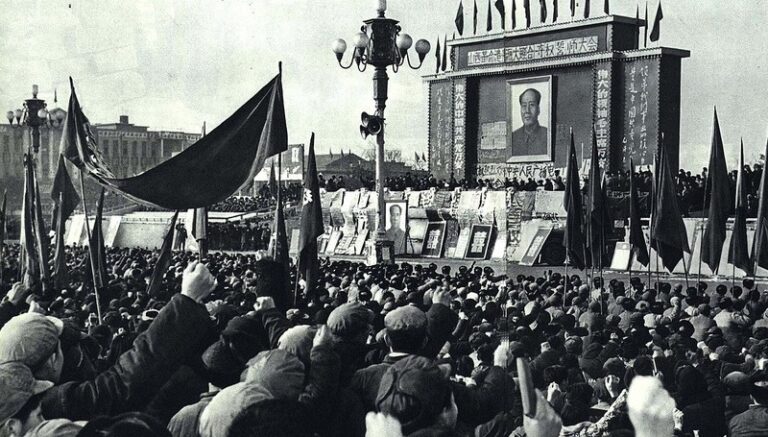
In summer 1966, when I was fourteen, my life was turned upside down when Mao launched the Cultural Revolution. Like other children, I had grown up to regard Mao as God. There was a song we all learned to sing: “Father is close, Mother is close, but neither is as close as Chairman Mao.” If we wanted to pledge what we said was true, we would declare: “I swear to Chairman Mao!” So, when he called on young people to be Red Guards, his taskforce for the Cultural Revolution, it went without saying that we should do as Mao told us to. A Red Guard group was formed in my school, and it ordered everyone to stay on the campus to “make Revolution.” But I shied away from militant actions that the revolution demanded, and kept claiming illness to try to stay away from school. I was criticized for having too much “warm-feelingsism,” and was not allowed to join the Red Guards.
The school I loved had changed into a terrifying place ever since Mao stood on Tiananmen Gate and told the young people to “be violent,” and to “smash all things old.” The Confucian temple was wrecked, and a crowd gathered to pull down the giant stone slabs. Boys urinated in the bronze incense burners, which they had toppled. They went around campus waving iron bars and hammers to knock off the heads of the small statues. Gardens were trampled and battered. I heard that our elderly gardener—with whom I had chatted, as I had been fascinated by what he was doing—had been accused of being a “class enemy,” beaten up, and died.
I cannot describe how frightened and repulsed I was. And there were more atrocities. One day all pupils were ordered to gather on the sports field to attend a “denunciation rally,” at which I saw a dozen or so of the school’s best teachers being hauled onto the platform. My English language teacher, an elderly man with courteous manners, was one of them; like the others, his head and upper body were forcefully pushed down, and his arms ferociously twisted behind his back into the so-called “jet plane” position. On another day I was forced to watch my philosophy teacher being attacked in a classroom and made to beg for mercy by boys from my form because she had previously told them off dismissively in her lessons.
One evening I was swept onto a truck to go on a “house raid” after two female chiefs of a “neighborhood committee” had denounced a woman who they said was hiding a portrait of Chiang Kai-shek. In the house, I heard the woman’s blood-curdling screams as she was stripped half-naked and lashed by a pupil I knew with the brass buckle of a leather belt, the standard weapon of the Red Guards.
On yet another evening, I caught sight of a vague figure falling out of an upstairs window. The Red Guards had divided the pupils into categories based on their family backgrounds. Those from the “good” families were the “Reds,” and those from the “bad” families were the “Blacks.” The “Reds” were licensed to torment the “Blacks.” That evening a seventeen-year-old girl who had been classified as a “Black,” and had had her hair half shaven leaving grotesque bald patches, threw herself out of a window. That night in the dormitory, the moment I closed my eyes I saw a human form smeared with blood. The next day I asked the Red Guards of my class for sick leave and went home. I desperately wished I would never have to set foot in the school again.
*
Home was no longer a refuge from the end of August 1966, when my father was taken into custody. That month atrocities like those in my school swept across China; in many places teachers were beaten to death. My father finally decided to speak up.
His sense of guilt at not voicing his opposition during the Great Famine had never left him, and now all the horrible things taking place were the last straw. He wrote to Mao asking him to stop the violence that was wrecking so many lives. My mother had tried to talk him out of writing, arguing that it was at best pointless and at worst suicidal. My father said that it was the only thing he could do. My mother said, “You don’t care about yourself. You have no concern for your wife. I accept that. But what about our children?…Do you want our children to become ‘Blacks’?” My father replied, “I love my family. But I must do something this time.” He asked my mother to divorce him and tell their children to disown him.
I was at home when my father was taken away, on the orders of the Sichuan Party bosses. My mother asked where he was being taken and was told that the Party had said “No one is to know.” I walked with Father to the side gate of the compound, holding his hand. The long path was lined with grim-looking junior Party officials. My heart throbbed violently and seemed to be jumping out of my mouth. I felt my father’s hand twitching in agitation and stroked it with my other hand. Outside the gate, he was conducted into a waiting car and driven away.
As soon as Mother and I returned to our apartment, she hurriedly packed a few things to go to Beijing to appeal for Father’s release. I asked to go with her to the railway station. She agreed but did not explain anything, telling me that at fourteen I was too young to understand. I stayed with her overnight waiting for the train that would leave at dawn. Later she told me that she had wanted me to bear witness in case something happened to her, and I could also keep Grandma informed.
In Beijing my mother went to a “grievance office.” Chinese rulers throughout history had set up this type of offices for the population to lodge serious complaints, and the Communists continued the tradition. As my father was a senior official, and my mother was one of the very few spouses with the courage to go to Beijing to appeal, she was received by Vice-Premier Tao Zhu, who was one of the Party leaders at the time, before he was purged for his own opposition to the Cultural Revolution. Tao Zhu ordered the Sichuan Party to release my father.
I never thought of refusing to join the Red Guards. Those were Mao’s orders, and to follow them was not open to question, just like to eat or to breathe.
Although I knew that disaster was befalling my family, I did not think of rejecting the Cultural Revolution. Despite my loathing for the horrors in my school, I never thought of refusing to join the Red Guards. Those were Mao’s orders, and to follow them was not open to question, just like to eat or to breathe. Such was the power of the brainwashing. So when I was told that all pupils who had not been admitted into the Red Guards could now be enrolled en masse on National Day, October 1, 1966, I returned to school and put on the red armband. By now the Red Guards had become a looser organization, and virtually all my urban contemporaries were calling themselves Red Guards.
My membership lasted two weeks, till mid-October, when five girlfriends and I left Chengdu to go on a pilgrimage to Beijing to see Mao. My mother, having succeeded in getting my father freed, had returned home and was with Father. My family seemed to be all right, and I felt I could leave, as the pilgrimages might end soon.
Since August the regime had been encouraging young people to come to Beijing to be received by Mao—in a bid to stir up more frenzy for Mao’s deification. Food, accommodation and transport by train were all provided free of charge for the millions of traveling young people, involving colossal administrative work that was managed by Premier Zhou Enlai. Mao made eight public appearances on Tiananmen Square. On the day of our turn—Mao’s last show—the Great Helmsman stood in an open car driven along Chang’an Avenue across Tiananmen Square, passing by us and a million other youngsters who lined the avenue. (We had been informed about the review only the day before, after which we were not allowed out of the premises; and, as another safety precaution for Mao, we had all searched each other just before the rally for potential weapons, including keys.)
When Mao’s car approached, the crowds jumped up and down blocking my view, so I only caught a glimpse of his back. For a moment I thought I should feel devastated, as we had been indoctrinated to regard seeing Mao as the purpose of our lives. But fanaticism was not in my nature, and the consciously worked-up despair vanished the next instant. After traveling for two months in extreme discomfort—packed trains, blocked toilets, hunger and cold, itchiness from lice and inflamed knees from rheumatism—I longed to get home, and have a bath.
__________________________________
From Fly, Wild Swans: My Mother, Myself and China by Jung Chang. Copyright © 2026. Available from Harper, an imprint of HarperCollins Publishers.

