
February 28
Dear Miroslav,
I don’t know what faith means anymore. I’m fifty six years old with a pile of books behind me and an experimental bone marrow transplant ahead of me, and I don’t know what faith means.
But that’s just the beginning of the problem. Do you know that scene in Joyce’s Ulysses with Stephen Dedalus: “I fear those big words, Stephen said, which make us so unhappy”? I forget the exact words he’s referring to—history, I think, is the main one. It’s the idea of the encompassing abstraction that appalls him. I sometimes think that’s where I am with regard to Christianity. I fear those big words—faith, grace, sin, redemption, love—which make us so sad.
Why sad? Because they seethe and shift and slip free from meaning. Because they seem to demand some whole- souled attention but are not stable enough to warrant that. Because they are both necessary and impossible, and pinch individual life in that vise.
I am in my little boat on the open seas with no land in sight.
I know from our many walks and talks over the years that this is not exactly the case for you, but do you feel this linguistic/existential problem that I do? Or perhaps to be more specific: How would you define faith at this point in your life? Not before God but before humans—in an email, say?
–Chris
March 5
Dear Chris,
When you listed your own “big words which make us so sad,” my mind went to Moses’s encounter with God in the burning bush. Speaking from the restless flame, God says to Moses, “I have observed the misery of my people who are in Egypt; I have heard their cry on account of their taskmasters. Indeed, I know their sufferings, and I have come down to deliver them from the Egyptians, and to bring them up out of that land to a good and broad land . . .”
I grew up with a different set of big words, proclaimed with finger-wagging and fist-slamming by semidictatorial rulers. Some ten years before I was born, in what was at the time Yugoslavia, words like “revolution,” “proletariat,” and “brotherhood and unity” sent my then-teenage father on a death march. I, too, felt their force beating me, even as a nine-year-old, into wishing, at times, my nonexistence for being the son of a minister.
For me, big and semantically unstable Christian words mostly became “good and broad land,” hospitable spaces in which I could live without pressure, face unconquered giants, and occasionally feast on the promised milk and honey. I don’t know whether you have had a chance to look at Moltmann’s autobiography, which is about his coming to faith and his lifelong wrestling with it. It is titled A Broad Place. I resonate with the title. He, too, almost perished by big words, though National-Socialist ones rather than Leninist ones like my father.
As I have aged, I have come to believe that my faith matters much less than I thought it did when I was younger.
What sometimes assails me, a giant that I cannot but let be, is not so much the instability of “faith” as it is the experience of its content just vanishing, which may be what you mean by big words slipping “free from meaning.” In the space where God was present to me, there is—nothing.
My life continues in its inertias, but at the edge of my experiences, I sense a cosmic motherlessness: I am in my little boat on the open seas with no land in sight. When the seas are calm, things seem bereft of meaning; when the seas rage, terror is on all sides. I am channeling Nietzsche here, a section from his The Joyful Science just before the famous passage about the madman and the death of God (Nietzsche borrowed the metaphor from Schopenhauer and, like much he borrowed, used it in his own way). Nietzsche’s way of seeing the world is my temptation, as I am sure I’ve told you.
As I have aged, I have come to believe that my faith matters much less than I thought it did when I was younger. I am saved by God’s faithfulness, not primarily by my faith. My faith is a fruit of God’s faithfulness, not the condition of God’s arrival into my soul—and into my speech. I have always had as much faith as was needed to say, if there is God, then nothing can separate me from God’s love—not the instability inside the abstraction that faith might be, not even utter lack of faith. I don’t trust in my faith. Nor my love.
Even at my best, I am incapable of the “whole-souled attention” that God actually commands. (What a wonderful rendering of the first commandment!) When my faith becomes empty, I wait for God to return into my faith, to dock my little boat on the shore. Faith is not a way to hold God close. Faith is trust that God will see me, hear me, know me . . .and come.
“God” is the biggest of the big words and a very unstable linguistic space. Sometimes, for no apparent reason, it suddenly empties itself of meaning for me, most often, for some reason, in the middle of a prayer. But when it doesn’t, that word moves me and makes me quietly rejoice. Not the word “God” as such, but God’s cryptic self- description to Moses, which follows upon the promise of exodus.
So maybe, in terms of faith, there is a good hunger and a bad hunger.
When I “hear” God say, “I am who I am,” I gloss it with “and I will remain that always, also for you.” I then become one of the children of Israel. I feel myself taken out of my own narrowness, out of the dominion of some little Pharaoh, and transported into the wideness of God’s self- commitment to me—and to the whole world. I always think of “God,” a word whose meaning shifts more than the restless flame from which
God spoke to Moses, as a promise. Sometimes I also experience it as such.
—Miroslav
March 10
Dear Miroslav,
I find it very consoling to think of my faith not mattering so much, of it being mostly a form of patience. I’m always quoting to my students Barth’s statement that faith is not an achievement, but I live with a kind of restless and appetitive drive that often seems to belie that. The thing is, I can’t help but see this hunger as a “gift” from God. All of my writing has come out of it, every word, even in works that seem to have nothing to do with God. I am after something, and that something is also after me. Sometimes we meet—vision? collision? it’s hard to say—and our lives catalyze each other and are one force, one love.
So maybe, in terms of faith, there is a good hunger and a bad hunger. The former lives with no expectation of permanent fulfillment. “Glimmerings are what the soul’s composed of,” as Seamus Heaney puts it in “Old Pewter.” One gathers one’s soul, one’s god, fitfully, fugitively, and is content with that. Though everything I have written so far—and not just in these emails but literally everything I have written so far— suggests I am a long way from being content with that. Bad hunger.
God as promise, as you put it? Yes, definitely, another consoling notion.
The word “catalyze” in the paragraph above suggests a different conception of God between us. I don’t think God is this entity out there altogether apart from us. “The eye with which I see God is the eye with which God sees me,” says Meister Eckhart, a quote which I’m sure you know and which is no doubt overused. But it does get at an important truth. Attention enables God’s presence. The life and love that are God are catalyzed by the life and love we expend in his direction, whatever form that expenditure takes (art, prayer, worship, theology, maybe anything beneficent that is done with “absolutely unmixed attention,” as Weil puts it). God really is more of a verb than a noun, as are our “selves.”
Given all this, it matters enormously what words we use to seek God. At least for some of us. I don’t find those “big words” broad and spacious places. I find them fuzzy and gauzy and obscuring of the very thing they are meant to illuminate.
You mention that Moltmann book. Of course, I read it when it came out because, as you know, Moltmann’s The Crucified God is a book of immense and durable importance to me. But I wasn’t able to finish the memoir. It seemed to me deadened by a kind of newspaper prose, no sense of pacing or structure or any of the elements that make that kind of writing come alive.
Technique is the test of an artist’s sincerity, says Ezra Pound. There are ethical consequences to technical decisions. Pound is talking about art (certainly memoir is a form of art), but life, too, is a kind of art, and there are spiritual ramifications to the linguistic decisions/efforts/failures we make therein.
God as promise, as you put it? Yes, definitely, another consoling notion. But that seems to me a goad to an ever- further refinement of our forms of faith. You say you don’t trust your own faith. I guess I don’t either, except in the making of art, when trusting in my own faith (in poetry? in life and love? In God? I’m not sure it matters) is the only way that true art gets made.
I hope I’m also trusting in God’s promise in these moments. I certainly have experienced many moments when my own faith seems to be answered—or, maybe more accurately, fulfilled, a moment of being so replete and consummate that the word “faith” just falls away. How to make a life out of these moments? How to turn this mystical sense of God into a daily faith? How to simply rest in God? These are questions I still struggle to answer.
—Chris
__________________________________
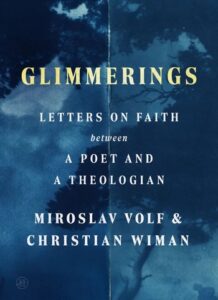
Excerpted from Glimmerings by Miroslav Volf and Christian Wiman and reprinted with permission from HarperOne, an imprint of HarperCollins Publishers. Copyright 2026.

