
Lost Lambs is a stunning first novel, wondrously comic, propelled by absurdist wordplay and a deep knowledge of today’s over commercialized culture. It’s droll, sophisticated yet empathetic toward human flaws as it follows the Flynns, a dysfunctional nuclear family of five, and the sometimes wacky people around them. Add-on: it’s a crime caper involving each Flynn, one way or another.
I asked Madeline Cash about the writing of Lost Lambs. “I worked on Lost Lambs for about a year,” she explained via email.
The idea came piecemeal, from current events, from my own family and from great books I admire. Novels, like charity, generally start at home, which is where I began Lambs, in my childhood bedroom which got me in touch with the teenage girl spirit, surrounded by relics from high school, rereading old diaries, screaming MOM from the kitchen. But I wrote the bulk of it in my Chinatown apartment, on nights and weekends, while I was working as a copywriter for Jack in the Box. I did edits at the Ditrapano Foundation residency in Italy.
There was revision involved, as well. “The novel did change dramatically from the first sentence to the first draft to the finished product, with the help of my patient and brilliant editors Bobby and Jackson, plus the less-official editors, my friends, who read draft after draft, helping nudge me closer to where I needed to go.”
*
Jane Ciabattari: What influences your fiction, including your story collection Earth Angel?
Madeline Cash: Lost Lambs: I love, and endeavored to write, a systems novel, a maximalist novel, a book that makes us examine our societal or political systems. So I read a lot of those, like Something Happened by Joseph Heller, Underworld by Don DeLillo, Absalom, Absalom! By Faulkner. Jonathan Franzen is a huge inspiration/ north star, particularly The Corrections. The Last Samurai by Helen Dewitt and The Virgin Suicides (book and film). The art of Henry Darger, particularly Vivvienne Girls. Movies with bumbling criminals like Burn After Reading and Lock Stock and Two Smoking Barrels. I love Martin McDonagh.
The style I like is hard to define. It’s like pornography, you just know what it is when you see it…
Earth Angel: I was very influenced by Tyrant Books writers like Atticus Lish. The short stories of Donald Bathelme. The Babysitter at Rest by Jen George. Ben Lerner. A.M. Homes. Rebecca Curtis. Nathan Hill. Lorrie Moore. The short story Orientation by Daniel Orozco.
JC: You write with such fluidity and deadpan wit, you create crazy-funny situations, line by line you nail the absurdity of our times. How did you develop this voice, this tone, this style?
MC: I’m sure the style was poached in part from writers I love (see above). The style I like is hard to define. It’s like pornography, you just know what it is when you see it…
I was advised by my editors to balance the humor with the sentimental, which was a challenge—I tend to hide in humor, especially when uncomfortable—but this is more of a conversation for my therapist.
JC: How did you develop the primary characters—the three Flynn sisters (Harper, the youngest at twelve; Louise, Abigail), and their parents, Catherine and Bud, who are experimenting with “open” marriage?
MC: I don’t have three sisters. I don’t even have a dad. I mean, I had a dad obviously but he’s not in the picture. So the characters are constructs. I made character charts. I made a Dan Harmon story circle. It was very calculated, giving everyone individuality. What are their wants? What do they need? What would they listen to? (I made playlists for certain characters.) Even if it didn’t end up in the book, knowing these things helped develop the characters. Some are composites from people I know, some are plucked at random.
JC: How did you settle on the title, a reference to a Christian guidance group led by Miss Winkle at Our Lady of Suffering church? And your opening line: “The gnat situation in the church was getting out of hand.” Did you always have the polyphonic narrative structure in mind?
MC: The title is the name of Bud’s self-help group but also speaks to the characters’ respective journeys—each lost and looking for something (community, reinvention, love, purpose, immortality, etc.) and the various ways they go about finding it.
The polyphonic structure: Like I said, I used to write copy for Jack in the Box. My job was coming up with puns. I love word play, jokes, and double entendre. There was this French writing “school” in the 60s called Oulipo which included Georges Perec and Italo Calvino that was predicated on the idea that more restraint leads to more creative freedom. They’d write, for example, without using the letter E. If on a Winter’s Night a Traveler is a good example, a story collapsing in on itself, using mathematical structures and patterns to construct a narrative.
The grammatical conceit with the gnats: I wanted the town and the text to be infested. You’ll notice that the “gn” stops when the gnats are exterminated, but by that point, they’ve become gnatural in the text and, I’m told, part of the architecture of the book. You don’t even notice they’re gone.
JC: I didn’t at first, but did notice by the end…. Did you have a favorite voice while writing Lost Lambs?
The highest compliment I could hope for is if people see themselves in these systems and feel driven to alter them.
MC: The character Harper took a lot of research. Her penchant for language exceeds my own. I loved writing Miss Winkle because her 180 was difficult, going from a pesky nuisance, frumpy and dissatisfied, to a rounded character who is lovable and pitiable and even sexual, that was hard.
At the risk of sounding like an after school special, if readers could identify with even one of the characters, I’d feel satisfied. The highest compliment I could hope for is if people see themselves in these systems and feel driven to alter them.
JC: Do you have experience living in a small town where everyone’s actions seem visible to neighbors, townspeople, friends, rivals?
MC: Not particularly, no. I grew up in Los Angeles, where we did not know our neighbors and mailmen and clergy members. It is a topic that fascinates me, pulling back the curtain on the American dream, but the town is fully fictional. Actually, everything is fictional. There are no proper nouns in the book. The names of places, brands, medications, dinosaur fossils—all made up! I have a master grid of all names that helped with world building.
JC: At what point did you decide to insert the plotline about the secret society of billionaires seeking immortality (no spoilers here) led by Paul Alabaster, Bud Flynn’s boss?
MC: I didn’t want to be confined to the “family saga” genre and was excited to explore the mystery aspect. I’m reluctant to call the book a mystery because I’m told that puts it on a different shelf. I read detective noirs from the 1950s to understand the tone and plotting of a mystery, a genre I’d never written before. The book’s villain, Paul Alabaster, was inspired by a real person who ritually transfuses his son’s blood to look younger. Fear of aging/fighting mortality, vanity masked as science fascinates me.
Aside: I wrote an article about an island in the Mediterranean where billionaires go for FDA-unapproved gene therapy. The piece was killed.
JC: How has being the cofounder/coeditor of Forever magazine (and its Substack) affected your fiction writing, and your work on Lost Lambs?
MC: One wears different hats being a writer and an editor. I try not to conflate the two roles. That said, founding Forever Mag gave me experience and access I never would have had otherwise. It moved me to New York. It’s how I re-met Anika Levy. We went to high school together and reconnected when I asked her to work on Forever with me. I owe a lot to her. She has a debut out too, Flat Earth. Editing other people’s work helped me be less precious about my own, helped me trust my editors and seek outside perspectives. It also helped me trust my own instincts.
JC: What are you working on now/next?
MC: I just finished my second novel! More will be revealed very soon. I’m now working on the Sunday crossword.
__________________________________
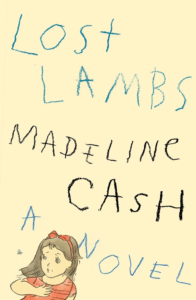
Lost Lambs by Madeline Cash is available from Farrar, Straus and Giroux, a division of Macmillan.

