Megan Milks on Visiting an Animal Sanctuary, Writing About Dairy, and Their Fascination With Cows

I’m reading a book called Milked, about the economic interdependence of Wisconsin dairy farmers and Mexican-born farm workers, with B, my sort-of boyfriend, next to me on the couch. We’re in Kingston, New York, at the book-store that is also a coffee bar. “This seems like a moment,” B observes. “Megan Milks reading Milked.”
I’m a few pages in when a friend DMs me a meme of Kafka’s best quotes about milk. Milk is very good (1924). Drinking down with milk the boredom of six hours work (1908). However I will now drink my milk and go to sleep. Keep well (1920). I’m sipping a mint chocolate latte with oat milk. B is drinking milk-cloudy tea. I put the book down and pick up my phone to research the farm animal sanctuary we’ll visit tomorrow. I want to make a list of questions to ask our guide.
I’m just dipping my toes into this world, I remind myself.
“Uh-oh,” I mumble as I scroll down their page. “Looks like there are no cows at this sanctuary.”
B gives me a bemused look over a copy of Hilton Als’s My Pinup. “Wasn’t meeting cows the whole point?”
It was. I’m building up to visiting dairy farms. I want to meet some cows and maybe, ideally, learn how to milk. B has graciously agreed to accompany me on this trip, a month after our original plan to go to a larger, more well-known animal sanctuary got scuttled when I came down with COVID. That place is now closed for the winter, so my friend Diana suggested we go to And-Hof instead. Her friend Ryder volunteers there and would be down to give us a tour.
I’m sheepish to learn there are no cows, but oh well. There are other animals, and I’m sure I’ll learn a lot regardless. I’m just dipping my toes into this world, I remind myself. The prospect of this kind of research is daunting, as my life is so removed from farm culture. I’m lacking basic knowledge of its vocabularies and cadences, its pressures and challenges, and there’s only so much reading can give me. This will be a first step, cows or no cows.
Diana drives us to Catskill to pick up Ryder, a lithe weirdo artist whose steampunk-fae aesthetic suits them perfectly. Ryder directs Diana to a farm stand on the way, where we pick out kale, spinach, and berries for the birds. Inside, Ryder asks me who I am when I’m not visiting an animal sanctuary.
“I’m a writer and teacher,” I tell them. “I’m working on a book about milk.”
They grimace. “We don’t have any cows,” they say apologetically. The owner used to have one but found her another home. Ryder says that’s a good thing. Cows are a lot of work.
I assure them I know about the cowlessness. “I’m just dipping my toes in,” I say, I keep saying. “Trying to enter the world of farms.”
“We do have goats and sheep,” they go on. “But we don’t do any milking.” There’s no consumption of animal products at this sanctuary. No commerce. The hens’ eggs are up for grabs, but Ryder is vegan, and they’re not grabbing.
Back in the car, they bring up cow insemination. There’s someone whose job is solely to slide sperm up cows’ vaginas. With cautious enthusiasm, I mention my research on the bovine semen industry. “It’s fascinating,” I say.
“I guess fascinated is a good way to be,” they respond slowly.
They’re not intending to chasten me—I think they really mean to convey a respect for my fascination, not imply that their own sense of being deeply disturbed is the only accept-able response. I’m chastened all the same.
Diana parks at the lot and we start up the snowy path, talking about milk. Diana and I both consume dairy products, but no one in our group drinks cow milk on its own, Ryder as a rule, the rest of us out of taste or lactose intolerance. B’s mother hated milk and drank cereal with orange juice. We break into pairs as we walk, stepping into icy tire treads.
Most animals here are free to roam at will.
“I see the hog hut!” Ryder cheers. We approach a wood structure with a wire fence. Loud grunts precede the animal. This long, beautiful hog emerges as if its body won’t end. When it’s all out—huge! The hog’s hide is a mottled black and pink, lightly hairy. Its nose seeks upward like the finger of an elephant’s trunk.
Soon come the snorts, the heavy body of a second hog tottering heavily from the hut. Then a third. And a fourth. They’ve been sleeping hard, it seems, in a cuddle pile. It’s cold. Winter. The first snowfall two nights ago has stuck. Their eyes are tiny and squinting, maybe from the brightness, the sun on snow. The oldest is shivering and seems to have a hard time balancing. They’re all hoping for food. But we only have treats for the birds, not for the hogs. Sorry, hogs.
We proceed down the slippery path, where two alpacas await us, one with a shaved face. They’re friendly, aggressively so. We’re eye to eye, their heads bobbing on skinny necks. They’re a little intimidating, to be honest. They don’t respond well to pets, Ryder tells us. They might spit, but if they do, they’ll arch their necks, that’s the warning. The more assertive one nibbles the edge of my coat. Comes for my hat.
Most animals here are free to roam at will. The sanctuary’s mission supports permaculture, a holistic approach to ecological management. “Rather than being contained in pens, our animals enjoy as much freedom and autonomy as is safe,” the mission statement reads. “We then nurture them to follow their instinctual habits and build on that to create a healthier ecosystem.”
We meet some goats. Some bellowing geese. We squeeze through a gate into the duck pond, where wild turkeys strut, iridescent feathers shining in the bright day. Many of them are rescues from Staten Island, relocated several years ago as part of efforts to manage their overpopulation. The turkeys hang out on an iced-over pond. Some ducks nap on its snowy edge. Others sleep standing on the ice. There’s a shed on the other side. The donkeys come out of it to say hi. They protect the birds from predators, Ryder says. Their braying keeps the wildcats away.
They all want treats. A donkey nibbles at the brown bag of veggies and fruits I’m holding, tears a rip down the side. Eats the paper until Ryder takes it from me. We slide back out of the gate. The geese nip at our shoes and ankles.
There’s Hugo, the antagonistic ram. Wants to charge us with his flatiron head, wants to play or assert dominance or both. I make the mistake of direct eye contact. He’s intent on headbutts. Ryder grips him by his fleece and tells him, “No, no, these are my friends.” They shoo us around the house quickly.
A gang of goats and sheep intercepts us on the way to the chicken coop, interested in whatever food we must have. We push them away and scurry down a trail and through the fence.
Many of the chickens and turkeys here are rescues from factory farms, where they were raised on hormones designed to plump them up as much as possible. As a result, their legs struggle to hold their bodies up. Many have trouble walking and seem unsteady on their feet.
B stays outside—it smells, they say. I don’t notice after a bit. Ryder and Diana and I feed the birds kale—they peck at the voluminous leaves we hold out to them. Then blueberries—Ryder shows us how to cradle the orbs in our palms and hold them out for the birds to peck. “It doesn’t hurt,” they assure us. One of the turkeys is older and going blind. Anticipating a berry, he pecks at the meat of Diana’s hand, drawing blood. We scatter spinach leaves in the dirt. Two bags of veggie slaw. We smush up strawberries and toss them to whoever’s fast.
Once we’ve exhausted our treats, we head back up and around the house the other way. The sheep and goats greet us again. Hugo wants to fight. Another ram intervenes and butts Hugo away. He doesn’t listen. Fight! Fight! Ryder does their best. Diana, B, and I escape the scene one by one, each with our own strategies. I’m the last to break free. We feel guilty leaving Ryder, who can clearly fend for them-self, but this ram will not leave them alone. We sequester ourselves in the donkey and duck pen as Ryder and Hugo circle a tree stump. “No, Hugo, no. We’re friends.” After a while, Ryder’s rubbing his head, scratching behind his ears. Then he’s ramming again. Ryder hides behind a tree and waits for him to get bored and forget about them. Finally Ryder escapes.
How do we justify eating dead animals after spending the afternoon at a farm animal sanctuary? Our answers are shrugging at best.
The alpacas escort us back up the trail, first leading, then following. When we reach the hog hut, they lose interest and fall back.
“The energy there was really intense,” B says. “There were so many needs.”
And it was cold. The animals have shelter but it’s unheated shelter. We’re bummed thinking about it. Resolved: I will cancel my dating app subscription and reroute that money into a monthly donation to And-Hof. I don’t know. It’s something to do.
We drop Ryder off and find food in Kingston. Diana has a burger. B has duck. I choose steak au poivre.
We talk about this. How do we justify eating dead animals after spending the afternoon at a farm animal sanctuary? Our answers are shrugging at best. I like eating meat and I don’t want to stop. In my teens and early twenties I abstained from lots of foods, and now any restriction I make is tied up with disordered eating practices. I try to choose food items with an awareness of context. This meat comes from local animals raised on small sustainable farms; supporting these farms feels like the right ethic.
One of my oldest vegan friends used to tell me to see the cow when she was in an evangelizing mode. The cow is the one common farm animal I haven’t yet seen—not up close, in living flesh. But she’s in my mind and on my plate. Actually this steak was probably not a cow, in fact, but a steer. I see the steer. I honor the steer. I enjoy the steer. I take the leftovers home.
__________________________________
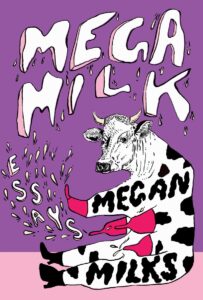
From Mega Milk: Essays on Family, Fluidity, Whiteness, and Cows. Used with the permission of the publisher, Feminist Press. Copyright © 2026 by Megan Milks.