We love a good cult story. A magnetic leader promising a better way of life. Bizarre rituals. A sympathetic convert who realizes too late that secret, sacred truths come at a cost. The result is a modern-day fable: This is what happens when you allow a charming wolf to lead you off the path.
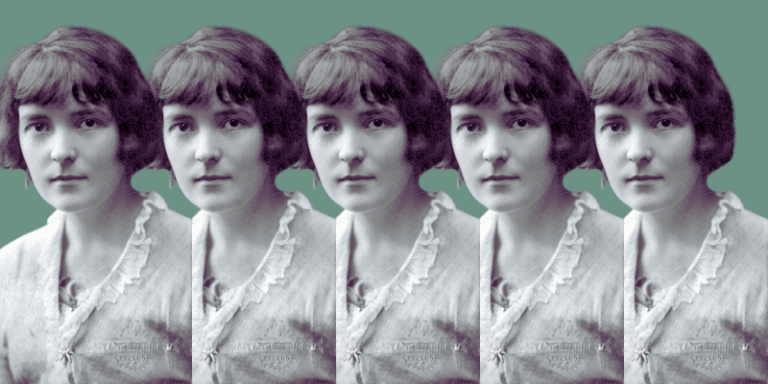
Modern pop culture is rife with these narratives. Documentaries like The Vow and Escaping Twin Flames expose the cults among us, and fictional accounts like The Girls and The Last Housewife dive deep into the cultist’s psyche. But the cult story, and our fascination with it, is nothing new. Cults inspired the same intrigue a hundred years ago, when the writer Katherine Mansfield died at the Institute for the Harmonious Development of Man in Fontainebleau, France, under the care of mystic, spiritual teacher, and choreographer George Ivanovich Gurdjieff. Known for her short stories, and as friend and rival to Virginia Woolf, Mansfield ran in London’s literary and intellectual circles. News of her death and its strange circumstances spread fast, igniting public intrigue and outrage.
The familiar story reassures us, the readers, that we are right and the cultists are wrong, that we would never fall for those tricks—and that if we did, bad things would follow.
Multi-part accounts of the Institute appeared in the Daily News and The New Statesman. Articles ran with titles like: “Dr. Gurdjieff and his Magical Secret of Life: How to be a Super-Man or Super Woman by Feeding Pigs, Dancing Weird Dances All Night and Other Fantastic Antics.” They fit what was known of the facts to a simple narrative: a woman led astray by the false promises of a charismatic figure. Mansfield, however, described her own experience very differently—a tension inherent in the modern cult story, as well.
*
The cult narrative begins with a vulnerable person in search of something society can’t or won’t provide. In 1922 Mansfield was thirty-three years old and dying of tuberculosis. She saw numerous doctors and underwent experimental (and ineffectual) radiation treatment. She also began attending lectures given by Russian mathematician and writer P.D. Ouspensky.
A student of Gurdjieff, Ouspensky had come to London to spread word of his teacher’s philosophy—and perhaps also to raise money. His talks, hosted in drawing rooms and theosophist meeting halls, attracted a slew of high-profile guests, including Aldous Huxley and T.S. Eliot. Ouspensky explained that Gurdjieff had travelled through the Orient and discovered the correct way to live. Man in modern society was disordered, but, at the school Gurdjieff was building across the Channel, harmony could be restored.
After Mansfield informed her husband that she was going to Gurdjieff’s Institute, he responded, disturbed, that giving up radiation treatment for the Institute “seems to me criminal. I mean wrong, utterly wrong.” But Mansfield was undeterred. She told him she was just going to take a look: “I’ll take a toothbrush and peigne and come back Wednesday morning, only.”
She set off for Fontainebleau and never returned.
*
The victim in a cult story encounters a new world too good to be true. And the grounds of the Institute were, in fact, “fabulous and otherworldly”: a former monastery backdropped by the forests of the Île-de-France, with large gardens and two hundred wooded acres. The Institute, still in its infancy, was home to around seventy students, about half Russian and half English. Nine children lived there as well, with “a different mother every week to look after them.”
And at the center of everything was Gurdjieff. Articles emphasized his “exotic” appearance. Bald, with a “handsomely domed” head, “powerful body,” and a long, dark mustache, Gurdjieff was striking, well-cast to play the wolf. He spoke Armenian, Farsi, Greek, broken Russian, and very little English. Described by some as “virile and magnetic in presence,” and by others as looking like “someone amateurishly disguised,” Gurdjieff was an enigmatic figure.
He was not what Mansfield expected. “He’s what one wants to find in him, really,” she wrote. “But,” she continued, “I do feel absolutely confident he can put me on the right track in every way.”
*
In time the new recruit realizes that something darker lurks in this new world. Many accounts of the Institute cast Gurdjieff as a cruel taskmaster who “reigned as a tyrant among devoted slaves,” and life at the Institute was undeniably hard. Students slept three or four hours and then got to work, wheelbarrowing or building or tending to livestock. Sometimes labor served no purpose apart from the work itself. Mansfield’s former editor and fellow student, A.R. Orage, explained: “Often [Gurdjieff] makes us spend a whole day digging an enormous ditch in the park, and then he has us spend the next day filling it up again.”
But they also built beautiful things. They converted a stone house into a Russian bath, fashioning a boiler out of an old cistern and installing the plumbing and lighting, with Gurdjieff laying the bricks himself. They transformed the frame of a wartime airplane hangar into a performance hall, with glazed and colorfully painted walls and a glowing fountain at its center. The roof shimmered with sequined cloths.
After hours of hard labor, the students would break for food. When there were guests, they’d have a feast, with dishes “bearing anything from a suckling-pig to Turkish delight.” More often, meals were bare bones: soup and a little Russian porridge, with little of the produce the students had worked so hard to harvest.
These living conditions—sleep deprivation, hard labor, scarce food—are widely recognized control techniques, used to enforce group obedience. And yet Mansfield found meaning and freedom in the work: “If I am sincere I can only say we live here—every moment of the day seems full of life.” She saw purpose behind Gurdjieff’s cryptic instructions: “He speaks very little English but when one is with him one seems to understand all that which he suggests….And he always acts at precisely the moment one needs it.”
We do not want to be taken in by the wolf. But what if he really does have something marvelous to show us?
More work followed dinner, and then evening exercises into the early morning hours. Gurdjieff choreographed elaborate ballets for his students out of sacred movements. These “weird dances” were the focus of many articles, ridiculed like NXIVM’s midnight volleyball games and the UFO ideology of Heaven’s Gate. But the dances were also striking. An article in the New York Times described them as “bewildering in their complexity,…amazing in the precision of their execution,…and exceedingly beautiful in the gracefulness of the postures.” Mansfield loved them.
*
At the end of the story, a tragedy. Mansfield died of a hemorrhage after three months in Fontainebleau, sparking interest in the Institute’s regimen. Gurdjieff became known as “the man who killed Katherine Mansfield.” D.H. Lawrence stated: “I have heard enough about that place at Fontainebleau where Katherine Mansfield died, to know it is a rotten, false, self-conscious place of people playing a sickly stunt.”
Some students of Gurdjieff were horrified by the coverage, claiming it distorted “a work directed toward consciousness until it was completely unrecognizable, either by making it totally absurd or by deliberately turning it into something evil.” Up until the end, Mansfield believed the Institute had real transformative power: “It is like a dream—or a miracle. What do the ‘silly’ people matter & there are silly people who come from London, see nothing & go away again. There is something marvelous here if one can only attain it.” Gurdjieff’s regimen did not cure her tuberculosis, but nor was any effective treatment yet available. Mansfield arrived at the Institute a dying woman.
The cult narrative, however, had already taken hold.
*
The cult narrative casts adherents as appropriate objects of ridicule or fear or both, and the unusual, harsh conditions of Gurdjieff’s Institute fit that framework well. The familiar story reassures us, the readers, that we are right and the cultists are wrong, that we would never fall for those tricks—and that if we did, bad things would follow. But to flatten Mansfield’s story into a cautionary tale is to oversimplify. Mansfield struck out in search of meaning and connection in her final days and believed herself to have found it. These competing visions of the world are at play in today’s cult stories, too, and this tension continues to fuel our fascination with them. We do not want to be taken in by the wolf. But what if he really does have something marvelous to show us?
_____________________________
The Ascent by Allison Buccola is available from Random House, a division of Penguin Random House, LLC.

