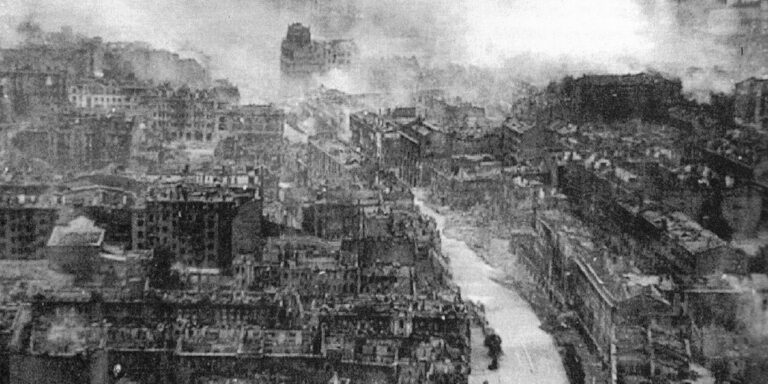
From the World Wars to today’s Russian invasion of Ukraine, conflict has shaped Europe’s cultures, politics, and language. Author Artem Chapeye (Ukraine), Peter Osnos (Poland) and Antonia Lloyd-Jones (Poland) explore how war transforms personal destinies and collective memory through their novels and memoirs.
This transcript has been edited for clarity.
*
Sabir Sultan: Artem, could you tell us a bit about Ordinary People Don’t Carry Machine Guns and what you were hoping to accomplish with the book?
Artem Chapeye: My book is a short work of nonfiction about the choices we are forced to make when history strikes us. Most people of recent generations have been lucky not to face existential choices, but sometimes history doesn’t give us that luxury.
When Russia invaded, millions of Ukrainians had to decide whether to give in without a fight or to resist. And we surprised ourselves—most of us, and probably most of the world, expected Ukraine to fall quickly. The reason we didn’t was because hundreds of thousands of people decided to fight rather than surrender to authoritarianism—or rather, to what I would even call totalitarianism—this new dark wave coming from the north and the east.
Sabir Sultan: You mention in the book that you were a pacifist before the war began. Could you speak to the cost that the war has had on Ukraine’s creatives—writers, artists, musicians—on the creative community as a whole?
Artem Chapeye: Yes, the cost to creatives has been huge. Many Ukrainian writers and artists simply can’t create right now.
At the same time, art in Ukraine has begun to flourish in new ways. People suddenly feel they have a lot to say—and they say it in different forms: through film, visual art, even posters and digital images that circulate online.
I understand the nature of war—writing about war, living through war—and why war is an indelible, horrible experience, yet absolutely central in human history.
In literature, many can’t write—not because they lack time, but because of the psychological burden. There’s also a big discussion in Ukraine now about when and how and who can write about the war. Writing about other people’s suffering, if you didn’t experience it directly, can feel parasitic.
So what we mostly see now coming from Ukraine is poetry—it’s more immediate, emotional, and it can be written anywhere, even from the front. Many poems are written by soldiers or by writers who became soldiers, and vice versa. There’s also powerful creative nonfiction emerging. So far, I don’t know of big novels about the war—but they will come.
Sabir Sultan: That’s a beautiful insight into resilience through creativity. This seems like a good moment to transition to another memoir—In the Garden of Memory—which, like Artem’s book, deals deeply with family and history.
Antonia, could you introduce this work by Joanna Olczak-Ronikier, first published in 2001, and tell us what’s important to know about it in the context of Polish history and literature?
Antonia Lloyd-Jones: This book, written by the now ninety-year-old Joanna Olczak-Ronikier, is essentially the history of her Polish-Jewish family. It traces their story back to the 1860s—to her great-grandparents Julia and Gustav Horwitz, who had nine children before Julia was widowed young and left to raise them alone.
The book follows what happened to that generation and the next. Being both Polish and Jewish is, of course, a complicated identity. What’s particularly interesting is that this family didn’t fit the stereotypical idea of Jews living in small settlements under the Russian Empire. They were part of the intelligentsia—highly educated, active in business, politics, and the arts.
So the book paints a portrait of a lost world, full of energy and ideas. It becomes especially gripping when it reaches the Second World War, where, as in today’s Ukraine, people faced terrible choices—whether to flee, to hide, or to risk their lives staying. There was tragedy, but it’s also a story of survival: a family that preserved its identity and creative spirit through everything.
By the end, we see a large, thriving family that defied history’s attempts to erase them.
Sabir Sultan: That note of family seems like a perfect transition to you, Peter.
Peter Osnos: I’m actually part of that family—one of the great-grandchildren of the people in the book.
What I want to emphasize is that when most people today think about Jews in Poland or Central Europe eighty years after the war, they think only of the Holocaust—annihilation. But there’s another story.
This family, and many like it, represented vitality, education, and devotion to their homeland. They thought of themselves not as Jews living in Poland, but as Poles who happened to be Jewish.
To explain simply: the family had nine siblings and many relatives—on one end, a founder of the Citroën Motor Company, on the other, friends of Vladimir Lenin in Zurich. A whole spectrum of characters—it reads like a great Russian novel.
In the U.S. edition we’re publishing now, there’s even a character list, like in War and Peace, so readers can keep track.
As for me: I’m a writer and journalist. I covered the Vietnam War for The Washington Post, later lived in Moscow during the Soviet era, and published many books about war—including Robert McNamara’s memoir In Retrospect, where he admitted, “We were wrong.”
The story of America and Vietnam is the story of a nation coming to terms with its inability to use power for good. The war was fought for reasons that made no sense for American security; 58,000 Americans and countless Vietnamese were killed.
And here we are, decades later, still living with those consequences. Sitting next to a Ukrainian serving in the military, I can say that for the first time in a long while, Americans are looking at a war being fought and looking at the fighters with enormous respect. That is the difference between how Americans perceived past wars and how they perceive this war—because we know what Ukrainians are risking, and the admiration for their valor is substantial.
Our book—Anna was the translator—includes me as one of the characters; there’s even a passage where my mother complains about me as a teenager. That’s one reason we’re here. The other is that I understand the nature of war—writing about war, living through war—and why war is an indelible, horrible experience, yet absolutely central in human history.
Ukraine is now the heir to Europe’s wars. The Russians invaded without pretext; they are still fighting, and Ukrainians are defending their country as valiantly as they are. So—here’s to you. Thank you.
Sabir Sultan: Transitioning from what you’ve just said, Peter—about the indelible quality of war and its shifting nature—I’ve been thinking about disbelief. Here in America, we see authoritarian impulses within our own government and a constant questioning of where we are and what’s happening.
Artem, in your book you write: “Until the very last day of peace, we didn’t believe this would actually happen… After everything in Europe—21st-century Europe—one country couldn’t just invade another, right? It couldn’t happen anymore.”
Would you take us back to that moment—when you and your family heard the explosions in Kyiv and the reality hit?
Artem Chapeye: I write a lot about those first days—the first third of the book is about them—because the breaking of reality is what strikes everyone hardest. Then, tragically, it becomes a routine, a new routine.
Even yesterday, Russia attacked Ukraine again—Kyiv and Kharkiv. They hit a kindergarten; the children were in a bunker, but some of the staff were killed. This is happening right now.
I feel a little guilty for not believing it would happen. We forgot—I forgot—that just a few years earlier Russia also invaded Georgia to impose its policies. That’s what Russia does.
I was ten when the Soviet Union and the Eastern Bloc were collapsing. There was war in Yugoslavia, then the war in Chechnya. I remember asking my dad, “Is this history happening?” He said, “Yes, of course.” He also told me how lucky we were to gain independence without blood. Thirty years later, it seems Russia is trying to recreate an empire. I’m sure it will fail—but now there is blood. More and more, Ukrainians say this is our war of independence, thirty years after we gained it formally.
Those first days were written in disbelief. The main feeling wasn’t fear but shock and numbness—everything sounded as if through a blanket. Only after a day or two did strong emotions come, forcing choices. We woke up to bombs at 4 AM—Hitler attacked the Soviet Union at 4 AM, too. I grew up with songs and poems about that. It felt like reliving our grandparents’ history: the bombing of Kyiv, occupation of Ukraine.
Millions fled west; we were part of that column. It took us three days to reach western Ukraine. By then I was asking: do I become a refugee and feel I surrendered without a fight, or do I try to fight? Honestly, like many in the West, I thought Ukraine would fall in weeks—but I decided I would at least try.
I went to the army with my foreign passport in my pocket, in case I had to run within weeks—we thought about Romania because that border is less protected. I was already in the army, holding a machine gun, still thinking the army might collapse in two or three weeks.
Why didn’t it? Because hundreds of thousands made the same choice to fight rather than give in. There was already a core of the army, but most of what the army is now are civilians who joined. That’s why the book is titled Ordinary People Don’t Carry Machine Guns: until the day of the invasion, about 95 percent were civilians.
Sabir Sultan: Antonia, earlier we spoke about a parallel—your brother Peter and the character in In the Garden of Memory who becomes a soldier in the Polish Air Force. Could you talk a bit about him and how that journey unfolds?
Antonia Lloyd-Jones: Yes. One of the things Artem writes about so movingly is the choice: do you go straight into the army, do you leave your family?
In In the Garden of Memory, the Jews in Nazi-occupied Poland faced terrible choices: flee, hide, or risk everything. One character—Peter’s first cousin, Ryszard Bichowski—and his family made a complicated escape and reached safety in the United States by 1942. He was about 21, in California, and decided: “I’m not going to sit here and do nothing while my country is invaded.”
He enlisted with the Polish forces, trained in Canada, then was sent to Britain to fly with the Polish squadrons in the Royal Air Force. He was an excellent writer and left a remarkable archive of his experiences. He became a navigator on Lancaster bombers flying raids over Germany—incredibly dangerous. Think of the American film Memphis Belle—that’s the kind of mission.
Tragically, on one raid they dropped their bombs, returned, crash-landed, the plane exploded, and he was killed trying to save someone else. He died very young—a hero. Peter is rightly proud of him. He chose to fight even after reaching safety, which I find profoundly moving.
Peter Osnos: The thread here is resistance—defining yourself through character, identity, resistance. That’s what struck me about the family in In the Garden of Memory across twentieth-century Polish history. And it’s what we’re seeing in Ukraine—a distinct and honorable resistance.
What is the resistance in Russia against the tyranny of the Putin regime? And what about us? If Americans were confronted with autocracy, would we resist? In my generation, during Vietnam, resistance had power—young people in the streets refusing to accept America’s imperial adventures in Asia.
Where in our character do we find the will to resist rather than give in—since giving in is easier and safer? Ukraine could have said, “Well, we were part of that universe for a long time; we’ll be part of it again.” They didn’t. In Vietnam, the resistance of the Vietnamese was so strong they defeated a superpower.
Ask yourselves: if faced with a choice—your integrity and security at risk—would you resist?
Sabir Sultan: Artem, where do you find the fuel to resist—to keep fighting into the third, fourth year of war?
One thing about authoritarianism, war, and writing is this: understand courage, understand resistance, and recognize that each of us is responsible for our own courage and our own resistance.
Artem Chapeye: Many Ukrainians are exhausted. What helps—I say this with some sarcasm—is that we don’t really have a choice. Putin’s war aims to exterminate Ukraine as such. It doesn’t necessarily mean death camps, but we all know what “re-education” means.
I cannot imagine my children being re-educated to believe they’re Russian. The International Criminal Court has issued an arrest warrant for Putin for genocide—specifically over the deportation and re-education of Ukrainian children. Genocide isn’t only mass bombings; it’s any attempt to destroy a group as a group. In occupied territories, children are taken from parents and adopted into “correct” Russian families who tell them their parents were Nazis and that they’re really Russian. Children who resist are punished.
That’s our fuel: there is no choice. He doesn’t want part of Ukraine—that would be “easier.” He wants to destroy Ukraine as such. Thirty-five million people cannot just emigrate. The elderly can’t. Many can’t leave. Without resistance, we would cease to exist as a people.
Sabir Sultan: On that theme of resistance—Antonia, in an earlier exchange you highlighted how, despite the cruelty of war, we also see unexpected human solidarity and deep family bonds. In the Garden of Memory is full of that decency. Could you speak to it?
Antonia Lloyd-Jones: Artem writes amazingly about family; it reminded me that in In the Garden of Memory, survival in hiding depended on the courageous actions of others who protected them at immense personal risk.
Joanna—as a child—was hidden by nuns in a convent school, and earlier she was hounded from place to place with her mother and grandmother. They survived because other people were decent enough to help. Years later, she found some of those families and asked, “Why did you risk your life to protect Jews?” One gentleman said, “It was simply the decent thing to do.”
Family is vital to survival and resistance. You want to live for your children and protect them. In both books there’s a strong sense of family holding together, even when they disagreed—supporting one another regardless. This family is a testament to that bond: they have large reunions now; new generations keep appearing. Hitler failed; he didn’t wipe them out. His genocide failed.
(…Audience questions and answers summarized…)
Peter Osnos: How war is perceived often depends on how it ends. The American view of Vietnam is what it is because we lost. History tends to be written by winners.
For now, the American view of Ukraine is fundamentally supportive. Long-term, it depends on how it ends. If Ukrainians prevail to the maximum extent possible, they’ll rightly be proud. Americans long saw themselves as victors; that didn’t happen in Vietnam—and then we pursued wars in Iraq and Afghanistan that also didn’t end in decisive victory.
So: it remains to be seen. I believe our support will continue because of how Ukrainians have conducted themselves in this three-year-old war. I hope we will be as proud as possible of their victory.
Artem Chapeye: I am very, very glad that Ukraine has a regular army. As long as we do, we can be actively supported—including by other governments. But as soon as resistance devolves into guerrilla warfare, most well-meaning people can only express “deep concern.” That’s one reason we cannot give in.
I remember being in New York years ago and seeing lots of flags—“Free Tibet,” for example. Does that free Tibet? No, it doesn’t. We all know about the atrocities China commits against Uyghurs; does protesting outside embassies stop it? No, it doesn’t. That’s why active resistance matters.
If, God forbid, it came to guerrilla warfare in Ukraine, I’m sure there would be some—but guerrilla war is always more controversial. Victors will call guerrillas “terrorists” or “bandits.” And people forced into guerrilla fighting tend to radicalize—not always in good ways.
After World War II there was guerrilla resistance to Soviet occupation in western Ukraine. But Soviet propaganda branded them terrorists and Nazi collaborators. Today it’s even harder: drones, satellites, and phones make hiding difficult. And no government wants to officially support a guerrilla movement; even when the U.S. intervened in Nicaragua, support for the Contras was largely covert.
So continuing regular resistance is crucial.
We have many cases of Ukrainians returning to fight. My best friend in the army had lived in Finland for fifteen years—he came back. That’s even more amazing than defending your own children; he returned from safety to fight. And I feel deep gratitude when we see foreigners coming—not as mercenaries, but people from richer countries who choose to fight.
Where I serve, there’s a large military cemetery nearby. Recently I saw the grave of a James Campbell. I also knew a man—an Oxford history graduate—who died for Ukraine. He told me that because he knew history, he felt it necessary to fight authoritarianism, to fight tyranny in general.
This panel isn’t only about war; it’s about authoritarianism. Unfortunately, we see it rising in some European countries and in America. Sometimes it feels as if America is becoming less democratic than Ukraine—the country that was supposed to be a beacon of democracy.
So this isn’t only about Ukraine. It depends on the resistance of each of us which way the world turns now—whether we go back to the 1930s, or not.
Peter Osnos: I just want to add something. The essence of In the Garden of Memory is what it meant to be Jewish in Poland.
We are all confronted now with the horrors of the war in Gaza. I’d like to point out that the heroic President Volodymyr Zelensky of Ukraine is a proud Jewish man. The role of people who rise to the challenge isn’t defined by their religion—it’s defined by their courage and their ability to tell right from wrong.
The story of Ukraine—and the story of the family in In the Garden of Memory—are stories of courage, values, and integrity. They are universal stories, including here in the U.S., where people have changed culture and society because of their bravery.
One thing about authoritarianism, war, and writing is this: understand courage, understand resistance, and recognize that each of us is responsible for our own courage and our own resistance.
*
Artem Chapeye is a Ukrainian writer, activist, reporter, and translator. He has authored two novels, four books of creative nonfiction, and co-authored a volume of war reportage. His most recent works include The Ukraine and tonight’s featured book Ordinary People Don’t Carry Machine Guns, both translated by Xenia Tompkins.
Peter Osnos is the author of An Especially Good View: Watching History Happen. He is the founder of the publishing house Public Affairs and a former publisher of the Times Books imprint at Random House.
Antonia Lloyd-Jones has translated works by several of Poland’s leading contemporary novelists and reportage authors, including Nobel laureate Olga Tokarczuk. She has also translated crime fiction, poetry, and children’s books.
__________________________________
European Literature Night (ELN) returns to New York for its 7th annual edition, presenting an evening of voices from across Europe through discussions, readings, and performances at the Ukrainian Institute of America. Organized by EUNIC New York, coordinated by Czech Center New York, moderated by PEN America.

