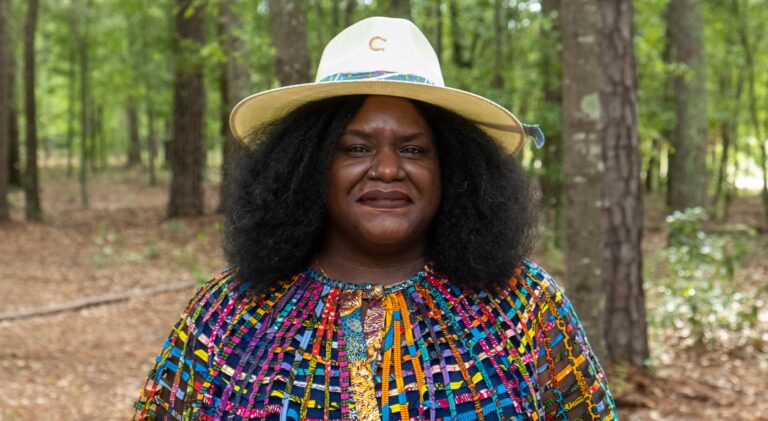
“People came by plane; people drove over 20 hours to sit together in her living room. Exactly as she would have it. It was tradition. Family and friends brought food—biscuits, dirty rice, pound cake, fried chicken, sweet tea—for our bodily nourishment, but it was the space that was opened up for us for the stories, the memories, the tears, the anger, and the sharing of it all together in this space that made it a place of healing.”
–DéLana Dameron
January 30, 1985–November 29, 2025
*
Two days after Thanksgiving, DéLana Rachel Anne Dameron, daughter of the South, citizen of the Black diaspora, and devoted member of arts and equestrian communities, transitioned from this life to become an ancestor. She was forty years old.
The foregoing words describe how her family gathered in South Carolina to grieve her grandmother’s death in 2013. Six years later, she returned home to her beloved South after thirteen years in New York City. Home would be the root of her remarkable life’s work, as an accomplished writer, cultural strategist, and equestrian. That work continues now, even after her passing.
In 2024, DéLana’s debut novel, Redwood Court, was published to critical acclaim. It is the coming of age story of Mika, a Black suburban South Carolina girl. Redwood Court was a Reese’s Book Club pick, a New York Times Editors’ Choice, a Time Magazine best new book, a Well Read Black Girl selection, and a finalist for the Willie Morris Award for Southern fiction. The recognition attests to how beautifully DéLana captured the post-civil rights movement Black South, full of deep inheritances, abundant crises and -nevertheless- possibilities.
A review by Betty Joyce Nash in the Southern Review of Books describes its magic in this way:
Dameron renders her ambitious, complex saga through lush, layered and satisfying scenes that immerse us in this era through the individual and collective lives of a family… insightful, smart characters and striking, original language keep the scenes lively, meaningful yet heart breaking, especially when the perils of ‘being Black’ inevitably crop up.
The success of Redwood Court followed an already distinguished career as a poet. DéLana’s first book, How God Ends Us was selected by Elizabeth Alexander for the South Carolina Poetry Book Prize and published in 2009. These poems explore, loss, wonder, spirituality and the presence of the divine. Alexander said of the work, Dameron listens to her own strange music and plays it. That is what her craft serves and that is what her artistic courage enables.” And “these poems are beautiful and tough. They sound like no others…”
You can see just how tender and incisive her poetic voice is within the poem, “The Body as a House” from How God Ends Us.
“The Body as a House”
after Forest Hamer
Say the body is not full of the spirit
Say the spirit does not exist.
Repent.
Say there is no such thing as the rapture
and live your days on middle ground.
Say there is no such rapture.
Say the mouth is a portal between heaven and earth,
that the eyes bring in or shut out the light,
that the ears harbor a song with which to dance.
Say I live in the body in order to dance.
Say your body is only flesh
and not a house of habitable organs.
Repent. You should not say it.
Say the body is imperfect and love it still.
The body is, in fact, imperfect, but
say you love it, as I do.
DéLana’s second book of poetry, Weary Kingdom, which was chosen by Nikky Finney for the Palmetto Poetry Prize, was published in 2017. It maps the terrains Dameron knew well: Harlem and South Carolina, and roads within and between. Ross Gay said of the collection, “It has a home thing, with its mapping and searching, it’s longing…for a home, a place in which to find rest, a sanctuary…That home, or idea of home, takes many shapes—the South, Harlem, family, memory, a lover, the body, the earth itself.”
Her poem, “At the Station,” gives us one example of that mapping
“At the Station”
There is a train leaving the station
& he is on it.
Rain again; a soft mist
on your cheeks.
Remember how you danced —
how light lingered its amber vibrato—
how you left your bags
at the station once, with the map
& just walked out into your day?
There was a time you two stopped
in your tracks for a while
& shared. You swore night
would never come.
The train whistle slices the air
& he is on it. You consider
gathering your things.
But in the rain, umbrella opened,
you lift your arms; flare up
your body & dance. You will not
go there again. You will wait.
There is a later train;
wheels churn in the distance.
On the cutting edge of the writing world, DéLana shared her insights and musings on a podcast and Substack.
The love-thick seeking that resonated with readers was evident throughout DéLana’s life. And as remarkable as her literary career was, so, too, was her commitment to artistic and culturally enriched community. A history department graduate of the University of North Carolina and the NYU MFA program in poetry, as well as an active participant in the Carolina African American Writers Collection, Cave Canem, and The Watering Hole, DéLana found and sustained community as she moved through each institution, always providing support, artistic inspiration, and friendship.
She was a brilliant storyteller who was dedicated to her craft and inspired the same in others.
She later used her profound storytelling skills as an expert fundraiser and development officer, founding Red Olive Creative Consulting, (later Red Olive Culture Commons), to serve small and medium nonprofit organizations like 651 ARTS, Kundiman, the Louis Armstrong House Museum & Archives, The Teak Fellowship, Weeksville Heritage Center, and The Drawing Center, among others. DéLana later became the founder and chief strategist of Black Arts Futures Fund with her husband, a collective of “emerging philanthropists dedicated to promoting, elevating, and preserving Black arts & culture through grant-making, board-matching, and organization-to-donor cultivation” that operated from 2017 to 2023.
Her deep commitment to community and imagination in the service of that community is apparent in her founding of Saloma Acres, which she ran with her beloved husband Curtis Caesar John. Saloma Acres is a 22-acre working farm with “eight horses, two donkeys, and two pigs… plus the vibrant wildlife that seeks refuge there. On property are wild and planted fruiting trees, vines, every kind of oak imaginable, and some forested trails. If you sit still at any of the picnic tables sprinkled through the property, it’s a birder’s paradise.” DéLana took up horse riding shortly before establishing the farm as she grieved the loss of her beloved father, Tom Dameron.
“I don’t know who I am in this whole world, but I want to be able to still move people, in this way, no matter which side of life I’m on.”
–DéLana Dameron, September 2018, Facebook.
In her healing journey, she decided she would create a space for the healing of others, eventually founding Saloma Acres as a place to provide rest, play and community for Black people. At Saloma Acres, just miles from where her ancestors had been enslaved, DéLana embraced the tradition of Black Southern stewardship of the land. And as an equestrian, she competed in cowboy mounted shooting on her horses, Shadrack and Jazzie June, and cow work with her horse, Gravie. She was often photographed on horseback wearing the hats she loved, a modern day mix of country and cosmopolitan. In her last days, she said, “horses are fundamentally part of my life” and had started to build her knowledge base towards becoming a horse breeder.
DéLana was an artist in both traditional and emergent forms. In the traditional, DéLana sewed beautiful, distinctive and colorful dresses. She also made gorgeous quilts, having learned the art of quilting from L. Teresa Church of the Carolina African American Writers Collective.
DéLana’s passion for life is remembered with joy by her loved ones who describe how much she enjoyed live music, especially jazz, good television, and laughing with friends. She believed in sisterhood, and institution-building. At the same time, she was a brilliant storyteller who was dedicated to her craft and inspired the same in others. Her second novel, Fairfield County, is slated for publication by Dial Press in June of 2026.
In her final days, she shared with her sister-friend, Raina J. León, “This morning I woke up at home [with] the phrase ‘this land is so loud; it’s overwhelming.” She listened to the land, the home of history within that land; now, we must learn to listen for her and what she still has to teach us. She continues to invite us, gather us. She knew her own value and as Steph Costello wrote, “she encouraged others to know their worth as well.” Costello also shared on social media that DéLana had
‘pre-celebrations.’ If she wanted something in her life, she would drink champagne and toast with her friends as if it had already happened. She did this before getting accepted into a creative writing program at NYU, and she did this before landing her book deal. But she didn’t just hope for things, she worked hard for all her success—she was ambitious and determined. She seemed to exude a doubtless belief in herself, backed up by decisive action, which I will forever appreciate.”
So will we all.
In Redwood Court, DéLana wrote in the voice of Teeta, the family patriarch,
You have all these stories inside you—that’s what we have to pass on—all the stories everyone in our family knows and all the stories everyone in our family tells. You have the stories you’ve hi heard and the ones you’ve yet to hear. The ones you’ll live to tell someone else. That’s a gift that gives and gives and gives. You get to make it into something for tomorrow. You write ’em in your books and show everyone who we are.
Though she has transitioned, she wrote of her people—Black, Southern—with pride. She was uncompromising in the centering of her writing on her beloveds and invited us all to write of our communities, to “show everyone who we are.”
DéLana is survived by her husband of 12 years, Curtis Caesar John who she described as “my love and light. My muse and poem. My steadfast kingdom” and her sister Tressa Toreá Louise Dameron, aunt Jenneise B. Carr of Savannah, GA; father-in-law Bromley John; brothers-in-law Wayne John and Jason John and sisters-in-law Simone John and Monica John; nephews Asar, Meru, Kuasi, and Ikemba, and niece Siyanda-Yara; god-siblings Detra, Shelby, and Craig; as well as a host of friends and an audience of people who were deeply moved by her work. She had recently lost her mother, Lavoris Rená (Melvin) Dameron, who, as a childcare provider, had raised hundreds of children in Columbia, South Carolina, Indiana, and Arizona. The grief is great and shared by so many—may words from her own poem “Inheritance,” dedicated to Lucille Clifton, provide some comfort to her loves:
Frequented in dreams
by fresh-dead loves, so I have seen
with these eyes the eyes of a spirit
who has crossed, seen the body reject
its coffin bed and climb right out
onto the church’s plank floor
seen the dove at the bed’s foot
calling out all names, or the red eyes
of the flesh, abandoned. Do not say
I should be grateful for perfect eyes
or their ability to see such distances.
Say I should be grateful for sight,
for open and shut.
________________________
Donations in DéLana’s memory can be made to Saloma Acres, the proceeds of which will go to the continued care of her beloved horses and animals.

