Whenever I’m deciding if I want to read a book, I’ll read the first few pages to see if they make me laugh. And more often than not, the books that make me laugh the hardest are written by women. I think funny women are criminally underappreciated, often mistaken for unserious or silly.
But I’ve found the exact opposite: The voices I find the funniest are usually telling pretty grave stories. It’s no new revelation that comedy and tragedy are a double helix. We use humor to process tragedy, and our tragedies inform our sense of humor. In fiction, I’ve found the best moment to reveal a character’s humor is often during a dark or difficult situation—this juggling act of emotions helps the reader relate to your voice and your characters. I think a story is better when it spans a variety of emotional responses, and laughter is just as significant and tender as any of the others.
On its face, my short story collection is about fame—who wants it, who has it, how to get it, and what becomes of people once they have it—but really, it’s about a bunch of lonely women who are desperate to be seen and understood. That’s pretty tragic. While I was working on this collection, I often turned to the same few writers for help when I lost track of my humor in a dark space.
The books below are unquestionably dark. Death, addiction, deterioration of friendships, loneliness, suicide, cancer—it’s all there. But the women who wrote these stories are the funniest voices I’ve read. They’re perfectly timed comedians who give grief and humor the equal respect they deserve, and the stories are better for it.
Side note: Of course I think men can be funny too. I’ve read a lot of funny books written by men. But women are funnier. And I like to think that’s because we have a lot more shit to deal with (biologically, culturally, politically, et al.). With that, I give you six sad books by funny women.
*
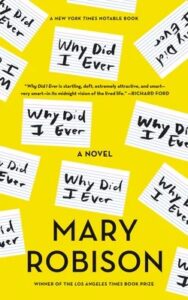
Mary Robison, Why Did I Ever
In her hometown of Melanie, Alabama, Money Breton has two friends: Hollis and the Deaf Lady. Her daughter, Mev, a methadone addict, is renting a place down the street. Her son, Paulie, is living under police protection in New York after a violent sexual assault. Money is on the verge of being fired from the Hollywood studio that has her writing a rom-com rendition of Bigfoot, the IRS is after her, and her therapist won’t give her enough Ritalin to support her habit. Also, her cat is missing.
And so begins the story of Mary Robison’s protagonist in her 2001 novel, Why Did I Ever. Written in five hundred and thirty six sections, Why Did I Ever jumps from scene to scene, settling on snippets of conversation and revelation for only a few sentences before taking off in the next direction. Mary Robison’s voice might be the funniest I’ve ever read (section 88 inexplicably begins, “Oh sure, in my dreams I eat Fritos.”), and Money Breton’s is one of the loneliest.
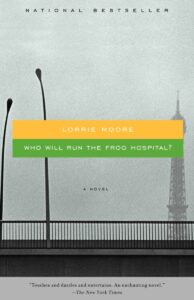
Lorrie Moore, Who Will Run the Frog Hospital?
Nobody has as much fun with words as Lorrie Moore does. This little coming-of-age novel, published in 1994, follows Berie Carr and her best friend Sils as they navigate adolescence while working at Storyland, a fairytale-themed amusement park, for the summer. The book jumps between the past and present, where adult Berie is arguably depressed while visiting Paris with her husband, whom she probably doesn’t love anymore. Lorrie Moore’s comedy is always right on time. Her word play is unmatched. And this story of adolescent friendship, love, and loss is both relatable and original. We have Lorrie Moore’s language and humor to thank for that.
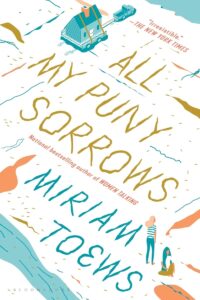
Miriam Toews, All My Puny Sorrows
This book is totally devastating. But Miriam Toews is undeniably funny, even when her narrator, Yoli, is weighing whether to assist her sister Elf in suicide for 300 pages. This story confronts death with profound compassion and wit, and its portrayal of sisterhood will make you laugh and sob interchangeably. I’ll leave you with this paragraph:
One of my latest ideas for saving Elf’s life is to have her parachuted into a strange and brutal place like Mogadishu or North Korea where she’d be forced to survive on her own in ways like never before. It was a risky plan. She could throw herself on the mercy of a child soldier and just get herself shot and that would be that or she could be jolted into a completely new notion of what it means to be alive and what is required to stay alive. Her adrenal gland would begin to work overtime and she’d be lifted up, energized, hunted, and desperate to outwit her attacker and survive. She would be utterly alone in this violent setting—though I would somehow have attached a live webcam to the side of her head or something like that so I could track and monitor her progress.
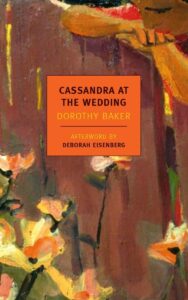
Dorothy Baker, Cassandra at the Wedding
I was tempted to include The Bell Jar on this list, but I chose Cassandra at the Wedding instead because it was probably on far fewer 10th grade English syllabi. Cassandra, who’s depressed and too smart for her own good, is home from graduate school for her twin sister’s wedding, which she’s dead set on sabotaging. Their father is an alcoholic, their mother is dead, and their relationship with one another is strained. Reading Cassandra’s voice is like reading The Bell Jar’s Esther if Esther were drunk on brandy half the time. Dorothy Parker was a master of witty dialogue and subtle comedy, and this story perfectly captures all the tenderness and rage of sisterhood.
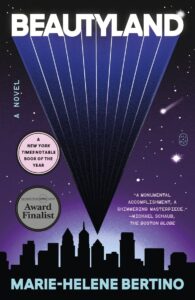
Marie-Helene Bertino, Beautyland
Oh, man. This book took me out. Adina is an alien who’s been sent to earth to observe humanity and report back to her superiors. The novel begins with Adina’s birth and spans her lifetime, throughout which she searches for a definition of humanity and her place within it. Author Marie-Helene Bertino’s greatest talent is her ability to make small moments feel huge. But she’s also hilarious. Throughout the book, Adina sends faxes attempting to explain humans to her superiors on Planet Cricket Rice. Her observations will make you laugh (e.g. Human beings did not think their lives were challenging enough so they invented roller coasters), but her perspective is also profound and heartbreaking, culminating in an ending so beautifully written I still get teary when I think about it.
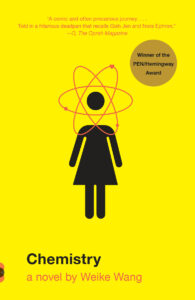
Weike Wang, Chemistry
Weike Wang’s debut novel is quick, wry, and fraught with self-deprecating humor. Wang’s unnamed narrator, whose boyfriend Eric has just proposed, is pursuing her PhD in chemistry without much success. Through often fragmented narration, we see her unravel as she fails to meet the expectations she’s set for herself. But even in her darkest moments of identity crisis, her insights are self-aware, profound, and, yes, funny, including a bit where she impulsively chops off her hair because her mother told her that “too much hair will suck nutrients away from the head and leave it empty.”
__________________________________
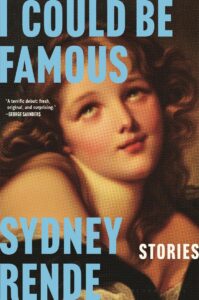
I Could Be Famous by Sydney Rende is available from Bloomsbury Publishing.

