I’ve always read my way through depressions. When my world sucks, I shut the drapes, hide under the cover, and read. And I will read everything: novels, classics, epic fantasy, romance, spy novels, you name it.
These last couple of years have been especially sucky, though. Watching a genocide being live streamed is something no sane person could abide. Seeing masked gestapo agents disappearing people in broad daylight is devastating. And what can I say about people who I thought were moderately intelligent acquiescing to the demands of a narcissistic sociopath?
If you’re not depressed, you’re not paying attention.
The other day, however, when I finished a wonderful novel, I realized I was feeling better. The world might suck, but I can still be inspired. I’m assuming here that everyone reading this knows the James Baldwin quote:
“You think your pain and your heartbreak are unprecedented in the history of the world, but then you read. It was books that taught me that the things that tormented me most were the very things that connected me with all the people who were alive, who had ever been alive.”
So, in this maelstrom of shittiness, I offer you a list of depressing novels that can lift you out of depression—a list that will not include my new novel, The True True Story of Raja the Gullible (and His Mother), because it would be too cringe to promote my novel on my list.
*
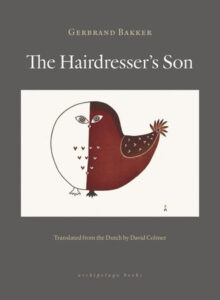
Gerbrand Bakker, David Colmer (Trans.), The Hairdresser’s Son
Why it’s depressing:
I have little in common with the main protagonist of this novel, Simon, other than being gay, lonely, middle-aged, grumpy, single, slightly misanthropic with mother issues. Simon is a hairdresser, just like his father who died before he was born, and his grandfather before him. Simon researches his father’s life and finds nothing, tries a relationship with an emotionally withdrawn writer that fails, and tries to get through to his mother and fails miserably. That’s depressing.
Why it will lift you out of your depression:
Because it’s fucking brilliant, of course. The novel shows us Simon living his life—honing razors, polishing mirrors, sweeping discarded hair—an ordinary life filled with wonder. The subtlety with which the reader comes to see Simon’s loneliness and desperation is magical (and depressing!) His condition is mine. It’s yours. It’s human.
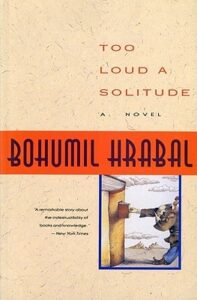
Bohumil Hrabal, Michael Henry Heim (Trans.), Too Loud a Solitude
Why it’s depressing:
Let’s start with the fact that the book is about a man, Haňťa, who has spent his life compacting wastepaper for recycling in a cellar. Is that not enough? He attempts to rescue banned books that are about to be destroyed. His life’s ambition is to buy the hydraulic press he uses to crush the paper, which he never achieves, of course. And when The Brigade of Socialist Workers replace him with apathetic paper crushers, he lies down in his press, holding a book by Novalis of all people, and crushes himself.
Why it will lift you out of your depression:
Because it’s fucking brilliant, of course. Haňťa is trying to survive a totalitarian dictatorship that disdains and prosecutes the arts (sound familiar?), yet he doesn’t merely survive, he transcends. The world might see him as a peon, but he sees himself as an artist. He considers every bundle of papers he creates a work of art. He wraps each bale with reproductions of paintings and places a rare book at the center of it. He dreams of the world seeing his bales the way he does. Dreams are an act of resistance.

J. M. Coetzee, Waiting for the Barbarians
Why it’s depressing:
No one escapes the savagery of colonialism in this novel (think Gaza). It shows us how we destroy our souls. The collapse of the magistrate echoes that of empire. The violence, the torture, the killings. It’s so depressing, it makes Disgrace read like a walk in the park.
Why it will lift you out of your depression:
Because it’s fucking brilliant, one of the great novels of the twentieth century—hell, one of the greatest novels ever. I’m not sure how well I can write about it because I’ve read it so many times, and each reading impacts me in a discrete way. Reading and rereading it makes me feel better because it helps me understand that we all are both the empire and its barbarians.

Leo Tolstoy, Anna Karenina
Why it’s depressing:
Unhappily married Anna decides to have an affair, fucks everything up, causes much pain to many, and finally commits suicide by train decapitation. Ouch!
Why it will lift you out of your depression:
Because it’s fucking brilliant, arguably the best novel ever written. If asked to define the word ravishing, I’d reply Anna Karenina. However, that isn’t the only reason why the novel is uplifting. As with The Hairdresser’s Son, reading about Anna’s loneliness helps us see our own. It shows us our wound, and hopefully, once we see it, we might be able to apply antibiotics and maybe some gauze.
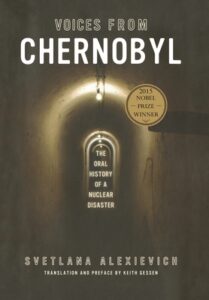
Svetlana Alexievich, Keith Gessen (Trans.), Voices from Chernobyl
Why it’s depressing:
Let’s see. The collective nightmare of a nuclear meltdown with all its accompanying horrors: leukemia and a hodgepodge of other cancers, disfigurement, mutation, displacement, forced evacuation, death of people and animals and land and hope. It’s a horrific situation that is exhaustively documented.
Why it will lift you out of your depression:
Because it’s fucking brilliant, of course. I don’t remember any book ever affecting me as much as this one. It’s supposed to be an oral history, but Alexievich calls it a novel in voices. No matter how sad their stories are, how awful, hearing from people whose voices are rarely listened to is exquisitely cathartic. Alexievich does something mindboggling. The reader not only gets to hear these singular people speak but also begins to see a people do so. No matter how many times you have read this book, I suggest a reread. It is Kafka’s axe for the frozen sea within us.

Hans Fallada, Michael Hofmann (Trans.), Every Man Dies Alone
Why it’s depressing:
An apolitical, working-class couple’s son is killed while in Hitler’s army. Their neighbor, an older Jewish woman, gets arrested and Nazi thugs brazenly loot her apartment. The woman jumps off the balcony. Otto and Elise decide they must do something—and that something turns out to be the most stupid, most futile thing ever, and gets both executed.
Why it will lift you out of your depression:
Because it’s fucking brilliant, that’s why. This novel was written in 1947 but wasn’t translated into English until 2009. I don’t understand why it took so long. Otto and Elise are so alive on the page, and noting how this staid couple who enjoyed their dull routines come alive with their small acts of resistance is breathtaking. Knowing that what they were about to do—write antifascist postcards and leave them around town for people to pick up—could get them arrested and killed, these antifas still felt compelled to do it. The people who found the postcards were so terrified that almost all the cards were turned over to the gestapo. The act was stupid and futile, yet heroic and life-affirming. When I first read the novel, I had no idea that it was based on an actual couple and that the events of the novel were true. In reproductions of the real postcards, we see that the handwriting is clumsy, all in block letters, and the messages are littered with spelling errors. Like Haňťa’s bales, those postcards are art. Reading this novel helps you understand that a short life is more alive than a long life of acquiescing to tyrant wannabes.
*
I should note a couple of things here. I did not define depressing for many reasons, not the least of which is that I don’t know how. I do know, however, that what truly depresses me is a bad novel. I should also mention that even though I read my way through depressions, I don’t stop taking my anti-depressants.
Go on, read, resist, and then read some more.
__________________________________
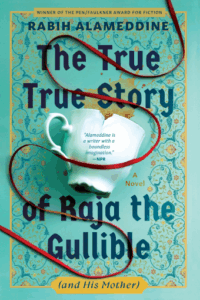
The True True Story of Raja the Gullible (and His Mother) by Rabih Alameddine is available from Grove Atlantic.

