I preferred to take Boulevard du Trente-Avril, a site of permanent chaos that lengthened my trip, rather than the shortest, most logical route, which inevitably led me past the soccer stadium, shops, playgrounds, and my childhood home. The only moving cars were the ones driving in the wrong direction. Some drivers, tired of waiting, danced bare-chested on the asphalt or on their hoods; taxi drivers honked or listened to the latest hits at full volume on their radios; street hawkers glued their faces to windows, peddling all sorts of food and wares; and motorcycles slalomed between the larger, trapped vehicles. I was headed to Samy’s studio, a former carwash located on the outskirts of the Cité des Enseignants. The neighborhood where Sennke and I had lived with Madeleine. I spotted a police uniform in the distance and unlocked the RAV4. Perched on the running board, the open door under my arm, I gestured vigorously in his direction. When he reached me, he pinched the visor of his khaki beret between his thumb and index finger.
“Mama Prefect, God bless you. You’re in a go-slow, oh! I beg your pardon. I’ll clear the road for you, now now.”
The prefectural badge on the windshield hadn’t escaped his attention. I got back into the car and rolled down the window.
I usually refused to take advantage of the priority lane. Today, I needed to keep my arms and legs busy. Avoid potholes, taxis, and motorcycles slamming on their brakes without warning, pedestrians who cross without looking. To get the letter from the Fènn Town Hall out of my head, I had to keep my attention focused elsewhere.
“Abeg, Mama Prefect, save a brother.” “And who will save me?” I joked.
“Mama, Mama, times are tough . . . Your sister at home dey always on my back.”
I took my purse from the passenger seat, pulled out a five-thousand franc bill, rolled it up in my fist, then palmed it to the officer. In no time, he had cleared a path. I jammed the key into the ignition.
The SUV bounced down the dirt alleyway that led to the studio. It was a far cry from the paved roads and air-conditioned streets of the Fleuve neighborhood where I lived with Tashun. This district, where the government once housed Ministry of Education employees, had grown dilapidated since it was sold off to private investors, but the rent was affordable. Impoverished, like most parts of the capital, the Cité des Enseignants wouldn’t be able to avoid the status of “ghetto” much longer, despite the flowering flame trees that brightened the houses. Everywhere, families had moved into makeshift shelters cobbled together from sheet metal and wood. During the rainy season, their hovels turned into hovels on stilts. An expensive renovation to raise its foundation protected Samy’s studio from the elements; high above it all, the veranda provided a stunning, unobstructed view of poverty and all its ills. Samy knew that I used to live nearby. I would have preferred he settle somewhere else, but he said the atmosphere stimulated his creativity. And he really did seem more prolific since he’d been working there. If the exhibition—his first solo show—was a success, he would finally be able to turn the page on the moldings he sold to tourists on the hunt for cheap souvenirs. I was eager to see his sculptures, his new work. I knew this wasn’t the right time to mention the letter I had received. I also knew that I would mention it anyway. Who else could I talk to about it? Under different circumstances, regarding any other subject, I would have laughed as I showed him the obsequious, handwritten note the mayor of Fènn had added to the bottom of the page. The prospect of serving His Excellency and Madam Excellency fills me with deferential joy. My laugh, which Tashun always found inappropriate, would have slipped past my lips. But not this time. This letter didn’t make me want to laugh at all.
“The activist artist in all his glory!” Samy exclaimed, pointing at four sculptures supported by wooden rods. Hollow cheeks, red eyes, dark circles. He clearly wasn’t getting enough sleep. “This isn’t the final scale, just maquettes,” he continued. “It will be bigger, the height of a grown man. I’m doing ten on the same theme.”
Four male figures stood before me, their long necks headless, two-thirds of their abdomens replaced by their heads lodged between their solar plexuses and belly buttons. The square heads overflowed on all sides to create love handles and sagging bellies. Bloody nostrils, mouths twisted in pain, eyes wide with the same despair found in Courbet’s The Desperate Man. The faces of the four terracotta characters Samy had sculpted were vaguely familiar. I thought for a moment. The president and the three vice presidents.
“So?” he asked anxiously.
“You really want to put this on display?”
“There’s more, not just sculptures,” he said as he gestured toward the far end of the warehouse. “I’m still thinking about the title for the show, but I think I’ve got something. Come with me.”
A rattan bookcase, volumes on sculpture and photography, old newspapers, a pile of drawing notebooks, and on top of them, a sheet of paper.
“Come sit here, you’ll be more comfortable while you read,” he urged as he pushed toward me the tall bamboo stool where he usually sat to draw and held out the piece of paper.
Ante Mortem. Before death. As I read, I grew uneasy. In Zambuena, people weren’t arrested for expressing disagreement with the president or his party anymore. Samy had the right to sculpt and write what he wanted, to criticize whomever he chose. That was his role. The important thing was that he have no political ambitions, and since he didn’t, there was nothing to fear. I only hoped that he wasn’t lying to himself so deftly that he actually believed that choosing the right type of clay—sandstone, ceramic, porcelain, or kaolin—and obediently following the meticulous, thankless steps required to create a sculpture or a bas-relief would be enough to influence the status quo. He couldn’t actually believe that a bold and powerful piece of art forged from nothing could force society to deviate from its fixed trajectory. An activist artist, fantastic! Tashun would be sure to choke on that. “Your friend is a constant thorn in my side!” I could already hear him bray.
A projector displayed an experimental film on the floor: overweight children devouring banknotes, laughing hysterically with each mouthful, while others looked on angrily, licking their lips. I made a mental note to ask Samy if the bills were real or from Zambony, our local version of Monopoly—in the video, they looked authentic. Against the wall, a plywood trestle bore a series of 24 x 32-inch black-and-white photographs. Bodies of children, teens, the elderly, men, and women. Bodies pieced together to create a two-headed, multi-sexed fresco. Was it in keeping with the times? Was it good? Beautiful? Modern? I didn’t know what to think except that I was troubled by the combination of buttocks as old as Methuselah with a young man’s head, a grandmother’s withered breasts, children’s legs, and sex organs of different sizes and types. Not to mention the obese little gluttons.
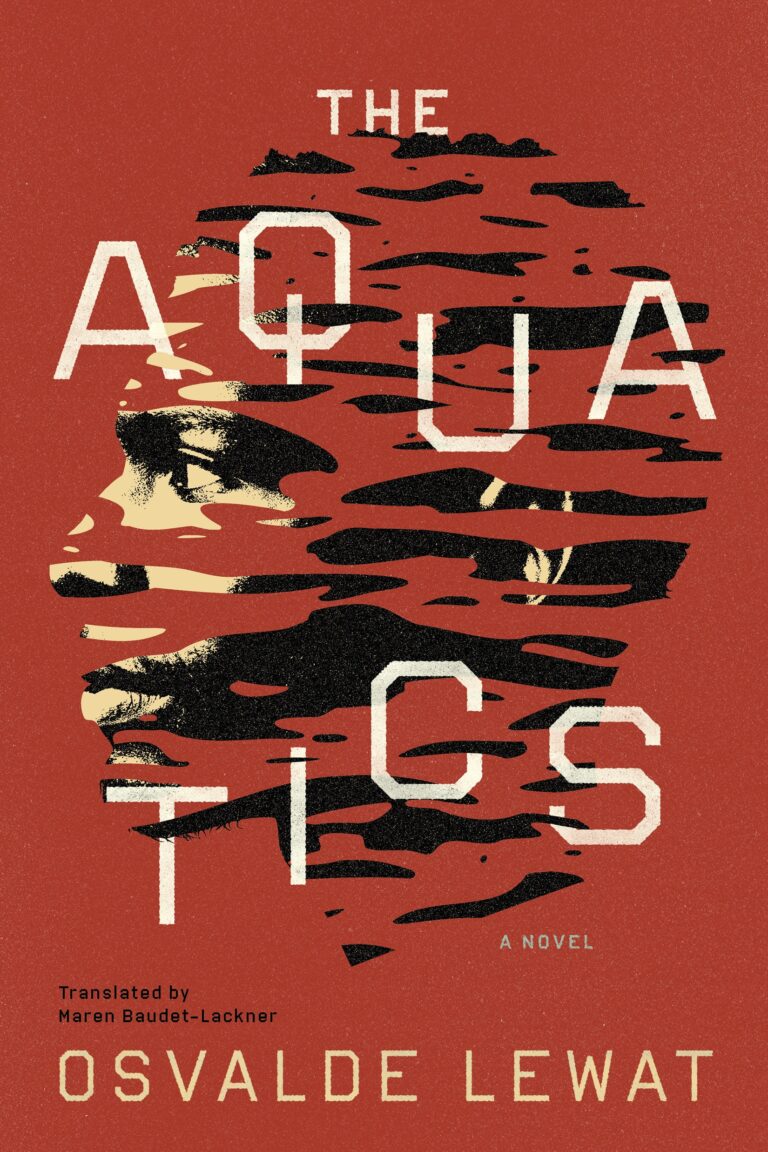
Last but not least, a series of photographs titled The Aquatics featured terrified faces emerging from wastewater and flooding, ID cards floating, women hoisting babies, lamps, or suitcases overhead, the swollen face of a drowned man. The images weren’t new. Every year during the rainy season, the same ones, more or less, appeared on television screens and newspaper pages. But Samy’s frame—rusted corrugated sheet metal, scrap metal, and papier mâché—and his juxtaposition of these cataclysmic images with pictures of carefree couples lying in a field of ripening corn with their children, amplified the radical despair that was bursting from every scene. My eyes were full. When had Samy had time to do all this? His anxiety was stifling.
“So?”
I didn’t know where to start.
“If you don’t like it, you can say so, Katmé!” he exclaimed with a reproachful look.
“Come on, don’t get upset. It’s just that . . . How can I put this . . . ? It’s . . .” I despised my voice for jumping an octave without my consent. I asked to see it all again, once, twice, three times. How I wish I had been able to declare with certainty, “I like this but not that.” Samy believed that a lack of linguistic precision resulted from a lack of sincerity; he would ask me to find the words. What little I know about sculpture and the visual arts I owe to him. The library catalogue at the high school where we met was not so bold as to include the fine arts; and growing up with Mama Récia—whose fierce devotion to the Bible and the Eucharist limited all attempts to embrace other forms of creation—certainly never exposed me to Sow, Depara, or El Anatsui. Samy slid down the wall to sit on the floor and extended his legs.
A part of the image from the video projector reflected off his plastic mules. I sat down in his rocking chair, the sole comfortable seat in the room. Samy only sat in it when he wanted to “unlock” his creativity. I looked down at him and steeled myself to say whatever I thought as it came to me, no hesitation or overthinking. “Maybe there’s too much to take in at once. It’s very dense, Samy.”
“It’s my first solo show! It can’t be ordinary!” Anger loomed in his voice. He made as though to stand, but stayed seated, gathering his knees beneath his chin for a moment before stretching them back out.
“Sculpture is your art, not the rest of this stuff!”
“It’s all my art! Some of these photos are four years old. I recorded the video footage two years ago during a workshop with my students. I’m obese like the kids in the video, obese and overfull of everything I want to show people. Did you really think I had done all this in two months?”
“You should narrow your focus a bit, Samy. You’ll suffocate people, otherwise. You should tone it down a little. Really, it’s too much.”
He stood up, sullen, and leaned back against the wall. The fat children burst into laughter on the hem of his pants. I left the rocking chair to stand across from the photos of the flooding again.
“You really don’t like it, do you?” he asked, coming closer. I frowned. “Their faces . . . It’s too raw, Samy.”
“What these people live through is raw! Not everyone is lucky enough to live in the Fleuve neighborhood. You’re starting to worry me! Keuna says they’re very good. The photos and everything else!”
“Keuna thinks it’s very good, well that’s great, I’m thrilled for you. When did I lose the right to say that it’s not perfect?” I asked, my tone drier than I would have liked. Hearing him mention Keuna always annoyed me. “Your sculptures, your title—Ante Mortem—you’re looking for trouble! It’s like giving unripe plantain to a newborn. Your Keuna, who loves to go around playing White Lady all the time, how long has she even lived here? When Tashun sees this! Let’s not forget that he’s bankrolling it all!” As soon as the final words crossed my lips, I could taste ash in my mouth. You can’t choke ash back down.
Samy let out a nervous laugh. “What was that? What did you say, Katmé?” His lips curled into a bitter line. I reached my hand out to him, full of regret. He recoiled. “Keuna says it will be a success. I’ll pay you back. I swear I’ll pay you back.”
“Samy, that was stupid. I’m sorry.”
His features hardened and he grasped his arms across his chest, his back to the wall once more. I tried to unclasp his arms, but he pushed me away. How could I have said such a thing? My tongue could be sharp and merciless, but never with Samy. It was the letter. The letter at the bottom of my purse. The letter and Tashun’s extravagant plans. I needed to hurt someone. Samy was my unlucky victim. “That was hateful,” I said, pleading now. “Tashun doesn’t even know about the money or the studio. Please . . . I’m sorry . . . What do I know? I go on and on, but I don’t even know how to hold a drawing pencil properly! Samy . . .”
He turned his red eyes toward me. He was a nervous wreck. He was a nervous wreck and, though he called me his airport, the safest place for him to land, his better half, I hadn’t noticed. As usual. He pushed off the wall and made his way to the far end of the studio, pulling aside the curtain that hid the small private space that he had set up for himself, and lay down on his wrought-iron bed.
I followed him and sat down on the edge of the mattress, on the Scottish wool blanket that covered the sheets and pillow. Oblique rays of sunshine entered through the studio’s glass ceiling and shone on Samy’s ashy skin, on his face ravaged by insomnia.
I took off my ballerina flats, crawled up the bed, and lay down next to him. I lifted his arm and slipped my head onto his shoulder.
“It’s not even you, Kat,” he finally said after a long silence. “It’s not even you. Ety called and it didn’t go well. The usual complaints. I’m never available, the studio takes up all my time, and so on. I sat in the rocking chair for an hour trying to get over our conversation. And as soon as I got up to get back to work, the Loon turned up. Come to see what I’m ‘up to in this dump’ since I haven’t been home for a few days. As usual, she made it very clear that, at my age, it would be best to give up on such frivolities, that if I were a real artist, we would know by now. I could have killed her. I could have strangled her.”
“You’ve known your mother for thirty-five years, Samy . . .” I had forbidden myself to call her the Loon, as he did. He often said that someday he would write a novel, and the first line would be: This is how I became allergic to my mother. “Your mother’s not a bad person, you know. Maybe just not very smart . . .”
“I have my doubts about that. At a certain point, the line between stupidity and cruelty blurs. I resent her for it. Ignorance doesn’t excuse her behavior. She’s right, though. I’m a fake artist and a real failure. Just thinking about this show paralyzes my brain and fingers.”
Samy had been turned down so many times that he’d lost all hope of ever having a major solo show until he met Keuna, the owner of the new Bubinga Project gallery. As far as his work went, Samy had heard it all: too ethnic, not authentic enough, too documentary, not realistic enough, too conceptual, not abstract enough, too political, not socially conscious enough, too unique, not original enough.
I took his hand and placed it on my chest. “I don’t have the right training to understand your approach. I’m not a good judge, but my heart doesn’t lie. Believe in yourself.”
“I hope it goes somewhere this time, or I’ll have no choice but to rot away in my art teacher’s smock until retirement.”
“Please, Samy, don’t start down that road again . . .” I loosened my embrace and propped myself up on one elbow. “Now it’s my turn to show you something,” I said. I walked barefoot across the floor to retrieve my bag, which I had dropped at the foot of the rocking chair. Amid paperclips, menthol lip balm, a headwrap, and some crumpled papers, I found what I was looking for. “Tashun gave me this at the prefecture this morning. I know it’s not an excuse. Let’s just say that I’ve been a bit of a mess, too, since leaving his office.”
Samy skimmed the letter. “What do you plan to do?” he asked, just as Tashun had a few hours earlier.
“First, go to Fènn and find out more. They don’t say when the grave has to be moved. It’s supposedly urgent but the tone is about as dry as a shipping report. Urgent in this country could mean tomorrow or ten years from now.”
Muffled voices reached us from outside. Someone was knocking. Samy handed me the letter. As he made his way to the front door, I gathered my things, frustrated that our conversation had been cut short. I joined him and squinted; the sun was in our eyes. There were six children who looked to be about ten years old, each holding a terracotta vase.
“Uncle Samy, we’ve chosen our designs, and we prepared the patina like you told us,” said the tallest boy.
“Customers prefer vases with enameled necks, Uncle Samy. They always sell best. Can you show us how to make them?” asked another, whose T-shirt collar gaped.
“I thought you never saw anyone. Your goddaughters will be jealous when they find out,” I joked. Samy usually gave Axelle and Alix sculpting lessons twice a week, but he had put them on hold to prepare for the show.
“I know, but if I stop teaching these kids, their parents will kill me. It’s a good thing they come interrupt me, actually. Otherwise, I’d never see the light of day.” Samy called the time he spent with his young potters his pro bono publico work. The children, who lived with their parents in dilapidated public housing on the outskirts of the Cité des Enseignants, sold the objects they made with his help at the market, claiming they were the artistic creations of tetraplegics from the local disabled center.
“What’s his name?” I asked, gesturing towards the youngest-looking boy.
“Him? Little Paul. Little but clever. Very clever. Clay no longer holds any secrets for him, isn’t that right, Little Paul?”
By way of reply, the kid puffed up his chest and smiled shyly.
“And here you have Blaise, Kouankeu, Emmanuel, Paul—Big Paul, that is—and Chrysostome.”
I plunged my hand into my bag and pulled out a stack of bills, which I handed to Little Paul. “You share with the others, all right?”
He nodded. “Thank you, Mama. You lift us up, Mama!”
As I expected, Samy shook his head and gave me a disapproving look. He pinched my earlobe. “Mbindi, you know this is bordering on pathological, right?”
He walked me to the bottom of the stairs where we were surrounded by his beds of African violets, his miracle babies. The barren soil just outside of the studio had yielded to the gentle persuasion of Samy’s fingers. The intense purple of the little flowers, a surreal shade of indigo, stood out against the ochre floor and muddy water around them.
I shared Tashun’s big idea with Samy. “Maybe if we talk to him together, he’ll see that it makes no sense . . . You could tell him—”
“As if your husband has ever taken me seriously! He only asks my opinion when it doesn’t matter. It would be pointless, and you know it as well as I do.”
The boys watched us impatiently, eager for me to leave. Samy hugged me and went back up the steps.
As I opened the car door, I heard him say behind me, “Mbindi! Ab amicis honesta petamus. One should only ask from a friend what he is capable of!” Providence doesn’t give you a Latin teacher for a mother without consequence: Samy declaimed classical locutions with scandalous ease.
I turned around, raised my right hand, and joined the tips of my thumb and index finger, my other digits raised to the sky. Samy smiled. As I brushed the fallen pink flame tree petals from the windshield and shooed away the stray dog who was urinating on my back tires, I wondered if Samy was alluding to my inability to gauge the quality of his work or to his inability to plead my cause to Tashun.
__________________________________
Excerpt from The Aquatics by Osvalde Lewat, translated by Maren Baudet-Lackner (Coffee House Press, 2025). Reprinted with permission of publisher.

