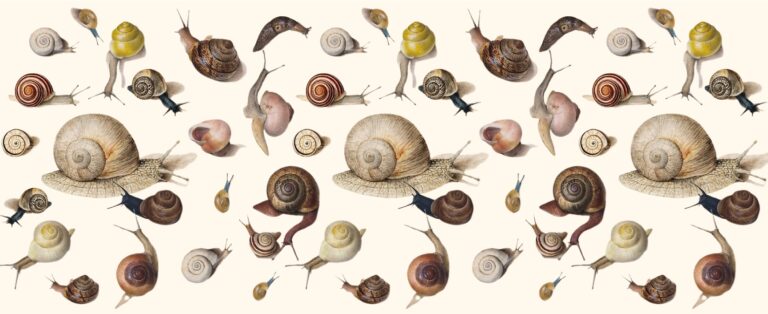
What do you do when you’re about to publish your debut novel and you discover another book—released eighteen months earlier—with the same title and a strikingly similar cover? And that its plot, too, features a last-of-its-kind snail?
This June, my debut novel Endling was published. I’d been working on it since 2018, exploring rare snail breeding in Ukraine and the equally perplexing world of modern dating. (The word “endling” means the last surviving member of a species.) When Russia invaded and the setting of my novel was burning in real time, with my relatives fleeing their homes as I watched from Canada, the book morphed into an exploration of the ethics of writing about catastrophe as it unfolds.
When Virago Press revealed the UK cover of the novel on Instagram, a handful of commenters tagged an author by the name of Jasmin Schreiber. According to the commenters, not only had I copied the German bestselling book, which also featured a snail endling and a road trip of women, I’d even stolen the novel’s title—another Endling!—and molluscan cover. I watched more comments like these roll in with a sense of horror. Could this really be happening? It was every writer’s nightmare. I hadn’t heard of Jasmin’s work until that point. I don’t speak German. While choosing the title for my book, I’d googled whether there was already a book with that title but Jasmin’s had not appeared in the English-language results.
Once Jasmin and I connected over email, we discovered that our novels were indeed linked, in a way I hadn’t expected. Both drew from the same article, published in The Atlantic six years earlier: Pulitzer-prize winning journalist Ed Yong’s “The Last of Its Kind,” featuring George, the last known Hawaiian tree snail of his species.
One snail. One article. Two entire novels on separate continents. I wondered how Ed Yong would react.
On August 1st, Jasmin, Ed, and I met virtually for the first time. We talked about the leap of ideas from non-fiction to fiction, the ethics of using others’ pain for art, the inaccuracies we permit ourselves in service of a broader truth, and how to counteract ecological grief with hope. What follows is a condensed version of that conversation, with some sections moved around for clarity and flow.
*
Maria Reva: Ed, let’s start with you. How did you start writing “The Last of Its Kind”? And how did you find out about David Sischo, the biologist who cares for snail endlings?
Ed Yong: The seeds of this idea first germinated in 2018, when I was trying to get into the heads of people who were wrestling with ecological grief. Then I happened across a story about George the snail. George was an endling, the last of his particular species of Hawaiian tree snail and he died under the watch of David Sischo. What really grabbed me was, here’s this guy who saw extinction happening under his watch. Who had been shouldering this responsibility of caring for this last individual. He has this trailer full of snails, it’s like this arc for dying species. I wanted to know what that was like for him.
MR: That mental toll, which is so apparent in your reporting, is what drew me into the story. I also didn’t know I could cry over a snail. Jasmin, what hooked you in?
Jasmin Schreiber: The part where you describe what an endling is. Since I’m a writer, of course, words are important to me. For two years this word just ping ponged through my head. Endling, endling, endling, I knew there’s a story in it. Endling is maybe the saddest word. And I love snails, I have pet snails, so I thought, let’s put a snail in.
MR: Can you describe what your book became?
JS: It’s about the women of a family in 2041, when Germany faces a biodiversity crisis, dying forests, and a right-wing government persecuting women and scientists, banning abortion, and restricting contraceptives. We also have an underground organization of women and doctors who rebel against the government. The protagonist’s aunt has a panic disorder from the last pandemic and she does not leave her house anymore. She is with her snail endling in her house all the time researching. But when a friend vanishes, she, her two nieces, and a dog set out to find her, uncovering her ties to the underground organization.
The word ”Endling” is kind of a gift, you know.
EY: The word ”Endling” is kind of a gift, you know. I remember having a visceral reaction to the word right from the start. It’s just so achingly beautiful. It’s the perfect word because it contains both meaning and an inbuilt emotional valence. You couldn’t really ask for a better framing concept.
MR: Have you heard of this concept called endling ache? When a human feels like the last of their kind in some way. For example, if you’re the last one who speaks a language, right? Or if you are the last one who holds memories of a deceased person. So when you die, that person disappears completely.
JS: It can also be the last person of a people or of a family tree. So we also have this word in German. It’s “endling” as the biological term and as the cultural history term or sociological term.
MR: It’s a sad, rich word and writers do love to milk pain for all it’s worth, don’t we.
EY: [Laughing.] God. It’s so true.
JS: I pretend and say no, but we mean yes. Yes.
EY: This is how it feels as a reporter. It feels faintly ghoulish. I’m talking to people and I’m asking them about what are often the worst experiences of their lives and I often feel my mind forking in two during this process. Half of it is right there with them. In my interview with Mark Mandica who cared for Toughie [the last Rabb’s fringe-limbed treefrog], he was crying, I was crying. I needed to take a long walk after that. But then there’s also a part of my brain that says, this is great. This is good material. A gift. The clinical engineering side of it and me-as-an-actual-person side of it sit weirdly together in my head.
If I wouldn’t be so emotionally affected by my research and stories, I wouldn’t be a writer.
MR: I still don’t know how to grapple with this bifurcation. It feels perverse to me sometimes, but I can’t do my work without it. How do you two grapple with it?
JS: I cry a lot during writing. I just cry and I hate it and I’m scared if I have to read it out loud on a stage or something. So I practice not to cry in front of people.
MR: I wish I cried while I wrote my Endling. But for me the book was a colossal procrastination of not fully feeling the pain of the Russian invasion. If I could treat real life as material, a narrative puzzle, I could keep a distance from it. Only when I had to practice reading chapters aloud for the audiobook narration did the full impact of what I’d written, the full impact of what my family has lost in the war, finally hit me. I couldn’t read it aloud without breaking down. So, Jasmin, I suppose in the end we did come to the same place, in terms of emotional weight.
JS: If I wouldn’t be so emotionally affected by my research and stories, I wouldn’t be a writer. And if you react to it, other people will react to it.
EY: Yeah, I feel much the same.
MR: Me too.
EY: It certainly feels like a tension, but I don’t think it’s a negative one. It feels right. I write these pieces because I do want to capture something and instil emotion in my readers. So it’s good that I’m feeling I’m right there with [my research subjects]. It would feel different if I was trying to marshal others’ emotions for exploitative reasons. I’m doing it because I think these stories are important and the techniques of good non-fiction writing—that colder clinical side of it—will help me get readers bought into the same topics I care about. I’m not just doing it for the sake of it. And that helped to resolve that weird uneasy tension in my head.
MR: But Jasmin and I get to hide behind fiction. If we use details about people we know, we have the privilege of fogging up what’s real and what isn’t. Obscuring. Ed, you write about really vulnerable moments in people’s lives. Scientists grieving loss, or people living with chronic disease. Do you worry about their reactions to how you portray them?
EY: There is always that worry. Some journalists are adamant that they’re not writing for their sources. So there’s a distance there. I don’t think that works for some stories and I think it absolutely doesn’t here. For example, I was very clear with David Sischo about the kind of story I wanted to write—that it was going to be as much about him as about the snails. It was going to be about how he felt as much as how he thought. Consent is really important. And his thoughts are just so powerfully poignant, in some ways the job is very easy. In a situation like that, I just write it down in the truest way I can and the stories almost tell themselves.
One of the themes of my book is exactly this question: which lies can you permit yourself to tell a broader truth?
MR: On the subject of accuracy: Jasmin, as a biologist, do you ever bend scientific fact in favour of plot or emotional resonance?
JS: I can’t. I just can’t. I’m so scared of writing something scientifically wrong, maybe because I’m also a science writer who writes non-fiction books. I don’t want to manipulate readers or push some agenda, but I do use my books as a Trojan Horse for scientific facts. I want to show people stuff they hadn’t noticed before. I just can’t bend the laws of nature or physics or biology. I feel like I would lie.
MR: I invent snail species in my book. And I over-represent tree snails vs. land snails. There’s a climactic scene in my novel where the biologist has to climb a burning tree to save an endling tree snail. That’s much more dramatic than having her sift through a swamp or through some grass. It’s more of a rising image, which coincides with rising tension. And the shell of the snail has to have a certain look in order to camouflage with the acacia tree, it has to be hard to find…again, for dramatic tension. So I invent a bunch of different species to mold them to my plot.
JS: I mean we are in middle Europe there. There are some tree snails. And since tree snails often like warm climate, they are indeed climbing up into middle Europe with climate change. So if you write tree snails, it’s not lying.
MR: In any case, the general state of snail endangerment in Ukraine is very much real.
EY: You may have made up snail species, but I was really struck in your opening chapters how many details from my article found their way into the novel. It was really, really lovely to see all these things that I know to be absolutely true and to work their way into the plot in different ways.
MR: Thank you.
EY: I’ve been thinking a lot recently about the difference between being wrong and being merely inaccurate. You can capture a lot of underlying truth about snails and their plight and so on. I think it’s important to make a distinction between these two things so you’re not just nitpicking stuff that is actually doing important work.
MR: One of the themes of my book is exactly this question: which lies can you permit yourself to tell a broader truth? When writing about the war in Ukraine and about my relatives, I thought about this a lot. Jasmin, on a different note—have you written through the point of view of an animal before?
It’s like your article is the seed and from this we split in different trees.
JS: In my Endling, I switch to the POV of nature or a landscape or a countryside. Like an animistic approach, where nature has a whole personality, soul, spirit. As humans we think we are the crown of crown of everything, human is everything, God created us, whatever—but I suspect every fungus or mushroom will just laugh about this and think, humans have existed for five minutes and will be gone in ten. Humans are just funny little apes in stinking cars and weird machines, but we can’t do anything against nature. The fires in LA, the floods we had two years ago in Germany. All our money, all our hybrids won’t save us. I’m a biologist but also always have this feminist take, like you, Maria, in your book. We both have those ladies in a car going around fighting against patriarchy and surrounded by a situation like the war in Ukraine in your book and a right-wing government in mine. We had such a similar approach, even with the car and camper van.
MR: Initially my novel was going to be the “mail-order bride” trope. You know, Slavic woman marries Western man and moves abroad and something goes wrong. But I realized I didn’t actually want to write that story. I wanted to have the romance tour participants—the would-be grooms who come to Ukraine looking for docile brides, the would-be brides who go on dates with them—to have motivations other than romance. Or to be “saved.” So when I read your article about snail conservation, Ed, my plot just clicked. It made so much more sense to me to have a so-called bride who is actually not interested in romance herself at all but is using proceeds from the tours to try to get rare snails to breed in her RV/mobile lab. And she also feels like an endling herself, as someone who doesn’t want children. Also, my mother is a chemist who once drove a mobile lab around Canada testing oil spills. So that image has always fascinated me.
EY: I love that there was this unexpected snail-conservation shaped hole in your story. I love that this random thing just fit into it perfectly.
MR: I’m just so happy to have met both of you through this. And to have Jasmin send me photos of her pet snails. They’re really beautiful.
EY: I do love the way you have both reacted and that we’re having this conversation now because you could easily imagine a world in which like your reactions were, “Now I have a competitor. I have a rival who I need to take down.” I love that this is the actual outcome because, like Maria what you said, the ways in which ideas flow is endlessly fascinating. I’m kind of blown away actually. I’m really slightly lost for words, which is a weird thing as a writer. I absolutely did not expect that my piece would have led to this outcome. I truly love it.
JS: It’s like evolution. It’s like your article is the seed and from this we split in different trees. But we also have some structures that are similar but evolved separately from each other. Like wings—in dinosaurs, and in bats, but are very different from the wings in birds and are still very different from wings in insects. I mean the function is similar but how it evolved is different. So it’s not the same story. There are similarities but it’s not the same story and not for the same audience, and that’s what I try to explain to people—it’s like the evolution of an idea of a text.
Nihilism is a luxury we truly cannot afford right now.
MR: Absolutely. Now, before we say goodbye I wanted to end on the question of hope. I’m sure you both get asked this a lot, since the current state of ecology is not exactly uplifting, but do you feel a duty to give your readers hope?
JS: Yeah, but I lie. Will we manage to revert everything? No. But it can always get worse. We will never reach a point where we say, okay, now it’s the worst. It can’t be: it can always be worse. But I think there is hope that our survival instinct finally kicks in and we stop it from getting worse which would be an accomplishment in my eyes.
EY: Crisis shuts down our collective ability to imagine better futures. As if we’re on this runaway train and we’re headed into oblivion. It’s not true. It’s really not true. Whether the odds are likely that we are going to avert this is a whole different question—and almost the less important one. Nihilism is a luxury we truly cannot afford right now. I write about the biodiversity crisis. I also spent four years writing about the pandemic in real time, watching every policy action that would make a difference not happen. Of all the existential crises we’re facing, whether it’s climate change or the biodiversity crisis or the increasing threat for infectious diseases or any of it—at any time we could choose to do something different. The future is not baked into our lives. It is something that we allow to happen through our collective choices. It’s not at all a lie to say that this could be different and to repeat that incessantly.
MR: I sense this underlying fear of extinction among Ukrainians—cultural, linguistic, existential. The attacks have worsened since Trump’s election. A friend said, hope can work on different time scales. Maybe it’s not something to be had within our lifetime, but it doesn’t mean it isn’t there. But I should add that Kyiv was initially expected to fall in days, and that didn’t happen.
EY: There’s an amazing thinker and abolitionist named Mariame Kaba who is famous for saying that hope is a discipline. Hope isn’t this nebulous thing that exists in the ether and that you passively tap into. Or find. Hope is an active skill that you work on and that you build. It’s like a muscle that you get that gets stronger through the flexing and the working of it.
JS: I also think hope is something every being just has. I live with depression. So even though my depression tells me it’s better that I’m dead, I know that a big part of me doesn’t think so because I get up, I eat. So I think it’s not all is lost, you know. People ask me if the world is ending. No. The world is 4.5 million billion years old. Do you know? Have you heard of the Great Oxygen Catastrophe? It survived. So the world is not ending. But it would be nice if not so many people and animals suffered and died until the sun will extinguish and everything will end.
Go out and rescue a snail from the ground. One life saved. Check. Start small. Everybody wants to save the world but you should start small and then you can scale up. So I always say no, I don’t have hope, but I’m sitting here so there must be some hope left even if I don’t feel it.
MR: I’m just so thrilled to have met you both.
EY: This has been a total joy. I love that these two Endling books exist.
__________________________________
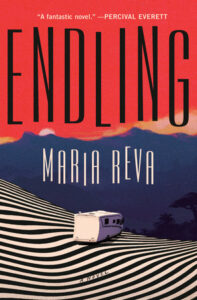
Endling by Maria Reva is available from Doubleday, an imprint of Penguin Random House.