During the tumultuous and hazy days of early motherhood, the books I needed most weren’t sleep guides (although I tried them, usually to no avail) or medical compendiums (the internet was a close frenemy) or milestone overviews (we preferred the human nuance of our pediatrician). Rather, I found myself craving true accounts by mothers who had experienced parenthood as I was experiencing it: as a Tilt-a-Whirl of feelings, ricocheting through the carnival lights of joy and terror, worry and wonder. I wanted to hear from mothers who’d dealt with the same wrecking sleep deprivation I was experiencing and who’d been electrified by the sense of astonishment this strange new world had opened up. I wanted books about the all-of-it-ness of new motherhood.
Many of the parenting books I’d been gifted while pregnant fell into one of two categories: aggressively upbeat how-to books that referred to me as “mama” (as in “You’ve got this, mama!”) and made me feel like I’d never quite fit into this new community of mothers, or thoughtful, beautiful, devastating memoirs about the bleakest moments of childbirth or parenthood. But what I wanted, now that I was actually in the thick of it, was to hear from mothers who were reckoning simultaneously with the very real difficulties and the very real amazements of this incomprehensively big new reality I’d entered into. I wanted to know that it was okay to feel all of the contradictory things I was feeling, often at the same time. I wanted to read something where worry and wonder lived side by side.
A few years later, that was the book I set out to write—the book that eventually became Foxes for Everybody: Twenty-Four Hours of Early Motherhood. As I worked on the essays in the book, I was also reading, and found fellow writers who bent form and genre to capture early motherhood’s all-of-it-ness. While the structure of Foxes for Everybody plays with the around-the-clock nature of parenthood, other books that I loved embraced flash, micro-memoir, graphic literary forms, and hybridity to plunge readers into the reality of raising a young child. These books spoke to the sleepless newborn nights I knew well, offered me the comfort of knowing I wasn’t alone, and fed my love of smart, inventive prose.
Here are five books that I would have gratefully devoured as a new mother (and did gratefully devour as a not-quite-as-new one).
*
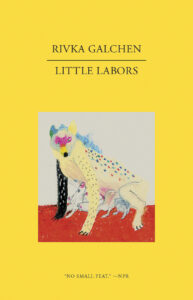
Little Labors by Rivka Galchen
Inspired by Sei Shonagon’s The Pillow Book and clocking in at a tight 130 pages, Little Labors is a wry, whip-smart, comfortingly strange tour through motherhood, babies, and the literary and cultural trappings of both. Galchen refers to her baby as “the puma”—“In late August a baby was born, or, as it seemed to me, a puma moved into my apartment.” I love the perfect strangeness of this naming, the affection and awe embedded there, the baby as something Other than the mother, something to marvel over but also to keep an eye on, lest it devour you. And as a physical object, Little Labors is a delight. There’s always something magical about a small book—who doesn’t love the surprising and satisfying heft of a pocket-sized volume?—but especially when one is deep in a season of life, like early parenthood, when it’s very, very difficult to complete anything. Come for the pleasure and surprise of these short pieces; stay for the thrill of actually finishing an entire book.
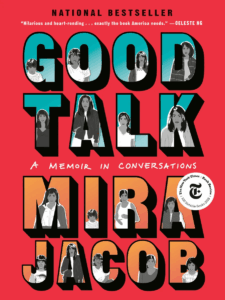
Good Talk by Mira Jacob
Good Talk deftly navigates the complexities of race, family dynamics, politics, micro- and macroaggressions in the wake of the 2016 election, and the surprises that come along with a child’s inevitable questions. In addition to being thought-provoking and moving and cathartic, Good Talk is genuinely funny and utterly engrossing. There’s a reason why graphic novels have become such a successful “gateway” medium for parents trying to get their kids into reading—and it’s not because a graphic novel is watered-down version of a traditional novel. The conciseness, the visual satisfaction, and the crucial interplay between image and word makes reading a good graphic novel—or, in this case, graphic memoir—an electrifying, transporting experience. That was the experience I had when I read Jacob’s Good Talk when my own children were five and eight. This was one of the first books I was able to lose myself in even while my kids were running around the house being the opposite of quiet, and it’s one I haven’t stopped thinking about since.
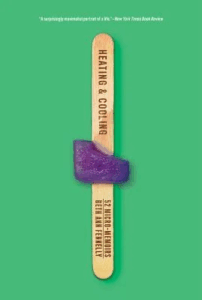
Heating & Cooling: 52 Micro-Memoirs by Beth Ann Fennelly
While not solely about parenting, this book includes some of my favorite depictions of the fullness of a domestic life with children. Heating & Cooling was my introduction to the micro-memoir, defined by Fennelly, a skilled poet, as “[a] true hybrid [that] strives to combine the extreme abbreviation of poetry, the narrative tension of fiction, and the truth-telling of creative nonfiction.” Childbirth and parenting are here, alongside reflections on art, family, mortality, and romance. Sometimes a micro-memoir is no longer than a sentence, as in “Married Love, III,” which reads as follows, in its entirety: “There will come a day—let it be many years from now—when our kids realize no married couple ever needed to retreat at high noon behind their locked bedroom door to discuss taxes.” This moving, funny, compulsively readable book is perfect for new parents, and for anyone struggling to teach their attention how to return to written language.
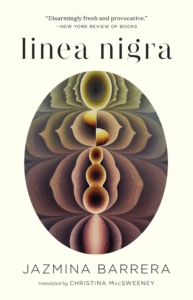
Linea Nigra by Jazmina Barrera
This book is a gem—sharp, sparkling, small, and multi-faceted. I only wish that I’d had the opportunity to read it during my own early motherhood. Subtitled “An Essay on Pregnancy and Earthquakes,” Linea Nigra is about those things but also about so much more. In short, segmented vignettes written during her pregnancy and first year of motherhood, Barrera considers mother-artists, depictions of motherhood in art, the wild science of pregnancy, her own family, and what it means to create. I deeply appreciate the way that humor, gravity, fear, and marveling all co-exist here. As an added bonus, this slim volume’s fragmentary form makes it a perfect match for the fragmentary brainspace of early motherhood.
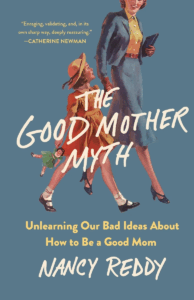
The Good Mother Myth by Nancy Reddy
Part memoir, part cultural criticism, The Good Mother Myth unpacks the questionable science, biased studies, and archaic social ideals that have shaped modern expectations of mothering, while simultaneously chronicling Reddy’s own journey through early motherhood. “Before I had a baby I was good at things,” writes Reddy in the book’s opening chapter. “I believed that I could handle any challenge if I worked hard enough, read the right books, consulted the experts and followed their advice.” Reddy—who is, like Fennelly, a talented poet in addition to being a nonfiction writer—deftly interweaves research and memoir in sparkling, compelling, and often funny prose. An essential book for anyone beginning their own navigation of motherhood’s wild terrain.
__________________________________
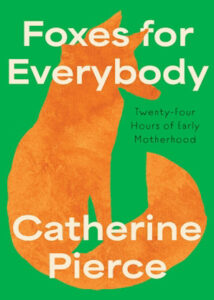
Foxes for Everybody: Twenty-Four Hours of Early Motherhood by Catherine Pierce is available from Northwestern University Press.

