
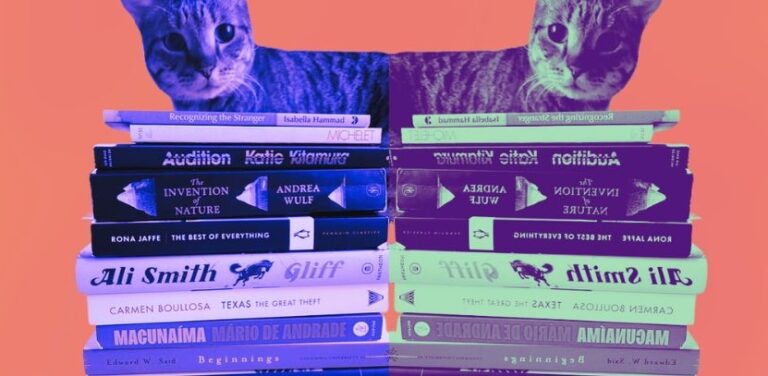
In Sarah Chihaya’s memoir Bibliophobia, we enter into the moment of her breakdown—an event that she has seen on her horizon since childhood, but also seemed impossibly remote. As a child of Japanese and Japanese-Canadian immigrants to the US, Chihaya’s parents “didn’t really believe in the concept of mental health,” while her father continuously exacts psychological torture on her, throwing plates so they barely miss, showing up to track practice unannounced to caustically critique her, both parents telling her to lose weight.
Living in a town in Ohio in which Chihaya was outside the two predominant racial groups (white and Black), life beyond the walls of her home was hardly a balm. (She attempts suicide three times, but her parents do nothing about it.) As an adult, Chihaya has hit the marks so many aim for: a PhD, a tenure-track position at Princeton.
So she finds herself before the terrifying chasm of writing her tenure book—a dread-inducing experience for anyone. Yet for Chihaya, who has come to largely lean on self-harm as a coping mechanism, it is like jumping out of a plane and trying to knit the parachute on the way down. She ends up in the hospital.
One of the most devastating results of her breakdown is she suddenly cannot read without dread or simply having the words scramble before her eyes (hence the memoir’s title). “Looking at these books, I felt shunned,” she writes, “like I’d walked into a chamber full of hostile turned backs.”
Throughout the memoir, while making plain how debilitating her condition is as it zaps her capacity to read, Chihaya catalogs, chapter by chapter, the different books in her life prior to this moment that were instrumental in her self-realization and deep love of literature.
Toni Morrison’s The Bluest Eye gave her insight as a teen into self-hatred and internalized racism; A.S. Byatt’s Possession informs her notions of affinity and intellect; Lucy Maud Montgomery’s Anne of Green Gables series gives her a sense of the beauty of fantasy and selfhood. Each title operates as a window into that period of Chihaya’s life, and how the book changed her.
All of this is hounded by a specter of Chihaya’s very real desire from childhood to find a book that would be her salvation, a kind of religion. Her friend Merve (Emre) gamely hosts Chihaya at Oxford to help shepherd her into recovery. It is ultimately a book a that Emre forces into Chihaya’s hand, Helen DeWitt’s The Last Samurai, that opens the door to Chihaya’s ability to read again.
About her to-read pile, Chihaya writes,
For me, 2024 was defined by illness and physical limitation, so I ended up doing a lot of comfort reading and rereading. This year, I’m trying to ease one foot out the metaphorical door by reading books—many of which are unfamiliar texts by authors I already love—about encountering new people, circumstances, worlds, selves.
*

Isabella Hammad, Recognizing the Stranger: On Palestine and Narrative
Hammad was a guest on this column when Recognizing the Stranger came out. Here is a bit of what I included in that post.
“Empires have fallen, The Berlin Wall fell, political apartheid in South Africa did end,” she writes, “[These] are testaments to the fact that, under the force of coordinated international and local action, Israeli apartheid will also end. The question is, when and how? Where in the narrative do we now stand?”
In her extended afterword, penned in January of this year, Hammad reflects on the words we have just read. “I began the lecture claiming that we can only identify turning points in retrospect. Given the speed and violence with which the cogs are presently rotating, it does feel like we might be in a turning point now: still, we don’t know in which direction we are moving.”
Rashid Khalidi calls Recognizing the Stranger “extraordinary and amazingly erudite. Hammad shows how art and especially literature can be much, much more revealing than political writing.”

Roland Barthes, Michelet
While I believe Chihaya is reading this in the original French, I’m bringing in a review of the Richard Howard translation. I love digging into old reviews, and this one is from the LA Times in 1987.
“In ‘Roland Barthes,’ Barthes writes that Michelet attracted him by founding ‘an ethnology of France,’ that is, by his skill in questioning historically the most natural objects, such as faces, food, clothes, complexion,” begins Annette Smithy in her review.
Rather than analyzing Michelet’s prose in a conventional way, Barthes creates a parallel text of his own, often governed by little more than his own free associating on Michelet’s text. Although each section is followed by relevant excerpts from Michelet, it is not so much his voice the reader hears as it is Barthes.
As an enormous Barthes fan, no complaints here.

Katie Kitamura, Audition
Kitamura’s forthcoming novel describes a meeting between a young man and an actress. Though the young man is a stranger, he informs the protagonist that she is, in fact, his mother. In a profile in Elle, Lauren Puckett-Pope writes,
The idea for Audition first occurred to Kita’mura seven or eight years ago, she says, when she came across a headline that stated, “A stranger told me he was my son. She didn’t click on the link itself, but its mystery lit a subconscious fuse. In 2021, after Intimacies’ release, she finally started writing this “are you my mother?” tale, which would become Audition.
“I’m fascinated by the idea that there can be a moment, an interaction, an exchange with somebody, that can completely overturn your sense of who you are and what your place in the world is,” Kitamura says. “And I think the novel is really about the aftermath of that encounter.”
Lauren Groff says “Audition is eerie, a book so cold it feels hot.”

Andrea Wulf, The Invention of Nature: The Adventures of Alexander Von Humbolt: The Lost Hero of Science
