I was six years old when I logged on for the first time. It was 2001, fresh after the Twin Towers fell on 9/11. There were plenty of pop-ups comparing President George W. Bush’s IQ with just about anything to lure you into clicking.
At the time, the internet was an arcane world that made everyone an alien. We used a large box-like machine with a hump on its back to explore this world. We did not hold anything in this box, but it took up room.
It was made to be its own world with very few rules or regulations and little community. Or perhaps that is the concern conjured by the hysteria of Y2K—with its fads of fears pumped by a skepticism over technology and wars people could not hold so freshly after the recession of the early 1990s. For an adult nation that recently could not hold down reliable jobs, the suggestion of putting faith into virtual realities was comparable to caging lightning between your hands.
I invested time on many childish websites, which is to say I became aware of the value of time there. Online, you learn exactly how fast an hour is when twenty-four of those hours only went into a weekend twice. Online, you learn how much time you burn sleeping between long stretches of time trying to best scores that matter largely only to you.
And when you invest time this dramatically into any space, you find yourself being defined by it. In most skills, this would be called a craft at least, an art at most.
Ironically, I didn’t make art on these childish games. And I’d never think of what I was doing wasting time on there as art. I’d call it “culture building.” Those small things you do as a child where you fill the gaps of existing that adults expected you to leave empty before they too realize you are human: and that you exist outside of their own hawk-like purview. Those gaps of existing they hope to fill with a God, a religion, a class status, a race.
Eventually, you may learn to paint over those gaps to avoid disappointing an adult, though you sense they feel the clumps. As a child, the internet left some sizable clumps that could not be flattened by my family and what they knew Blackness to be as inheritors to generations of Black history, art, and culture. Those things contained in a book and given static, life-shattering word association like “Empowerment” and “Oppression” and “Colored” and “Nigga.”
In 2019, the spaces for Black folk to rest and roost on the internet were plentiful. By 2025, those places blinked out like starlight.
Just behind the Dell desktop in my grandfather’s living room, behind the cracking pleather of our office chair, there was a bookcase. It couldn’t have been more than eight feet tall, but as a child it stretched far up and up into the heavens. Its shelves were pregnant with encyclopedias from local salesman, religious apocrypha snatched from Philadelphia yard sales, coffee-stained Jet magazines bound in twine, loose South Jersey R&B mixtapes, pimp manifestos, and old pulp paperbacks from the ’70s: the kind of Black art that scorned bookstores and were traded with paper price tags between brown hands.
Books printed on the cheapest paper made gray by ink and elements bleeding into its skin through the years. It is an eternal moment that recalls everything Blackness was yesterday as far back as the literate Black soul. Such should be true for tomorrow as well.
In 2019, the spaces for Black folk to rest and roost on the internet were plentiful. By 2025, those places blinked out like starlight.
The internet and Black art triggered awe for completely different, profound reasons. Black art made me one-of-many, never myself. The internet made me myself all the time, one of many. No one would suggest finding the revolution on a blog or a chat room. It’d be years before teenagers were building profit off their hasty electronic art and chat logs. Nothing could be shared or dissected among a community without janky daisy chains of hyperlinks.
And if nothing could be shared, nothing could be compared; nothing could be granted value and heft. But Black art is always compared, shared and given a value. It weighs the cost of one life with the lives chained to it even off the scale.
It did not usually feel preoccupied with my joy, though. Even as a Black person who smiled ear to ear when Black people fought for laughter with the mighty pressure of their jaws. I don’t think Black art has taught me what joy is though, especially Black joy.
Joy is not a snack, but a meal. You chew on it to experiment with flavors. Roasty and savory like garlic butter before dessert, where fragrances can become an abnormal testament to a brief, unyielding safety. Joy invoking a memory of a home warm and wide and sheltering. Joy like a mother’s bed. Like a father’s shoes made of lived leather. I could only know joy because of what I found online. It was hours uninterrupted with my race online that affixed me to what my Blackness had been trying to share with me just beyond all these troubles in us. It was solely what the internet was for.
To the chronically online, this does not sound like the world we know today. The chronically offline might not think there is much to a world of electricity behind our own.
The concepts haven’t changed, just the names.
Today, sharing a video is the most casual act of a neighbor—the most natural reaction online after shock or joy. Today, elections can be polarized by the news we suspect as true online despite the flaws of suspicion. Today’s children are told a numerical formula to their worth.
Digital and tech journalist Taylor Lorenz expounds upon the influence of the digital space called social media in her book, Extremely Online. “The rise of social media and the creativity of its users has given more people the chance to benefit directly from their labor than at any other time in history,” she writes. “This expansion of opportunity has been particularly life-changing for many who have been historically shut out of legacy institutions. The creativity and tenacity of online creators has challenged traditional gatekeepers as never before, often with socially and economically liberating results.”
Lorenz was, of course, talking about all creators on social media creating a space and history for themselves. However, tucked within the crevices of this history, like always, are Black people and the things our experience plant and our politics grow. It is these moments that define Renaissance—many little artful seeds exploding into political jungles, such as the biome of the Harlem Renaissance.
In Harlem, artists arose, and they became Negro artists and Black icons. They holed up in smoky dens and brownstones tasting alcohol and drugs between shifts. In those brownstones, the icons scribbled about notepads and surrendered those eternal drafts to thin paper zines. All of these icons wrote and speculated on civil rights and the idea of Blackness resisting the world at large. They had a language for their identity that existed in their circles and outside of it. They could be surmised as artists of this age: the artists of the Harlem Renaissance.
Today, we’ve created new vocabulary that shapeshifts rapidly: Viner, TikToker, YouTuber, influencer, yapper, content creator. The concepts haven’t changed, just the names. We’re all artists: digital artists. As my grandmother used to say, ain’t shit new under the sun except the folk smelling it.
I believe Blackness is traditional. We follow trends set forth by our cultural past.
My grandmother—Grandma Kandy Kane, named after the cane she walked with since the 1980s—taught me what Black art was growing up just after the Harlem Renaissance in Philadelphia, just 113 miles away from Harlem, NYC.
Socially, I find that Black people engage the world with a political mind.
Deeply, she knew everyone in our family was like her, drawn to the arts by nature. She was a Catholic Black girl who could not knock the call of R&B, Motown, and Stevie Wonder. She snuck out the house and sung off-key to the kind of music that’d get the sin beaten out of you in a good Catholic household. She fell in love with the type of art bad Black girls swooned to and strived to understand why it was so bad to feel so loved in her own skin.
Why, she asked, was this sin of Black folk creating so much worse than the sins of any man—colored or Caucasian? When she figured it out, she made Black music her business.
Her lessons for me suggested there is no way to be an artist while Black without speaking on Black people. Grandma suggested that Black people as a culture struggle with the world’s racism in such a viscous and tactile way that despite the ways the world tries to invent passive synonyms for our trauma, the impact is all over our work. That’s a frightening type of alarm for a certain kind of person.
Later in life, Grandma Kandy Kane became a devout Jehovah’s Witness. She compared it to the “System of Things,” a theological philosophy believed by Jehovah’s Witnesses concerning the corruption of our social civilization. As a Black woman, she translated its principles to describe the universal suffering of Black people. She didn’t have data to back it up or a background in study, but she lived in a racist existence; she knew.
And while my grandma suggested there is no choice but to be Black while being an artist, she knew there has always been a choice of whether or not to be revolutionary.
Personally, I do not think this ends as at just art. Socially, I find that Black people engage the world with a political mind. Our hair, our skin tone, our children, our culture, our speech are politicized in a new context every year. It’s easy to lie by denying the political in what we are. But it’s a shame; it’s not what we could consider conservative. So, it makes sense that when we are online, we create explosions of politic. We look for oracles who can divine the shapes left in the aftermath’s debris. We typically find those grand seers to look like us and have learned as we have: other Black people. And where we gather is a space no different than the smoking dens and the brownstone literati societies.
It is amazing that people think that there aren’t such spaces where Black art can thrive in excess when there’s a congregation like that. In Harlem, we only needed several long blocks and tall buildings to share the stories and skills that survived in the diaspora of our many tribes and bloodlines. It was an era before overwhelming adult literacy at that. When we speak the same language in the same space, we could demand education from each other that transcended the convention of our upbringing.
Community can be anywhere, even if making community with everyone you find anywhere is dangerous. Black digital art is as real as we let it be. And what we let be is as real as our circumstances, because who would ever accept a reality like this if we were not conditioned to do it?
Throughout the twentieth century, Black art—without the vital power of the mainstream—was just a hobby that consumed too much time, energy, and perseverance. That energy could be spent somewhere building a name backed by the only thing that should’ve been on Black folks’ mind: money.
And yet here we are almost a century after the Harlem Renaissance; many brown-eyed Black students graduate high school and college into one of the most brutal American job crisis since the unemployment line hovered over 8 percent. In Ohio, where I spent the death of my boyhood, most Black and Brown men have a more realistic chance of attending college by joining the military than by any other means if they are not an athlete or of the top ranks in their high school; this “sacrifice” is often encouraged by academic professionals.
Black spaces were maybe the most impacted by this shift in the culture of economics. However, these digital spaces did not seem to suggest it. Financial reality is often presented as comfortable in an Instagram post, or a quick tweet where the reality of the artist is the commodity being sold. The truth is that no one wants to engage with a Black creative who does not at least seem to have their shit all the way together. It often comes at a shock when these creatives turn up on a feed with their lives significantly upended by the realities that was mostly veiled behind a well-maintained mirage.
__________________________________
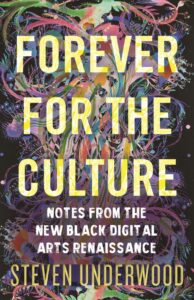
From Forever for the Culture: Notes from the New Black Digital Arts Renaissance. Used with the permission of the publisher, Beacon Press. Copyright © 2026 by Steven Underwood.