There is no reason to be afraid of death – when we exist, death is not; and when death exists, we are not. This, roughly, is how Epicurus put it a long time ago. I tend to think of it as like sharing a flat with a lodger you never see. The flat has two rooms, and two doors. Whenever you go through one door, the lodger goes out by the other. You might hear him moving about from time to time, but the moment you go in, he’ll go out to where you just came from and start moving about there instead. This is how we live our lives, with death on the other side of the wall. The day we meet him in the doorway, it’s over. The sly thing is that we never know when it’s going to happen, only that sooner or later it will. Of course, if we want to, we’re free to take the matter into our own hands and provoke the encounter.
Which is what I’m intending to do.
Perhaps the above sounds like I find there to be something casual about it all – a flat, an encounter with a lodger – but the lightness belongs to the language, not to me. If I could articulate what I’m feeling as I sit here, the despair that night and day rips and tears at me, the bottomless darkness, you would understand. But I can’t, for in language there is hope, in language there is light. The night is without language. And language is always directed towards another. To convey loneliness by means of language is therefore impossible. Where there is loneliness, language is not; where there is language, loneliness is not.
In other words, then, I am ‘lonely’. And I am going to ‘take’ my own life.
But first I’m going to write this. Every day, in the weeks to come, I’m going to wake in the room upstairs, come down here, make coffee, and sit down at this desk in front of the window; I’m going to look out on the little harbour, and beyond it to the sea – which at this time of the year is mostly greys and blacks; I’m going to drink my coffee, smoke and work away at this story until it is finished. Why, I’m not entirely sure. Is it to do with how everything that happens just peters away into nothingness, and that this basically makes every event meaningless? The way it’s all to no avail? If those events are written down, they at least will exist somewhere. As for whoever may read what I now write, I don’t care. Perhaps it will be you, Emil, since you’re the owner of this house I have appropriated for the purpose. If so, I hope you can forgive me – I trust at least that I’ll have made sure to tidy and clean the place when I’ve finished with it and that you’ll find it in a better state than when you left it. Or perhaps it will be you, Yelena – in which case you need read no further: you know what’s coming. Perhaps it will be you, a local policeman, searching the place after my corpse has been found washed up on the shore somewhere close by. Or drifting on the sea, discovered by a fisherman or by the crew of one of the big container ships that plough back and forth off the coast here and whose passage I follow through the windows every day. I don’t know, and I don’t care. I’m writing this for myself. Or rather, for ‘my self’. The two words that contain everything we ever were, are and will be. Sitting here, at this particular moment, I am just a fraction of all that, perhaps only a few thousandths of it, while the rest, the bulk, lies stored in my cells. Some of it I am able to activate of my own accord – it’s called remembering – though most of it comes and goes as it pleases. So it is for all of us, presumably also for cats and dogs. As creatures they are superior to us – not only is much of their sensory apparatus more highly developed than our own, they have also had the nous, in what can only be described as an evolutionary stroke of genius, to halt the advancement of their conscious minds at the ascertainment I am here, rather than proceeding, as we have done, to the question of why.
Procrastination, this is called. I don’t want to think, I don’t want to
know, I don’t want to understand. And yet I must. Must I not?
Yes.
I don’t want to write about what happened to me. But then again, I don’t want to die before I’ve done so.
So where do I begin?
At the beginning, perhaps.
*
The first time I came across the name Christopher Marlowe was in August 1985, the summer I moved to London, where, much to my surprise, I’d been offered a place to study photography at an art school. Apart from music, I knew practically nothing about British culture, so one of the first places I visited was Foyles, the bookshop on Charing Cross Road, where I bought ten contemporary British novels in paperback, and then the collected works of Shakespeare, as well as a non-fiction book about creativity. I began with Shakespeare, but his plays were as good as impenetrable to me, so I returned to Foyles a few days later and bought a biography of the man and a book about the age in which he lived, to see if they might become more accessible to me. I dropped the books into my bag and walked towards what I now knew to be the Bloomsbury district, continuing on to Camden Town, where I sat down with a pint outside a pub and began skimming the biography. The very moment I set eyes on the name Christopher Marlowe, I looked up and saw in front of me a big lorry with the words Marlowe Removals along the side, green lettering against a white background. As if that wasn’t enough, I then read that Marlowe had been killed in Deptford – the same district I’d moved to only a few days earlier. Someone was pointing, but I didn’t look. I just closed the book, put it back in my bag and tramped off in a northerly direction, in the gigantic metropolis in which I now lived.
Lectures didn’t start until three weeks later. I knew nobody, and so I bought a bicycle and started to familiarise myself with the local area, at the same time as I took loads of photographs, always uncertain as to whether my work would be good enough to meet the school’s standards. The bedsit I rented was small and sparsely furnished – a bed settee, a desk, a bookcase – and so I spent as little time in it as possible. The neighbourhood wasn’t exactly charming either – the riverside area was run-down industry, disused warehouses, old factory chimneys, broken windows, piles of rubble from buildings that had been demolished and not been replaced. Chugging lorries here, scrap merchants there. And if in places a patch of green had grown up in all the colourless grey, rubbish would seemingly always be dumped on it. The shops in the streets had long since gone to seed. Often, they’d be selling a clutter of different goods, mostly things that I imagined could have been sold in the shops back home in the 1960s, things that looked so outmoded I’d never seen them on sale anywhere before. The signs above the doors of these places all seemed to stem from the previous century, or at least the 1920s or 1930s. There were cafes with handwritten menus and net curtains in the windows; a bakery, a butcher’s shop, where those behind the counter wore white, blood-spattered aprons. In this world behind the times, there was a brilliant record shop called Solid Cut, it was only small, but they had really good stuff, and I spent more than a few quid there during the first couple of weeks. There were foreign shops too, I guessed at African – one sold wigs, hair extensions, colourful fabrics, and I photographed the place from the pavement. I wanted to go inside and take pictures there as well, but I held back, unsure of how to go about things yet.
In the evenings I’d sit drinking over a book in the nearby pubs – there was practically one on every corner, the smoke-stained interiors unchanged in decades. The people there laughed a lot more than I was used to at home, and the bar staff called everyone love. The England I knew from the NME and Sounds was nowhere to be seen here – the odd young guy in a long overcoat with a cool haircut might go by once in a while, a group of goths might be sat in a corner one night, and a jukebox would occasionally play the Jam or U2 or the Alarm (I remember hearing ‘Into the Valley’ by the Skids once, and ‘Teenage Kicks’ by the Undertones), but that was just the area, Camden and Soho were different altogether.
It’s weird – a few nights in a row in the same place and you start recognising people, someone might acknowledge you with a nod, you get talking, and if it happens more than once then all of a sudden you’re friends, perhaps even for life, without either of you having intended. That was how, in those first few days in London, I met Hans, a Dutch artist ten years older than me. He wasn’t the only artist living in the area, I soon found out – everything was so run-down around there they could afford to rent studios as well as somewhere to live. There were a lot of drugs about compared to what I was used to, and plenty of dreams that came to nothing, or at least were radically scaled back. Even the strongest, most determined of wills could be ground down in the space of a few short years. By what? it might be asked. What forces are powerful enough to wear out a human life? Biologically, it’s obvious enough – our physical decline begins in our twenties, it’s a process that ticks away in us all. But what of psychological erosion, what governs that? This is fate, of course. All those thousands of chance occurrences that lead you to one place rather than another, to people whose wills and dreams and abilities collide with the prevailing conditions there. That’s why artificial intelligence, AI, will never be able to think like us. Even if the machines are self-teaching and able to adapt according to experience, the parameters are still rational, the machines will necessarily and for always be remote to the deep, slow-shifting layers of reality where fate is at work, and therefore they will always be remote to us. Even as simple a thing as coming up with a random number turned out to be far from straightforward for a machine, for in any circumstance there was always a program in the background that first had to define the algorithm, whereby all randomness was cancelled out. The solution was to connect the machines to other, chaotic systems in nature and allow what occurred there to govern the selection. But the issue of chance and fate appears considerably more complex to artificial intelligence than to us, because in the human world chance is often charged with meaning, beyond our control, often beyond our understanding too. How do we give the machines access to something whose nature is unknown to us?
I’m sounding like Hans now. Machines that communicate with each other and interact with the world around them, that was his domain. Of course, I knew nothing about anything like that the first time we spoke. Probably he knew little more – in the late summer of 1985, machines that could think on their own were still basically science fiction. But he was already there, at the interface of biology and technology, with his own particular ideas.
I’d noticed him the night before, a tall, skinny man with big hair the exact colour of which was hard to determine, a chiselled chin and narrow eyes, wearing a pair of faded jeans that looked like they’d once been black and at any rate were too short in the leg, a thin blue knitted jumper with a greenish pattern across the chest. He was a head taller than everyone else in the place, I suppose that might have been why I noticed him, but he was loud too, playing pool with his mates, all of whom were considerably less vocal, and so untidy in his movements. I assumed he’d had a few pints and was a bit drunk, that his mates were just lagging behind. He looked a bit gormless as well. That particular night I was sat reading one of the English novels I’d bought when a voice in front of me suddenly said:
‘Did you just move here?’
__________________________________
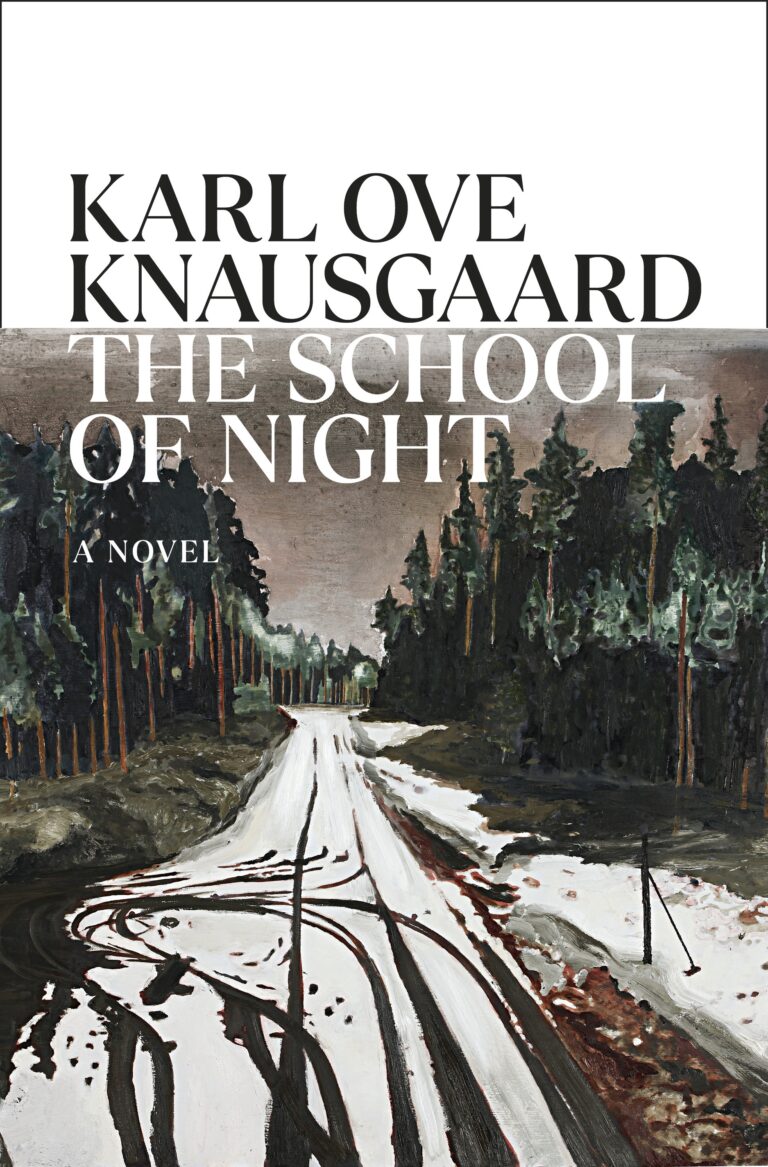
From The School of Night by Karl Ove Knausgaard, translated by Martin Aitken. Used with permission from Penguin Press, an imprint of Penguin Random House LLC. Copyright © 2023 by Karl Ove Knausgaard, Translation copyright © 2025 by Martin Aitken.

