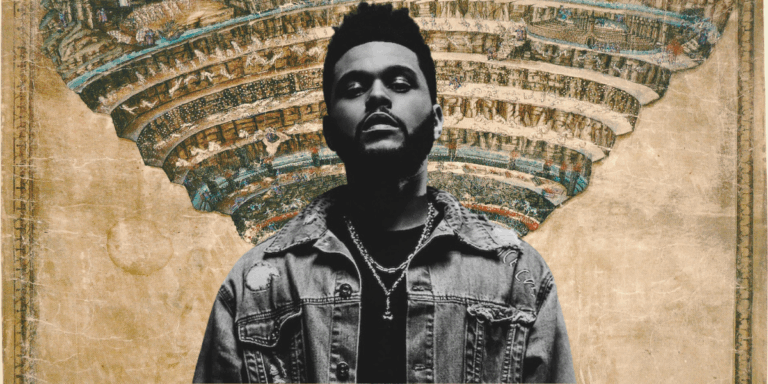
In a stack of CDs in my parents’ black 2006 Chevy Colorado in the suburbs of New York City sits a matte black cardboard case containing three discs so scuffed and scratched that certain songs stutter and skip at all the worst moments. They are unlistenable artifacts, played over and over until the unruined versions of the songs sound wrong to me now, a decade later.
On the cover is a black and white photo of a man, a woman’s arms wrapped around his neck, her face out of focus and half out of frame, his eyes averted, his face handsome and pensive, her face unimportant. Her face as faceless as the woman in the bathtub in the cover photo of the first disc, whose lifeless naked body is in focus but whose face is obscured behind black and white balloons. The monochromaticity, “TheWeeknd” in stark white Helvetica, the man averting his eyes like he might feel guilty about it all.
When his songs first circulated on internet blogs in 2011, little was known about Abel Tesfaye, a twenty-one-year-old rapper and singer from Toronto, apart from his curiously spelled stage name. Within months, however, the Weeknd had mainstream cosigns, critical acclaim, and lots of buzz. He released a darkly imaginative and startlingly cohesive trio of mixtapes—House of Balloons, Thursday, and Echoes of Silence—all in 2011 and all for free, eschewing the elaborate release schedules and 99-cents-per-song iTunes charts that dominated the era. Within a year, Trilogy had been remastered and released as a box set, eventually going triple platinum.
Long before his Super Bowl performance, before selling 75 million records and setting dozens of streaming records, before anyone knew his real name, the Weeknd was meticulously curating the morbid, shadowy theatricality that has come to define his persona. Trilogy is disturbing and alluring, with its ghostly production and chillingly misanthropic undercurrent. Its narrator performs a hazy nonchalance toward death and redemption. On the closing track of House of Balloons, the Weeknd’s voice quivers defiantly over a skittish beat:
I ain’t washing my sins
I ain’t washing my sins.
Yet even as he affects indifference, the narrator betrays from the beginning that he is transfixed by ultimate things—their glamour, their inaccessibility and inescapability. In its opening moments, Trilogy’s big single, “The Zone,” crackles with warbling bass and the Weeknd’s spectral crooning:
I don’t want to die tonight
So let me sip this slow.
Death is ever on his mind, but his interest tends to be cursory and platitudinal and obscured by pleasure—it merely signals the Weeknd’s cool detachment from this life of staggering excess.
*
I once heard that memento mori is the most commonly tattooed phrase in America, which is impossible to verify but seems like it could be true. Today, the Latin maxim reeks of cliché, but it still resonates for a reason. It is a distillation of nature’s most elemental law: remember that you die, remember you must die, remember to die. Seneca recognized this as a neutral truth, not good or evil, merely “the one law mankind has that is free of all discrimination.” He thought it good to meditate on, for “that man lives badly who does not know how to die well.”
After all of the hedonism and nihilism, we finally hear that the way we live or, more precisely, the way we die has implications that reverberate not only in this life but in the one to come.
The Stoic philosophers, fixated on the impassive, idealized masculine, wrote often of death, attempting to acknowledge its inevitability while staring untroubled into its abyss. “I cannot escape death,” writes Epictetus, “but at least I can escape the fear of it.” Whenever we kiss our loved one, child, friend, spouse, Epictetus urges, we should remind ourselves that the person will die. Memento mori, remember they will die, remember you will die, memento mori, memento mori, memento mori. The truth is unsettling and exhilarating and banal and comforting and you can’t stop replaying it like an old song on a scratched CD.
*
While living in Paris in 2018, Tesfaye was given his own internet radio show on Apple Music 1 (at the time, Beats 1). He called the project MEMENTO MORI—rendered in all caps and branded with sparkly gothic lettering and gleefully gaudy stylized skulls. Mortality is front and center, but it’s winking, ornamental, nothing more than a clichéd tattoo. The first album of the MEMENTO MORI era, 2018’s My Dear Melancholy, is a dark and paranoid EP, more sinister, suffocated, and sparse than previous work. It mines deeper into death and detachment and hedonism. On “I Was Never There,” he sings, “His happiness is never real / And mindless sex is how he feels.” The narrator is still melodramatic, but he is settling into his nihilism and resignation. The song shifts into something strangely reflective—a glazed-over, repetitious death meditation:
When it’s time, when it’s time, when it’s time
It won’t matter, it won’t matter
It was like I was never there
It was like he was gone in thin air.
The refrain echoes throughout the remainder of the song, vanishing into smoke.
*
The line between Abel Tesfaye and the Weeknd has always been hazy. Is the Weeknd a pseudonym? A band? A persona or character? Abel Tesfaye made his acting debut in the Safdie Brothers’ 2019 film Uncut Gems, playing the Weeknd. Neither film nor actor seems concerned with differentiating between reality and fiction. According to the end credits, the Weeknd is played by “himself (Abel Tesfaye).” Perhaps this suggests that the Weeknd and Tesfaye are one and the same, or, possibly, that it would be more accurate to say Tesfaye made his acting debut nearly a decade earlier, when he first began uploading free mixtapes as the Weeknd—a character he has played ever since, and whom he fully realizes in a project that began with 2020’s After Hours.
After Hours is slick, showy, cinematic, explicit about its eighties inspirations—new wave, electropop, R&B—and its pure pop aspirations. It includes what is now the most streamed song in history, “Blinding Lights,” and features production from critical darlings like Tame Impala’s Kevin Parker and Oneohtrix Point Never, the experimental electronic composer who scored Uncut Gems. The album begins with familiar images—drugs, sex, loneliness, the fear of death—but the Weeknd’s relationship with death is murkier now. Death is certainly an enemy, but it’s also utterly tantalizing. It’s unclear to the narrator whether the anesthetizing effects of sex and drugs are drawing death closer or are his best shot at keeping death comfortably out of sight.
Perhaps both, for death is both lurking in the shadows and persistently drawing near, and this inescapable truth begins to rupture the meticulously constructed façade of the Weeknd. On “Snowchild,” a plaintive keyboard melody over a gentle trap beat builds a briefly inhabitable confession booth in which the narrator considers his self-destructive past, when he “had nothing to believe in.” He’s nostalgic (in the music video, an animated version of the Weeknd journeys through the settings of his previous albums) and mournful, exhausted by the emptiness of his long-sought fame. Uncharacteristically, the Weeknd alludes to real-life events—a string of lawsuits alleging plagiarism and copyright infringement; accusations of homophobic and biphobic lyrics—but he quickly reconstructs his swaggering composure: “Only thing I’m phobic of is failing.”
For a flickering moment on “Blinding Lights,” the sparkling, synth-y mega hit, the narrator hints at vulnerability, dares a little hope: “Maybe you can show me how to love, maybe.” On “Faith,” the narrator simultaneously celebrates and laments his loss of faith while further opening up about his struggles with addiction and relapse: “Thought I’d be a better man, but I lied to me and to you.” Who is the one lying here? Is the mask disintegrating? In an interview with Variety, Tesfaye admits that “Faith” was inspired by his arrest in Las Vegas during the darkest time of his life, “a real rockstar era which I wasn’t really proud of,” though in the same breath he claims it was a song “the character” needed. The line between the two Weeknds blurs further as he continues,
I wanted to go to Vegas and be this guy again…the drug monster, the person who hates God and is losing his fucking religion and hating what he looks like when he looks in the mirror so he keeps getting high, and hating to be sober because “I feel the most lonely when I’m coming down”…the person who hates himself and hates life and hates the person who made him that way.
Is the speaker on “Faith” the “real” Abel Tesfaye—the one raised Ethiopian Orthodox, who dropped out of school and experienced homelessness and incarceration, the one whose “dark past” we can read about in salacious profiles? The moment barely lasts, and the Weeknd’s voice returns, droning, “I choose Vegas if they offer heaven’s gate.” The suffocating hatred of life and self ferments into a noxious mix of self-destruction and self-absorption:
But if I OD, I want you to OD right beside me
I want you to follow right behind me…
While I’m dying.
The album concludes with a jittery, atmospheric snapshot of the Weeknd’s death on “Until I Bleed Out.” The stilted, cascading synthesizers of Oneohtrix Point Never are plaintive and seductive. The vocals are mechanical and the lyrics repetitive and tedious, the narrator choking on decadence. He is finally dying, and only his lonely vindictiveness remains in his final breaths:
I want to cut you out of my mind
’Cause I’m bleeding out
Oh, I’m bleeding…
The final lines of the album are repeated like a mantra as he struggles to convince himself that this dying body of his is dispensable, unnecessary: “I keep telling myself I don’t need it / I keep telling myself I don’t need it anymore.” The Weeknd grasps at casual indifference, at the tranquility of the Stoics, the impassivity of the unmoved man. His longtime flirtation with death has finally brought him face to face with it, but there’s no relief, no nirvana, no enlightenment, only further confusion: “I can’t explain why I’m terrified, I’m so terrified.”
*
The damned yearn for what they fear, according to Dante. In the third canto of Inferno, Dante—the fictional, presumably autobiographical character—watches the eerily mesmerized masses approaching the gates of hell as his eschatological guide explains: “celestial justice spurs them on, / so that their fear is turned into desire.”
In a 2020 interview, Abel Tesfaye was asked if he was religious. After a long pause, he replied, “I dunno.”
*
After Hours ends with the Weeknd bleeding out, alone and afraid as he slips into the darkness. 2022’s follow-up, Dawn FM, begins quietly, with uncannily chirping birds and a slowly crescendoing synth line before the Weeknd’s voice bursts in, steady and vibrant:
I need something to hold
Make me believe in make-beliefs
’Cause after the light, is it dark? Is it dark all alone?
Before we can even register the bleak opening sentiment, the instantly recognizable cadence of a radio host cheerily welcomes us:
You are now listening to 103.5 Dawn FM. You’ve been in the dark for way too long. It’s time to walk into the light and accept your fate with open arms. Scared? Don’t worry, we’ll be there to hold your hand and guide you through this painless transition. But what’s the rush? Just relax and enjoy another hour of commercial free music on 103.5 Dawn FM. Stay tuned!
Both narrator and listener have died and are now in purgatory, stuck in gridlocked traffic in a tunnel, at the end of which a bright light beckons. The entire album plays as an hour-long loop of purgatory’s radio station, complete with afterlife-themed advertisements and the chipper interjections of a soft-rock host voiced by Jim Carrey, the actor and comedian. Dawn FM intensifies the Weeknd’s glittering 1980s-pop sensibilities, masterfully rendered by a surprising duo of executive producers: Oneohtrix Point Never and Max Martin, the Swedish hit-producer with more number-one songs than any songwriter apart from Paul McCartney. More than for its musical style, the album is fascinating because it’s the Weeknd’s most amusing and joyful project yet—far from the somber penitence one might expect in purgatory.
*
Immediately following the radio host’s introduction is the thematic centerpiece of the album, “Gasoline,” an exuberant dance anthem that picks up the unsettled thread from the end of After Hours. The content is familiar—again the narrator faces death, wallows in self-destruction, waves away redemption—but now the moment is situated within an entirely different sonic landscape, one that is sparkling and sunny. No longer disturbed by such thoughts, the Weeknd tries on a gleefully over-the-top Brit-pop affectation:
It’s five AM, I’m nihilist
I know there’s nothing after this.
On the chorus, he breaks into a mirthful falsetto over a playfully jittery drum machine:
And if I finally die in peace
Just wrap my body in these sheets
And pour out the gasoline
It don’t mean much to me.
The lead single, “Take My Breath,” is a rapturous plea for the euphoria of death and the afterlife. The narrator remains entirely self-serving—as he longs for death’s release, he refuses it to those around him, always centering his own experience: “You’re way too young to end your life / girl, I don’t want to be the one who pays the price.” Even still, the song dances onward as he repeatedly cries out, to a lover or to God, “take my breath away” and “bring me closer to heaven.” The song eventually escalates into a lecherous, breathless, glittering climax of incandescent synthesizers and melodic moans—an erotic asphyxiation depicted as utterly glorious.
The album coasts along dreamily, punctuated by flippantly dour lines (“there’s so much trauma in my life”) sung with breezy nonchalance as we near the end of the tunnel. The otherworldly radio host checks in sporadically to offer assurances:
There’s still more music to come before you’re completely engulfed in the blissful embrace of that little light you see in the distance. Soon you’ll be healed, forgiven, and refreshed, free from all trauma, pain, guilt, and shame…but before you dwell in that house forever, here’s thirty minutes of easy listening.
The Weeknd’s eschatological guide cheerfully sniffs at one of the Psalms’ most recognizable images of heaven, smoothly placating a terrified audience as we stare into the abyss.
After a stretch of jaunty love songs, the mood is dissolving into lurid electronic organ and plaintive crooning when suddenly the music cuts off and a previously unheard voice begins to speak:
Who, if I cried out, would hear me among the angels’ order?
Even if they pressed me against their heart, I’d be consumed
For beauty is the terror we endure
While we stand and wonder, we’re annihilated
It is a loose translation from Rilke’s Duino Elegies, a moment of luminous exultation on an otherwise insouciant album. The moment is fleeting, though, interrupted by the sharp pangs of rapidly escalating synthesizers that create a sudden sense of claustrophobic exhilaration. Then, after the moment of peace has vanished entirely, we hear a glitzy, suffocating advertisement for the beyond: “Critics say ‘Afterlife’ makes your current life look like a total comatose snooze fest!” Distractions persist, even after death.
*
Still, the Weeknd finally learns to let go, and we arrive at the haunting final track, “Phantom Regret by Jim”—though which Jim is unclear. Is it the fictional radio host who has guided our tour of purgatory, or Jim Carrey, Tesfaye’s real-life neighbor? His tone has shifted—less manic, more somber—as we’ve finally arrived at the end of the tunnel. “How many grudges did you take to your grave?” Jim asks. “Were you ever in tune with the song life was humming?” There is an earnestness here, rendered plaintively and without accusation, as though this is the first time anything he has said should be taken seriously.
If pain’s living on when your body’s long gone…
You may not have died in the way that you must
All specters are haunted by their own lack of trust.
After all of the hedonism and nihilism, we finally hear that the way we live or, more precisely, the way we die has implications that reverberate not only in this life but in the one to come. It is a painful revelation, and Jim quickly offers comfort: “Heaven is closer than those tears on your face.” In the context of this album, the quiet, soothing words are somehow jarring. And then the exhortation begins: “Heaven’s for those who let go of regret.”
Like a practiced preacher, Jim is slowly, methodically leading his congregation—speaking cryptically but with conviction as the music begins to swell. “Consider the flowers, they don’t try to look right / They just open their petals and turn to the light.” Jim’s allusion to the Sermon on the Mount is a moment of cohesion and beauty, but once he has hooked us, he undercuts that familiar ground.
Heaven’s not that, it’s this
It’s the depth of this moment
You don’t reach for bliss
God knows life is chaos
But he made one thing true…
You’ve got to be heaven to see heaven
May peace be with you.
The song functions as a benediction of sorts, though its concluding sounds slowly morph into the same chirping birds we heard in the album’s introduction, reinforcing the cyclical nature of life, death, even afterlife. After all that his sermon builds toward, Jim’s conclusion is striking yet damning: Heaven is only here, and salvation is up to us alone.
*
Within a week of its release, Dawn FM had over 500 million streams, and the Weeknd hinted on Twitter, “did you know you’re experiencing a new trilogy?” If After Hours is a shimmering ode to the hell of loneliness, and Dawn FM is a gleefully nihilistic drive through purgatory, it seemed obvious that the third installment would focus on heaven. The surprise came with rumors that it would be the Weeknd’s final album. “I’ll still make music, maybe as Abel, maybe as the Weeknd,” Tesfaye said in 2023. “But I still want to kill the Weeknd.” As the release drew near, advertisements with redacted versions of his name appeared, prophesying: The e nd is near.
Maybe there can be no redemption for the Weeknd; maybe no one will remember his death; maybe his glimmering grinning guilt will outlive anything else Abel Tesfaye makes.
By the time Hurry Up Tomorrow was released in early 2025, the Weeknd was explicit about it being his swan song—a conclusion to his second trilogy as well as to the Weeknd persona itself. Hurry Up Tomorrow rehearses the familiar images and themes that have always tormented the Weeknd, but here they are cast in a new light as the narrator struggles to find heaven after a lifetime of self-indulgence.
*
Any work that grapples seriously with the idea of redemption must also mine into darkness, and the early tracks of Hurry Up Tomorrow find the Weeknd revisiting familiar ground. On “Baptized in Fear,” the narrator finds himself spiritually and physically paralyzed, overwhelmed by regrets as he lies in a bathtub filling up with water. “This can’t be the way it ends,” he sings as he’s slowly drowning. Of course, the Weeknd has long romanticized his own self-destruction, but here, as the water fills his lungs, death finally loses its glamour—there’s nothing romantic about a man incapable of or unwilling to save himself from drowning.
An otherworldly “figure in the corner”—angelic or demonic, it is unclear—sits just out of sight, laughing at his pitiful state. This is not the gleeful dance party of purgatory—there is a more sinister and sincere quality to it. Oneohtrix Point Never’s atmospheric synthesizers pause as the weight of the moment settles on the Weeknd. “I’ve been baptized in fear,” he sings, “I’ve been the chief of sin / washing my soul within.” The lurching beat returns as the narrator repeats:
I’ve been baptized in fear, my dear
Like Paul, I’m the chief of sin.
It’s a withering claim—I’ve been crystallizing into a more categorical self-assessment, I am. It reflects and even one-ups Saint Paul’s well-known admission in his First Epistle to Timothy—it is sinners of whom Paul is chief, not sin itself. The Weeknd’s claim is both pompous and penitent, and it carries into the climax of the song as echoing vocals repeat: “Voices’ll tell me that I should carry on.” Is it the shadowy figure near the bathtub who is telling the narrator to carry on? It never becomes clear, but as the album continues, we see that this baptism in fear has somehow transfigured the Weeknd, and he emerges from the water changed.
Much of Hurry Up Tomorrow sees the Weeknd trying to make peace with his transformation—wrestling with the old habits that haunt him, watching his legacy slip away, recognizing the limits of hedonism, navigating nostalgia and sentimentality. Is this a regretful man grappling with his old addictions, toxic relationships, deep-seated misogyny? Or is this just a theatrical character in mid-act, a carefully constructed villain on his redemptive arc? Even here, at the end, is there a difference between the Weeknd and Abel Tesfaye?
*
As the album draws to a close, the Weeknd finally turns his gaze directly toward God. Toto-esque percussion and synths punctuate the unfussy vocals on “Give Me Mercy,” the chorus breaking into a bubbly praise song: “Give me mercy, like you do / and forgive me, like you do.” The narrator sounds lighthearted and free, almost as if the transformation was too easy. But then the end comes, the final track of the album—the final song of the Weeknd? On the title track, yawning, ethereal synthesizers float through the opening measures, then settle into a wistful electronic organ melody as the Weeknd croons,
Wash me with your fire
Who else has to pay for my sins?…
Now I’m ready for the end.
Who is speaking? The lyrics take on a brazenly confessional tone: “I’ve been trying to fill that void that my father left / So no one else abandons me / I’m sorry.” It’s a moment of startling vulnerability, nearly unrecognizable from the icy, unflappable misanthropy of the first trilogy. “I promise I’m sorry,” he repeats, though we can only guess what for. His lyrics are uncharacteristically unguarded, even devotional:
And I hope that I find what I’m looking for
I hope that he’s watching from up above…
Hope this confession is enough
So I see heaven after life.
In his final lines, the Weeknd cries out, “I want to change / I want the pain no more, no more, no more,” and the words echo into the final moments of the song as the music quiets and then cuts out, until all that is left is a gentle whooshing sound, faint but distinct. It’s the noise that began “High for This,” the opening track of House of Balloons, the first part of the Weeknd’s first trilogy. After such a long journey, the Weeknd’s final track still bleeds seamlessly into his first.
*
I haven’t listened to a CD in years, but the matte black Trilogy box set in my parents’ Chevy still has an allure that never quite transferred to the vinyl reissues that now sit on a shelf in my apartment in Brooklyn. When I first heard the Weeknd’s voice out of the tinny speakers of my family’s computer, I felt like I’d discovered something brilliant and new, so you might understand why I skipped my third-period history class a year later to drive to Best Buy on the day the box set was released. You might understand why I felt compelled to write a review of it for my high school’s art magazine, in which I highlighted the “shattered silence” and “wispy beats,” and perhaps you’ll forgive me for confusing misogyny with “uncomfortable contradictions” and “verses about anonymous women.”
If you remember the way EDM dominated the charts of that era, you might understand why I felt that the Weeknd’s dark world was uniquely mine, why I couldn’t believe how successful he eventually became. How I eventually felt betrayed by his ascent into glitzy stadium pop, fatigued by his relentless hedonism, bored by his celebration of loveless sex.
On the cover of the vinyl release of the Weeknd’s final album, the man is alone, his face taking up nearly the entire frame. He stares directly at the viewer, his eyes glistening and heavy. Sometimes it feels easier to die than to change.
Perhaps you’ll understand why I want the Weeknd to get his redemption, why I hope every version of him makes it to heaven. It’s never his songs about heaven that rumble out of open car windows or blast from boomboxes on packed subway cars. Inferno has always been more famous than Paradiso. Maybe there can be no redemption for the Weeknd; maybe no one will remember his death; maybe his glimmering grinning guilt will outlive anything else Abel Tesfaye makes. Or maybe you and I will both finally understand the dark world he devised, the relentless fixation on death, the plaintive song spilling out of my apartment windows as the record spins without end.
__________________________________
“World Without End: The Weeknd’s Divine Comedy” by Judson Bergman appears in the latest issue of Image Journal.