“Lazarus Species”
You don’t even need to be born
again in order to be born against
this riddled wall, each bayonet in love
with your bare, stigmatic neck.
Strange, the worst part is the waiting
to survive. Stranger,
let’s wait for the cave to act out
its name, invite the sun in
for the final rendezvous.
Oh to be you. Remember when you lived
in a century still
afeared of wild boars?
Now they march on Athens once again
to remind us how frail
our own endangerments. It’s a shame. I know.
You pay someone to puncture you.
The decades whir. Lost
is the TV show you watch
until there’s no season left
but the one caressing your window.
It’s overcast. It’s overkill.
Time to draw the curtains & play dead.
Once I was on a plane—
all ocean, blinding, down below—
a bald man seatbelted beside me.
He was high in every sense,
said, “I lived my father
alone to leave his life” & offered me
a hundred-dollar bill. “Here,
this is my business card.
Please stay in touch.
Please wear a toga to my funeral.”
Bad enough to find yourself
in a book of vanished things,
reports of vessels gulped down
by listless seas, whole farms smuggled up
into an Oklahoma sky. Now
to be born again & still
without one ounce of faith
in the durability of anything
but silk. I took the bill
& bought myself
a used priest’s robe
which I sometimes don
when I feel most prone
to survival & lament.
I, too, have not been seen
in years, so many years,
even the sycamores presumed me dead
& the boars began to dream
of meats far more exotic
than my own. Extinction is said
to be an event, but I can tell you nothing
is more uneventful—you find your family,
your whole phyla & future, buried
in some encyclopedia & glean
how small the risk of eternity,
how great the risk of not being reached for.
& under your entry, you find a man
discovered your decline & so became
famous by the standards of his day.
“There was no reasonable doubt,
the last individual had expired.”
So the search for you grows
exhaustive until it dies
down & no one watches the embers
but some canceled god, retired, forgetting
his own mellifluous names. I search
for my life as well, you know,
some passing evidence
besides the noise, which drifts about me,
so much exhaust inquiring, “Is this grief
the inexactitude we’d hoped for?”
*
“The Peasant’s Orgasm”
Three clear orbs fall across the blue edge
of my vision. Frail neural fables the retinae chase
after, I want to say, but can’t quite
catch. Meaning,
I fail to follow
the orbs’ trajectory (so often my own
thinking too) until these odd geometries
exit the visual
field. I asked my husband’s coworker once,
out of the blue, over
a business dinner,
what his consciousness felt like to him. His thoughts. I mean,
I said, is it colors ribboned with speech or
some other tumble of sensations
equally hard to articulate?
(Those aren’t the words I used
exactly, but you catch my meaning. I
mean, my drift.) He was so delighted
to be assigned
the impossible—to describe the clouds
of qualia crowding his brain case—
that he never resumed his discussion of loss
leaders, which in their way
have an operatic ring, though one that perishes
quickly in the corporate
lingo his tongue was freighted with. I got the sense
my asking him about his private
self—I mean, interiority—
its ineffable and peculiar
quality, led him ultimately from pleasure
to rage, though, which he soon directed
toward my husband. My husband,
who lovingly calls this man
“Hole.” I can’t confirm
the causal chain,
but out of his reveries, his healthy
reverence for his own mind, Hole—
who donned a hand-knit carmine cap—leapt
at my husband’s proverbial throat,
quite out of the blue, near yelling
in a rather upscale Italian joint
in DUMBO, under the distended shadow
of that huge foreshortened bridge, You know so much
about language, but you don’t know, not yet
anyway, the language of Design. The implication
being that Hole knew
the language of Design,
that Mars and Saturn and Jupiter were just
characters in a larger alphabet
my husband (also, I) could never read.
I’m of course exaggerating,
but the exaggeration feels true,
the way the northern lights do
even though they’re pure
distortion. A silence
then settled briefly
over the table, affecting the quality of precipitation
—I mean, snow—when it can be said
to sublimate, while Hole’s anger dissolved into the din
of diners—wine-drenched laughs, the delicate symphony of forks touching plates,
low murmurs suggestive of privacy and futility,
which reminds me
a slaughtered cow hung high to dripdripdrip,
and yet—
without preparation and wholly
beyond the reach of appetence, with its untold
motivational force
akin to that of pain
and the orgasm—devoured by the eye
before the mind can even hunger for it. Somehow
the conversation resumed while I was blipped out (toggling
between scenes
of chilly butcheries and subway cars, rib cages
of various life forms dangling
from metal rods), and the men
were now discussing matters
of taste, which seemed more appropriate to me than accusation, although
every discourse on taste is also a way of tasting the other’s
system of scrutiny. Fonts fell
under scrutiny. The sacredness
of some,
the profanity of others, and how
fonts could be paired
like certain meats are to fine wines. I wanted to know the fate
of Garamond, which I like best, for the almost “world” that closes
its utterance. My husband favors Futura, and I forget
Hole’s preference, though if I had to guess
I’d go with Helvetica.
It was only the first course,
and I wanted to reach under the table and do something obscene,
instigate, with a strategic touch, a timeless
sculptural desire in my husband, the way I used to do
to summon him, quite out of the blue,
into back-alley sex acts,
but my fingers felt bled of all strategy. I mean, intent. And I started to smell the tang
of blackberries as they shift
from fruiting to hoarding
carbohydrates in their roots,
and I saw the far-off fields
I grew up in overwrite
empire and dinner and the urban longing for what can no longer be retrieved
in its midst—the texture of clay-rich dirt
under my nails, all of it
crushingly sun-warmed and unlanguaged. Taste the grapes
whose insides would be forced
into rich flavors of oblivion
sommeliers might describe as “notes
of loam and asparagus”…swished and swirled
in a concurrent new-world
Italianate scene, though interred
under a rich layer of presence, the grapes pressed, in a future
now passed, by someone who will have been in possession
of the requisite milliondollar
press capable of translating fruit
into pleasure, if not
addiction and civility, whole Kalapuyan regions compressed into lines
curling over menus in New York. (To sell possibility
must be enough, those who designed me
taught me. To grow
the grapes, even if you have no means
of crushing them, is a living. Every peasant I’ve ever been or known
knows this truth.) Distraction
more than seduction being my
metier, I asked them both, feeling I might fortify their strained bond,
if either one of them were going to order
the rabbit because, if not, I would have to order it myself.
But this is wrong.
The memory is out of order.
Long before the yelling and the lustful soil came the rabbit.
Before the rabbit,
or long after it had been eaten
by Hole, I described, wholly off-topic, a course
I wanted to teach, called Wrong Science,
in which my students and I would digest untruths
that had entered this world in a diction of certitude
and with all the ineluctable fervor
of revelation. We would take turns
looking through the lead tube
of an early telescope,
watching the sun orbit our infancy,
suspecting
a distillation of all evil
to be crouched under our feet
instead of the lavatic rituals and shifting plates
the future, now the past, would finally acknowledge. You
could include a section on vision,
Hole suggested, and talk about mantis shrimp,
how they see all these colors we can’t,
colors we used to assume didn’t exist. But
how can we assume the absence of something whose presence we can’t even begin
to imagine? My husband answered, nostalgia
for the Garden or
the future, and then edited himself: future nostalgia.
And long before that, the longing for someone to ask, but not with words,
what is your thinking?
And what does it feel like
to hold its happening inside you?
In the middle distance imperceptible to language?
And why did you lie as a child
when asked if you saw ghosts, going so far
as to describe them as perfect
circles drifting through inner space,
by which you meant, the sky?
Someone, over dessert, dark
chocolate torte or maybe it was buttered artichoke, changed
the subject
to Egypt’s Middle Kingdom, the gaudy
shades of its presiding architecture—picture
the desert dabbed
with reds and golds and toxic-looking blues, the towering
implausibly pigmented likenesses of gods
who levied taxes and slew their serpent brothers.
I grew excited.
Hole lifted his wine glass to his mouth.
And it was red.
My husband was trying to chew and swallow
his cocktail’s greenish garnish, a leathery lime slice
dusted in orange pepper, and this made me fall
in love with him all over again, his curiosity that etiquette can never conquer. His
incorruptible
appetite for what may or may not be
digestible. All to say,
while the men replenished, I tried to describe a moment I’d never lived in,
when slaughter came to be
replaced—however nominally—by artistic representation,
as though the image had always been annihilation’s aptest understudy, just waiting
in the celestial wings,
and the buried pharaohs finally learned, deeply
as computers lately do, that meat carved with a stylus into a wall
kept far from worldly sight was far more tender
and delicious
than meat whose rot inevitably offered
a not wholly satisfying rhyme to their own. Digestion is also a form
of decay, my husband noted
somewhere along the line. And a movement
in architecture, Hole added. That’s concerned
with adaptation to shifting conditions. I noted
the care and strategy with which the tongues were often carved,
hanging from the cows’ mouths so the dead would not mistake for ornament
their perennial sustenance. The Greek influence
is so strong there, Hole might have said. You can see it best
in Alexandria. So I hear. All those archives
burning in fevered minds. History lost
in flames we can no longer read
or warm our hands by. Of course,
all of that’s likely fiction. The burning,
that is. A conquer so sudden and luminous it couldn’t even be seen
until it was over. Now they’re saying it was numerous fires spread
out over time. The conversation veered
to Plato then, as Socrates always knew it would, as he paced
the hemlock deeper into his dilating veins
while my future mouth watered at the thought.
I might’ve been that rare symposiast
who was also a woman, I ventured, uncertain
what shapes really related to what whirred
like alien weather behind my eyes. It’s true,
my husband verified. She’s a harpist—and former
bartender. She would have been allowed.
I could’ve poured the wine
and plucked the strings, I said. I could have
accompanied you.
So music transcends category, Hole said excitedly. I mean, gender. As in music
can pay your passage
to forbidden
places. Parties. Underworlds. Lives beyond life. I used to want to live forever
until I realized eternity would mean losing
everything anyway, the slow decay
of the wonderful, time digesting mystery
and misery like the same stale piece of cake, all of joy
and its aching origins and taxons
turning to dust in the grasp
of your ancient and unmurderable
mind. Space dust, my husband might have said. Space
as dust. Dust as mote or motive, I said. Yes.
It would be like witnessing your essence—
I mean, your whole soul—consumed
by what…all the distances inside it coming to
constitute it. Or
something…At the table next to ours a woman was discussing
monetizing her personality. Or maybe it was her lifestyle.
So many likes, she said,
on that skydiving post. Air thrumming in her ears, confiding
such elusive velocities. I want to say
it was something like three hundred.
More. A peasant skydiving in an alternate
century, growing so literate in distance and its breathtaking closure
that kings down on Earth began to swoon,
their gilded pleasure eclipsed
by a would-be swallow’s. I want to say
I’m remembering correctly,
that my husband did in fact order the hare.
Or maybe it was the coniglio.
That the same flesh passed over the two men’s tongues
though tasted of different animals because the tongues were divergent as were their fields
of blushing buds
and words. As for me, I forget the taste of
that night, and the more I reach for it, the less existent it becomes. So I look up
the orbs. It turns out they’re a sign
of detachment, the vitreous humor lifting…
“a sign,” the page I’m reading says, “of aging.” So I look up
at the orbs. As they fall—I mean, drift—
they lighten the bit of blue
they pass over. And lose dimension. Frail triad of contact
lenses descending through space
at the pace of snow
through the lower atmosphere. But I’ve seen these things
for as long as I can remember.
__________________________________
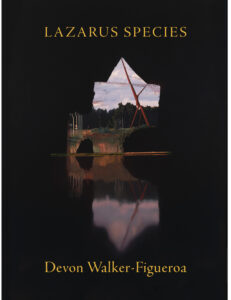
From Lazarus Species by Devon Walker-Figueroa. Copyright © 2025. Published by Milkweed Editions. All rights reserved.

