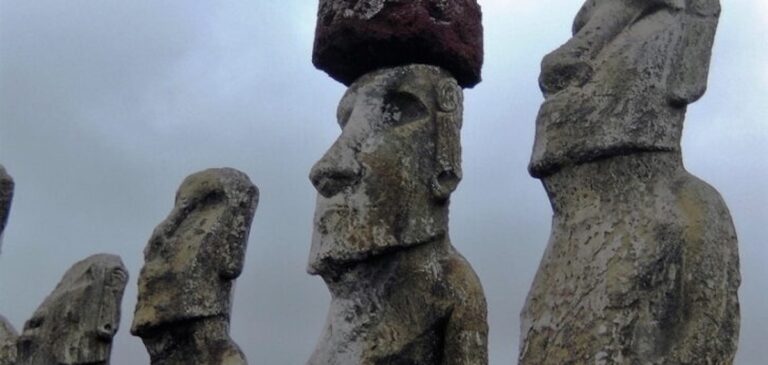
This story about statues begins on Easter Sunday 1722, on what was then the remotest inhabited island on Earth. This was the day the first European set eyes on Rapa Nui, the start of the final century when Islanders were in control of their own world. It was the day when everything about the island began to change, so that within a few generations no one there could say what the statues meant or who made them.
That time, as incompletely documented as it is, is the closest we can get through real lives to when statues were being carved, and Islanders’ only contacts were with themselves; when the island was still owned by those who discovered and made it. Whatever had happened in previous centuries, events must somehow have led to what was seen and described in the eighteenth.
My second reason for starting here is that, again, the records set a baseline, only now looking forward, to help us get the measure of what followed. Perceptions of eighteenth-century Rapa Nui have influenced more recent attempts to understand the island. By looking at the actual accounts, we can hope to see what it was really like. The observations, of course, were not scientific, and academics have come up with reasons for questioning them, some of which we must take seriously.
The records themselves are not easy to use; manuscripts are shelved around the world, and the texts, written in four different European languages, still have not been fully brought together in modern translations and analysis. Only in recent decades, for example, have manuscripts from the French expedition been relocated: its two ships sunk on reefs in the western Pacific with the loss of all lives (Louis XVI was said to have asked about the missing crews before mounting the guillotine scaffold). A witness report from the English expedition turned up in a Polish library, and was published as recently as 2014.
Europeans were used to finding people everywhere they went. Coming from a continent awash with ethnicities, languages, and histories, they knew the world as a place of endless varieties of culture.
On the other hand, we hear almost nothing from Islanders. There is one documented case of a reverse visit. In 1811, a young Rapanui man, said to have been the son of a “king,” joined a ship back to Britain, where he was baptized Henry Easter in Rotherhithe, London. Press reports say he learned English at school, was handsome and well mannered, and had “every appearance of a satisfied mind.” We last see him as a crew member on a ship in Sydney, and no record is known of his thoughts, expressed by him or anyone else. The island’s early European visitors may have arrived ignorant of Rapanui ways and holding different, irreconcilable values, but they left priceless records. We would be remiss to ignore the quantity of information they contain.
Europe came late to Rapa Nui, two centuries after Magellan led a pioneering Spanish expedition across the Pacific in 1521. Many of the statues were probably carved in those eight generations. When ships finally arrived—eight in all between 1722 and 1786, from Holland, Spain, England, and France, bringing a total of around 1,400 men—the visitors saw things they found hard to believe. There was a long tradition in Europe of representing named individuals realistically in stone, whether known persons or mythical beings or gods. The statues on the island were much larger, and far more numerous, than any standing at typical installations in Europe. And they seemed identical, anonymous, stylized, and alien. From the Islanders’ point of view, the visitors were equally strange, as they appeared and vanished overnight, over sixty-four years spending a total of no more than a week ashore. We may imagine that Islanders found it hard to stop talking and thinking about what had happened. But there must have been many who never saw a European.
Such brief and intermittent encounters had profound consequences, for the Islanders and for our understanding of their story, even now. It began on the Easter day when the Africaansche Galey signaled land. The Dutch West India Company had sponsored an expedition to search for a southern continent, which was thought necessary to balance all the land north of the equator. Jacob Roggeveen, a lawyer turned explorer, had wandered about the Pacific with three ships and found nothing. His crews were beginning to lose faith till they spotted a turtle and floating vegetation, and birds overhead. There was great joy, Roggeveen wrote in his log: They were about to discover Southland. But the imagined continent soon revealed itself as no more than a low, flat island. Rising plumes of smoke showed it was inhabited. Weather marked the occasion: They waited at a distance for thunder, lightning, heavy rain, and winds to clear.
The pioneer encounter occurred 3 miles offshore. The Dutch, spotting an old man approaching in a canoe, sent out a sloop to investigate. This unceremonial meeting was the first contact between people whose ancestors had parted tens of millennia ago in Asia, and whose experiences, cultures, and beliefs separately reflected that distance. It was an innocent event played out repeatedly around the world in various forms. A marker of unity. A harbinger of change and loss.
The naked man put up a good fight, but was overpowered and brought to the Arend, Roggeveen’s flagship. Curiosity trounced the Islander’s fears, and he seemed delighted by what he saw, taking a special interest in the ship—how it was made, the masts’ great height, the sails and the thickness of the ropes, and the guns, to which he gave particular attention. The sound of the ship’s bell and the sight of himself in a mirror scared him, and he appeared to be ashamed of his nudity. Offered a glass of liquor, he poured it down his face and tried to rub it out of his eyes. He put his arms and head on the table, and repeatedly raised them toward the sky, shouting loudly as he “addressed his gods.”
The whole performance might have been a traditional Polynesian welcome; or perhaps it was the simple question: Who are you? The smiling man kept it up for half an hour. He jumped and sang. Sailors played the fiddle. Surprised by the music, he danced with them. He had to be persuaded to leave, with gifts of trinkets and by the Arend sailing farther out to sea.
After this, Roggeveen decided to send two sloops and three other boats to shore and make friendly introductions. His main concerns were to find out what the Islanders looked like, and how they could help out with supplies. But he took no risks. His 134 men were armed with musket, cartridge pouch, and sword in case of a hostile encounter, and the Africaansche Galey lay close by with a couple of small cannon brought forward on the bow. They set out after breakfast on April 10, as summer was turning to winter, five days after the first sighting.
We will never fully understand what happened. Even before the expedition reached land, Islanders had gone out to the ships, paddling canoes or reed bundles, or just swimming, unafraid and unarmed. They had swarmed over the decks, climbing in through a window, taking hats and caps off sailors’ heads, and seizing any timber they could find, from old brooms to firewood. Now as sailors stepped out into the surf, a great crowd tried to take oars off the first sloop. The men were almost overwhelmed by Islanders proffering bare hands in welcome, apparently jumping for joy.
The visitors picked their way across the rocky coastline, waving at the Islanders to move back and make space. The ships’ commanders lined up their crews in three rows, guarded by soldiers. Then, out of the blue, four or five musket shots rang out, followed by shouts and, in an instant, the sound of more than thirty further muskets being fired. Scared out of their wits, Islanders fled. But not all of them. Some were wounded. “Ten to twelve” lay dead.
The confident welcome had unsettled the visitors. An Islander had tried to take a soldier’s musket by grabbing the muzzle, while another had pulled at a sailor’s coat. Others, it was said, watching their compatriots fail to obtain what they seemed to think was their right (or, we might feel, out of sheer panic), threatened to hurl stones. This apparently sparked the shooting, though the junior officer insisted he had not ordered it. When tension broke, one side was equipped with steel swords, muskets, and gunpowder. The other had pebbles.
After a time, Islanders returned. Cornelis Bouman, captain of Roggeveen’s ship the Thienhoven, identified a “chief” who nervously tendered a chicken and a bunch of bananas and ran off. On seeing a favorable reception, he brought others with more gifts of food. It’s hard to avoid seeing this as a peace offering. The inexplicable, sudden death of a dozen men was not enough to still curiosity, and an urge to show hospitality.
So it was that the outside world came to hear about the statues of Easter Island, or “Paasch Eyland” in the original coinage, in two Dutch paragraphs. At first the sailors were astonished: How could “stone images…fully 30 feet [9 meters] high and thick in proportion” have been raised without ropes or timber? But they soon decided—incorrectly—that they were in fact not made of stone at all, but “clay or greasy earth” into which had been stuck small stones to give the illusion of a great carving, in “the appearance of a human being.”
Others followed: Don Felipe González de Haedo in 1770, commissioned by Peru for Spain; James Cook, arriving for the British government in 1774; and Jean-François de La Pérouse for France in 1786. Like Roggeveen before them, González and Cook had been hoping for a continent. Louis XVI had asked La Pérouse to find a fabled Northwest Passage through the Arctic Ocean. While they stocked up on food and water, Rapa Nui was merely a way station for them. None of them viewed it as a destination or a place to revisit. They were on voyages of discovery, not interference or subjugation.
Europeans were used to finding people everywhere they went. Coming from a continent awash with ethnicities, languages, and histories, they knew the world as a place of endless varieties of culture. It was quite the opposite for Islanders. Evidence suggests that soon after its original discovery, Rapa Nui remained isolated until the arrival of Europeans.
If discovery occurred around AD 1200, as I will argue, that would mean, in 1722, Islanders had seen no one but themselves for some twenty generations, an extraordinary position for a small community. And neither had they seen any other land: There was nothing but ocean in all directions, and a horizon beyond which lived the dead and yet to be born, in a place from which their own, mythical ancestors had sailed. So who were they?
James Cook had spent more time sailing the Pacific than the other Europeans. When he came to Rapa Nui, he was well into the second of three long voyages exploring ocean and islands. He was curious and observant, and had acquired a perceptive understanding of Pacific peoples. He knew who the Rapanui were.
On his first voyage, he went to Tahiti and Aotearoa New Zealand, among other islands. On the second, he led the first European ships to cross the Antarctic Circle, and on the third, his expedition was the first to visit the Hawaiian islands (where he was killed). Also on the second, he took on board two Polynesian men. One of them, whose name was recorded as Hitihiti or Mahine, was on the Resolution when it visited Rapa Nui, and was able to contribute his own perspective on what they saw.
Thus Cook understood the people of what today we would call Polynesia to be the same—in “colour, features, and language.” Not that they all knew it, he said: They’d been dispersed long enough to have forgotten distant neighbors. Each had “adopted some peculiar custom or habit, &c,” but the Rapanui had the same origin as people “over all the isles in this vast ocean, from New Zealand to this island, which is almost one-fourth part of the circumference of the globe.”
Writing in his journal, Cook noted that the Rapanui grew sweet potatoes, yams, taro, plantains, and sugarcane, all of which his crew had eaten elsewhere in the Pacific. As in Tahiti, they cooked with hot stones in an oven dug into the ground; for fuel they used dried grass, and stalks and leaves from sugarcane and bananas. They also grew gourds as water containers, and the Tahitian “cloth plant,” making fabric with the bark. The only animals Cook’s crew saw apart from wild birds were rats and chickens, both eaten. Using tools only of stone, bone, and shell, Islanders made wooden spears and clubs, and canoes built from planks stitched together with plant fibers and fitted with outriggers. Everything is a Polynesian practice or object. The visitors even recognized numbers they had heard in Tahiti, though the “Languish [language] was in a manner wholly unintelligible to all of us”—except, “very imperfectly,” to Mahine.
If discovery occurred around AD 1200, as I will argue, that would mean, in 1722, Islanders had seen no one but themselves for some twenty generations.
It wasn’t just Cook who took this view of Rapanui culture. Among those also on the Resolution were Johann Forster, the expedition’s naturalist, and his son George, who back in Europe published two volumes about the trip. They made some perceptive comments about the island’s statues. All four European expeditions saw a Rapa Nui of gardens and grassland, with no forest or tall trees; Roggeveen had specifically noted Islanders’ excitement at the sight of timber. In Tahiti the Forsters saw rows of roughly carved wooden figures, 20 to 30 feet (6 to 9 meters) high, raised in honor of “deceased friends.” On Rapa Nui, wrote Johann, a land without wood, Islanders sought to achieve the same effect for “their chiefs and distinguished people” in stone. Raised “in honour of their kings,” said George, the statues “have a great affinity to the wooden figures, called Tee, on the chief’s marais or burying-places” in Tahiti.
The Europeans also described the Rapanui themselves. George Forster thought they closely shared features, customs, and languages with other South Sea Islanders. Skin color was not black, observed Roggeveen, but pale yellow or sallow. People were the color of a quadroon, said González, using an eighteenth-century word for someone who was one-quarter black and three-quarters white, adding that in the right clothes they could pass for Europeans. Their hair was black, said Cook, while González saw hair that was brown and loose, black, blond, or cinnamon-colored.
Perhaps González had witnessed hair coloring. Islanders certainly went in for body art, from painted white stripes reaching from beard to feet to complex tattooed designs. González gives us details of some extraordinary tattooing. Older men covered their entire body with burgundy-colored designs featuring “grid lines, pyramids, chicken and really ugly faces,” all skillfully arranged with great order and symmetry, most impressively in the form of a perfectly drawn maze on the back. On the front, there might be frightful faces, either side of the belly.
These were a distinctive Rapanui take on a widespread Polynesian tradition. So too were perforated and extended earlobes, in older men and women hanging down well below their chins like fleshy rings. If they got in the way, they could be hooked up over the top of the ear, giving the impression that the lobes had been cut off. But the proper guise was to plug the holes with material such as rolled cane leaves or slices of white taro; in the nineteenth century, a shark vertebra was collected having served this purpose. Cook commented on the length of the statues’ stone ears, but no eighteenth-century observer made the obvious connection: Not only do statues have very long, thin ears, sometimes distinct circular plugs can be seen carved in the lobes.
And what of society? This is of course an area hard to interpret, but there are some important insights. Coming from nations, and ships, with clear hierarchies and orders of command, Europeans arrived in a take-me-to-your-leader frame of mind. They struggled to find any. There are references to kings and priests, but these seemed to have limited authority. The Dutch saw a few men order food to be brought to them. One, distinguished by a white feather headdress, white clothing, and a white shell on his breast, was apparently a chief. But he had to threaten someone with a stone to get what he wanted. Cook believed chiefs owned gardens as “private property,” though he had no idea what power they held, while the French thought crops were held in common. Visitors universally complained about Islanders stealing things: They were “much addicted to thieving,” said Cook. One explanation for this is that they did indeed see goods, in some sense, as belonging to everyone.
Despite looking, no European was able to find the powerful political or religious leaders that they were already negotiating with elsewhere in Polynesia. Neither was there an army ready to defend Rapa Nui—crowds wielding spears and clubs were not uncommon in the Pacific—or any sign of violence. González was struck by the absence of any “apparatus of war”: For weapons, the Islanders knew only sticks and stones, and they showed “only many demonstrations of joy and merriment.”
__________________________________
Excerpted from the book Island at the Edge of the World: The Forgotten History of Easter Island by Mike Pitts. Copyright © 2026 by Mike Pitts. From Mariner Books, an imprint of HarperCollins Publishers. Reprinted by permission.

