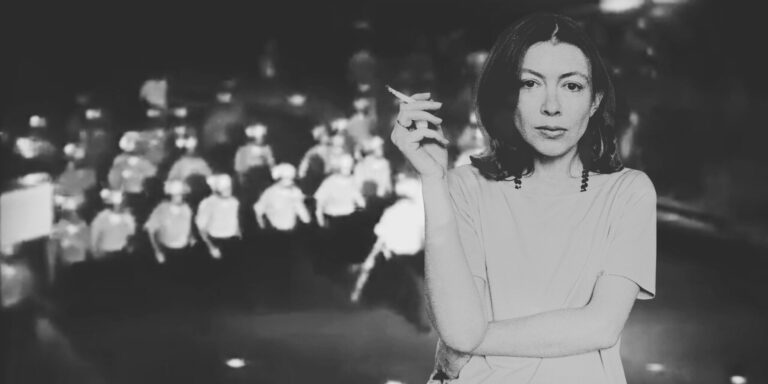
The week before Democratic Party delegates arrived in Chicago in late-August 1968 for what promised to be a combustible national convention—with delegates, antiwar protesters, and the Chicago police department assembling for uncertain battle—the Saturday Evening Post published a “Points West” column that departed from the magazine’s usual snug-to-the-center politics, not to mention the expected politics of its author. “On Becoming a Cop Hater” recounted how the author—primed as a child not just to obey the police but to consider them her “only friends”—came to distrust cops and bristle at their twisting of the truth. The piece was accompanied by an illustration, in a hyperbolic style more typical of the underground press, of a Janus-headed cop—one face placid and with a heart painted on its cheek, the other barking in rage with teeth bared and eyes squeezed shut.
Its author was Joan Didion, a regular Saturday Evening Post contributor; the magazine had featured her now-classic essay “Slouching Towards Bethlehem,” with its disturbing portrait of the Haight-Ashbury counterculture as a moral vacuum, as its cover story the previous fall. From one angle Didion could not have timed “On Becoming a Cop Hater” more perfectly. Its argument about police violence—that it was indiscriminate and blinkered—was validated by the ensuing events in the streets of Chicago: When a motley crowd of 10,000 gathered outside the DNC convention to protest the party’s complicity in the war in Vietnam, the Chicago police force treated them as invaders rather than people exercising their right to assemble.
On the night of August 28, police kettled the protesters into a small area outside the Conrad Hilton Hotel and, in full view of convention delegates, assaulted them under color of authority. According to the Walker Report, the official autopsy of the events outside the convention, this “unrestrained and indiscriminate police violence” was “made all the more shocking by the fact that it was often inflicted upon persons who had broken no law, disobeyed no order, made no threat.”
We can deduce that at this moment in the summer of 1968, Didion wanted to stress that, when it came to police violence, she was no naif.
Despite its immediate resonance, however, Didion chose over the course of her career to shed “On Becoming a Cop Hater” rather than claim it. Ten years later, it went uncollected in The White Album (1979), which drew upon seven of the other “Points West” columns she wrote for the Saturday Evening Post. More strikingly, “On Becoming a Cop Hater” remains the only one of her fourteen “Points West” columns not to be incorporated into either The White Album or her late-career anthology Let Me Tell You What I Mean (2021), which scoured thirty years of her writing for unpublished plums.
Why did Didion choose to re-publish, say, “A Trip to Xanadu”—a parallel story of disenchantment, fixed on William Randolph Hearst’s San Simeon and its promise of infinite luxury—but not “On Becoming a Cop-Hater,” which, if it had appeared in Let Me Tell You What I Mean, would have put her older work in dialogue with Black Lives Matter and the protests around George Floyd? Why let the essay fall into obscurity—an obscurity deep enough that none of Didion’s recent biographers even mention it?
*
There are other pieces from Didion’s 1960s catalog that have not been republished and are now mere historical curiosities, of interest only to hard-core Didionphiles. It’s not surprising, for instance, that Didion memory-holed “The Big Rock Candy Fig Pudding Pitfall,” her shambolic account of how, desperate to prove herself a “‘can-do’ kind of woman” in the fall of 1966, she committed herself to making twenty hard-candy topiary trees and twenty figgy puddings. (For the record: with the puddings Didion got no further than the purchase of twenty pounds of figs.)
But “On Becoming a Cop Hater” is vintage Didion, textbook in its method (the interrogation of preconceived ideas through precise observations of everyday encounters) and its tenor (the search for integrity in a corrupt and disenchanted world). The prose is taut and controlled, its ending analysis a sharp extension of George Orwell’s “Politics and the English Language” to encompass the particular dialect of copspeak.
The essay moves through three parts, from an opening scene of conflict to a middle section that narrates how Didion gradually grew to distrust police, and onto a last section that reflects on the crumbling of police authority and credibility. It launches with a scrupulous reconstruction of a false arrest that Didion witnessed on Honolulu’s Kalakaua Avenue “one early evening in the late spring.” A driver in a Thunderbird almost hits two “boys” in a crosswalk; one of the teenagers may or may not have responded with some words (Didion does not know, and records that she does not know); and the driver of the Thunderbird responds “malignantly” and with just as little vision as he exhibited in almost running them over:
“Stinking hippies,” he screamed, jumping from the car. “Burning your draft cards, you should’ve burned Germany, you should’ve burned Japan, stinking hippies.”
“I don’t know what you’re talking about, Mister,’ one of the boys said. He was wearing a blue suit and a white shirt, and his blond hair was about as long as the average college freshman’s. “I got my draft card.”
“Stinking cowards, stinking hippies.”
“Good for him,” said an old man behind me. Quite a crowd had gathered by then, most of them the retired and the conventioneers who wander aimlessly up and down Kalakaua Avenue in the off seasons, and, when two police officers finally drove up, the crowd clapped.
The reckless driver leaves the scene; a police officer grabs the boy in the blue suit and arrests him for “resisting an officer”—his crime apparently that he had the audacity to say “I didn’t do anything” to an officer who had told him “Don’t talk back.”
At this point in the unfolding drama, Didion crosses the line from observer to participant—acting not willfully but rather via her instinctive sense of injustice and reflexively echoing the words that led the boy to be arrested: “‘But you can’t take him in,’ I heard myself saying suddenly, ‘He didn’t do anything.” She touches a police officer on his arm to attract his attention, and he “recoil[s] as if touched by a snake.” His partner springs forward and raises his arms in a “defensive karate position” against Didion. The aggression is as theatrical as it is absurd. Didion notes that she is a mere five-feet-two and weighs 91 pounds.
Like the errant Thunderbird driver and the crowd of retirees who see “stinking hippies” where there’s just an average American teen (wearing a suit no less!), the police seem committed to not seeing what is in front of them: “Both of them fixed their eyes just over my head in that gaze peculiar to police officers and troops on review.” The opening scene ends on a downbeat, with Didion taking in the consequence of these acts of flawed witness: “I last saw the boy in the back of the patrol car, on his way to the precinct house.”
At this point, Didion fills in “a few things about myself” so that her readers can understand where, exactly, she is coming from. She was raised, she explains, “in that stratum of the society which teaches its children that the police are not merely their protectors but, in a world of hostile strangers, perhaps their only friends. When I thought of the police, certain images sprang obediently to mind.” Here “obediently” is the keyword. Her imagination itself had been schooled to obedience, trained to project benign scenarios of policemen leading small children across an intersection or otherwise coming to the aid of those who have not reached the age of reason: “Policemen were there to rescue lost balls, and kittens, and, were a child to drop her ice-cream cone, a policeman would dry her tears and buy her another, with a nickel from his own pocket.” These images of ever-benign policemen revolve around children and are likewise tailored to the ingenuous mind of a child, one that believes what it sees and reads in books. “I had never actually come into contact with such a policeman,” Didion adds sardonically, “but I knew all that to be true because I had seen pictures of it happening, in school readers and coloring books.”
This conditioning from her childhood was so strong, Didion admits, that until “quite recently” she had held onto the illusion that no policeman would treat her roughly. “Even when I knew myself to be in technical violation of the law,” she recalls, “I was confident that the police, should they by some bizarre error apprehend me, would recognize my essential ‘niceness’—i.e., my status as a daughter of the lawful and propertied bourgeoisie—and deliver me to my doorstep with a friendly and, well, respectful admonishment.” In a touchingly frank moment of self-scrutiny, Didion ties this benign view of police to “some unexamined snobbery” within herself. In the cocoon of her unexamined privilege—that place of feeling herself beyond suspicion—she had been happy to lead an unexamined life.
Didion offers this personal history to establish that she was “neither born a cop hater nor did [she] become one by way of some dramatic venture into the unlawful.” Her mind has been shaped “by way of an accumulation of small encounters, insignificant confrontations” like the Kalakaua Avenue incident; it’s the pressure of her lived experience that has forced her to discard the second-hand lessons of the primers and coloring books.
Rather than being allowed to sit back and watch the movie of her life, Didion was alarmed to be pressed into serving as its editor, in charge of every cut and splice.
She offers a brief catalog of damning incidents. When she phones the police to report that a female driver has suffered a grievous accident and is “intermittently unconscious and screaming,” no police car is sent, and the “desk man” asks her if the driver was drunk. Her friends get stopped for traffic offenses and are subjected to “extensive inquisitions.” She notices a pattern of unequal enforcement and profiling: “every time I saw a cop stop a car on the Sunset Strip, he was stopping either a juvenile or a Mexican.” She registers the customary posture of the police—“the belligerent crossed arms at police lines”—and how they see “the enemy” as “anyone not a cop, not on the force, not in the life.”
In the last section of her piece Didion pivots to a more writerly register, drawing out how policemen have become unreliable narrators in the public square. She takes Orwell’s insight from “Politics and the English Language”—that “the decay of language” is tied to the “defence of the indefensible”—and applies it to the phenomenon of coptalk, its features and its tone. The passage is worth quoting at length:
I began to distrust the baroque obfuscation of language common among the police, began to see it not as an amusing foible but as a quite purposeful barrier between the cop and the enemy. I watched cops caught in stupid lies. I started hearing a tone in police voices, a tone that made no distinction between the criminal and the noncriminal, between the Mafia narcotics dealer and the college boy with two sticks of marijuana in his glove compartment. ‘Move on, sister,’ the tone said, and ‘We aren’t running a hotel, lady.’ (I was told that by the desk sergeant in a jail where I was trying to arrange bail for a boy who had just been arrested for possession of marijuana. ‘We aren’t running a hotel, lady,’ and then: ‘I can give him a message if I feel like giving him a message, not otherwise.’) It was a tone calculated—whether by deliberation or reflex—to threaten, to harass, to humiliate, to bully. I read not long ago that the police call this tone, this stance, ‘aggressive prevention.’ Perhaps all they are preventing is the possibility of their own credibility.
In the last line, we hear the puffed-up language of “prevention” deflating with a whoosh, as Didion turns the term against those who wield it.
That last one-liner draws together what has come before in the passage: Didion’s quick anatomy of the conventions of coptalk, from its indiscriminate address (with everyone a potential “enemy”) to its put-upon and bullying tone. The section she places within parentheses is particularly choice—a vignette that might seem confected for a Hollywood film if it weren’t authenticated by Didion as her own experience, and one that offers a surprising image, within her oeuvre, of Didion as someone who cares enough to involve herself, to arrange bail. In the eyes of police, she suggests, an intercessor is a nuisance—and someone with no more rights than the accused.
The parenthetical section also crystallizes the final position of Didion within the essay: she is a person who, by background and temperament, would have preferred to trust the police and the system of public order that they administer but now feels herself pulled into intellectual sympathy with those in the police’s crosshairs. Didion being Didion, for all her “cop-hating” she cannot join in the sloganeering of those who protest police violence, but, again, in a rare moment for her, she shows a generosity towards those who have pressed by their experience, she suggests, to “start thinking in such slogans.”
The piece concludes with just this balancing act, Didion drawn to credit protesters even as she maintains daylight between herself and the “New Left provocateurs” who galvanize a movement with phrases like “police brutality”:
I know that ‘police brutality’ is a slogan, and that like all slogans, it corrupts and coarsens the perceptions of those who use it. But expose someone to enough ‘aggressive prevention,’ and she is going to believe the New Left provocateur who says the police broke his back, going to believe the country singer who says he was worked over when he was drunk. I do not go around using words like ‘blue Fascism,’ but it has been a very long time since I thought of a cop as a friend in blue.
The phrase “a very long time” seems a bit overstated: the incidents Didion evokes in her essay (involving “hippies” and marijuana busts) seem to date, at most, from a few years before its 1968 publication. Perhaps, if we wish to be generous, we might say that Didion was referring to a span of psychological rather than chronological time—the distance between Revolver and The White Album rather than, say, “two years.”
In any case, we can deduce that at this moment in the summer of 1968, Didion wanted to stress that, when it came to police violence, she was no naif.
*
A decade after “On Becoming a Cop Hater,” with the publication of The White Album, Didion made profitable use of a very particular set of the fourteen pieces she had written as a regular contributor to the Saturday Evening Post in 1968. The White Album ratified her place as an American essayist of the highest rank (“Nobody writes better English prose than Joan Didion,” critic John Leonard judged), and its title essay became an instantly canonical reflection on the turmoil of the late-1960s: “the best short piece…on the late 1960s that I have yet read,” said the reviewer in the New York Times Book Review.
Didion had “staked out California” and witnessed how LA had devolved, in the words of historian Eric Avila, into a “moral dead end, where the underlying values of industrial capitalism—hard work, thrift, diligence, and delayed gratification—had given way to the hedonism and narcissism of twentieth-century consumer capitalism.” On the commercial end, The White Album sold so well as a hardcover book—90,000 in its first printing alone—that Didion was able to sell the paperback rights at auction for $247,500, or over $1 million today.
“We tell ourselves stories in order to live,” Didion famously opened “The White Album,” and, as she herself underlined, there’s always much at stake in the question of which particular story a writer selects from the spectrum of possibilities. Though the endless recirculation of that sentence has softened its meaning—rendering it as something like “human beings are storytelling animals”—in the essay itself it expresses a dire, existential skepticism. The act of storytelling, Didion suggests, has life-or-death stakes (we tell ourselves stories in order to live, not just to entertain ourselves or locate ourselves in a community) even as the foundations underneath such storytelling are shakily unstable (the stories we tell ourselves are chosen to suit ourselves, not because they are more true).
In “The White Album,” Didion confessed to having been unsettled by the discovery that there was no providential or final arrangement to the “flash pictures” by which her mind condensed the stories of her life; the stories she had been “telling herself to live” no longer had depth of meaning or a rightful place in a larger storytelling arc. “I was meant to know the plot,” she wrote, “but all I knew was what I saw: flash pictures in variable sequence, images with no ‘meaning’ beyond their temporary arrangement, not a movie but a cutting-room experience.” Which is to say: Rather than being allowed to sit back and watch the movie of her life, Didion was alarmed to be pressed into serving as its editor, in charge of every cut and splice.
It can be instructive, then, to examine The White Album and consider how she worked as her own editor, fitting many of her older pieces into the fixed “arrangement” of the book and leaving others on her cutting-room floor. As a whole Didion snipped out of her collection those pieces that would have recorded her more sympathetic moments of engagement with the New Left and the counterculture, and stitched in those that crystallized her portrait of the late-60s as a time of aimlessness, thoughtlessness, and collective nervous breakdown.
__________________________________
“The Strange Career of Joan Didion, Cop Hater” by Scott Saul appears in “Beyond Media,” the sixth print issue of Dispatches.

